

Your brand is more than just your and your logo. It’s how customers perceive you, how motivated they are to purchase your products, and how you fit into the overall market. It’s important that you maintain the health of your brand, and that begins with an accurate analysis of where you’re at.
You don’t want to base decisions of what you believe your customers think about your brand. You want hard data and actionable insights.
With custom market research, you can measure your brand’s health and performance, diagnose potential issues, and identify opportunities for growth in the building products industry.
What are the Main Components of Brand Health?
While the process of tracking brand health can differ slightly across industries and markets, there are some integral components that remain consistent. The main components of brand health include:
- Brand awareness
- Brand perceptions/reputation
- Brand equity
- Share of voice
- Market positioning
- Brand satisfaction
Taken together, these components measure how a brand is both perceived and performing in their given market.
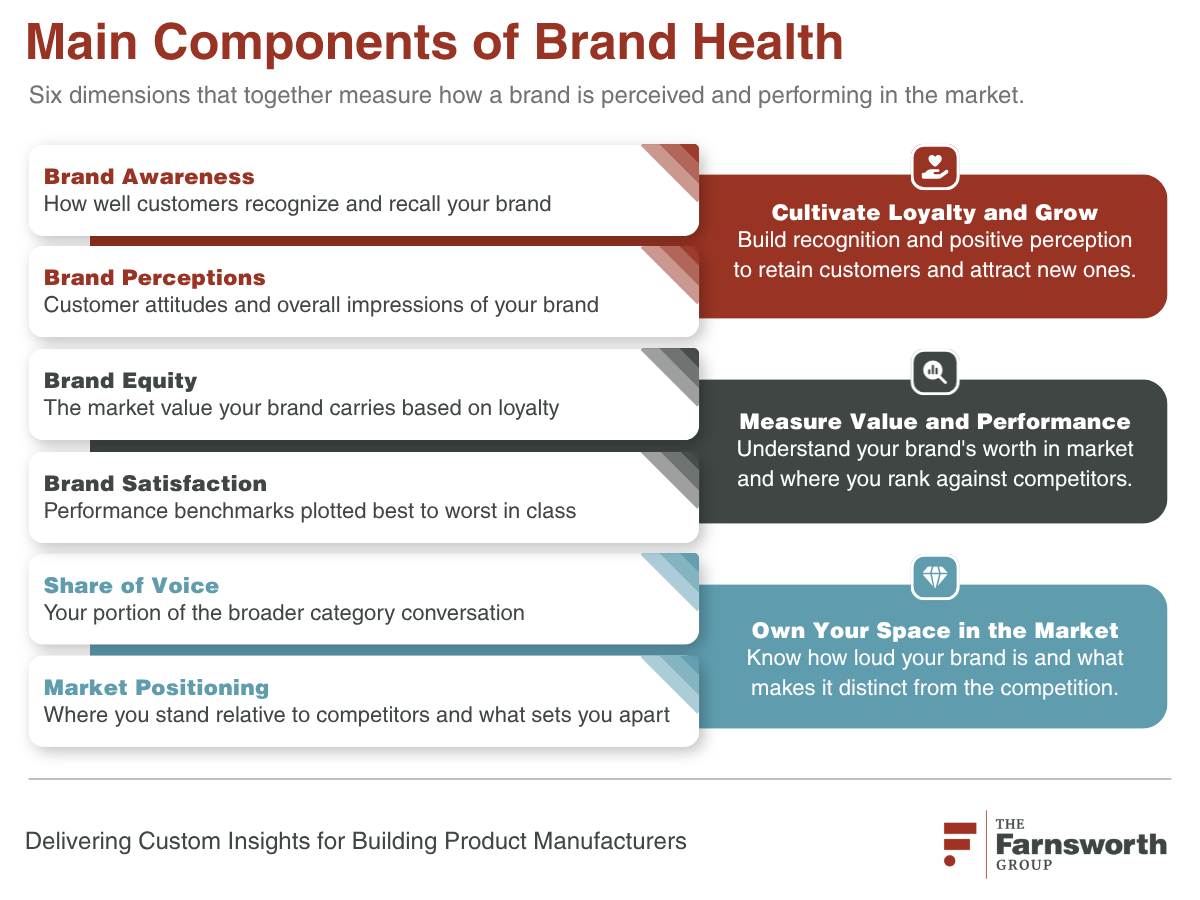
Brand awareness and brand perceptions, or reputation, look at the extent to which customers and channel partners recognize and recall the brand, as well as their attitudes toward and overall impressions of the brand. Cultivating brand awareness and positive perceptions about your brand is key to maintaining customer loyalty and also growing your base. Similarly, brand equity relates to the value that a certain brand offers in their market. This is also influenced by the perceptions, experiences, and loyalty of customers.
Meanwhile, marketing position and share of voice relate to your position in comparison to competitors, what makes them unique or sets them apart from other brands in the market, as well as what share of the conversation you occupy when it comes to your specific industry.
Finally, brand satisfaction measures the performance of multiple companies and plots brands against one another, from best to worst in class. When you understand the differences in brands, you can determine a product development and marketing strategy to gain brand share.

Measuring Brand Health in the Home Improvement Industry
Some of the key benchmarks for measuring brand health in the home improvement industry also include mental reach, share of mind, and mental market share. This includes the percentage of people who associate your brand with at least one attribute, and from there, how often your brand is considered versus competitors across attributes. Additionally, out of all the brands that respondents think about, how big is your brand’s piece of the pie?
For examples, higher mental market share can indicate growth potential if physical availability is increased, and lower mental market share can indicate a potential over-reliance on physical availability or contractual obligations.
How often should you measure brand health?
For building products manufacturers, it is acceptable to measure brand health annually. However, the best practice for consumer-packaged goods (CPG) is for brand health to be measured on a monthly or quarterly basis to better track changes over time.
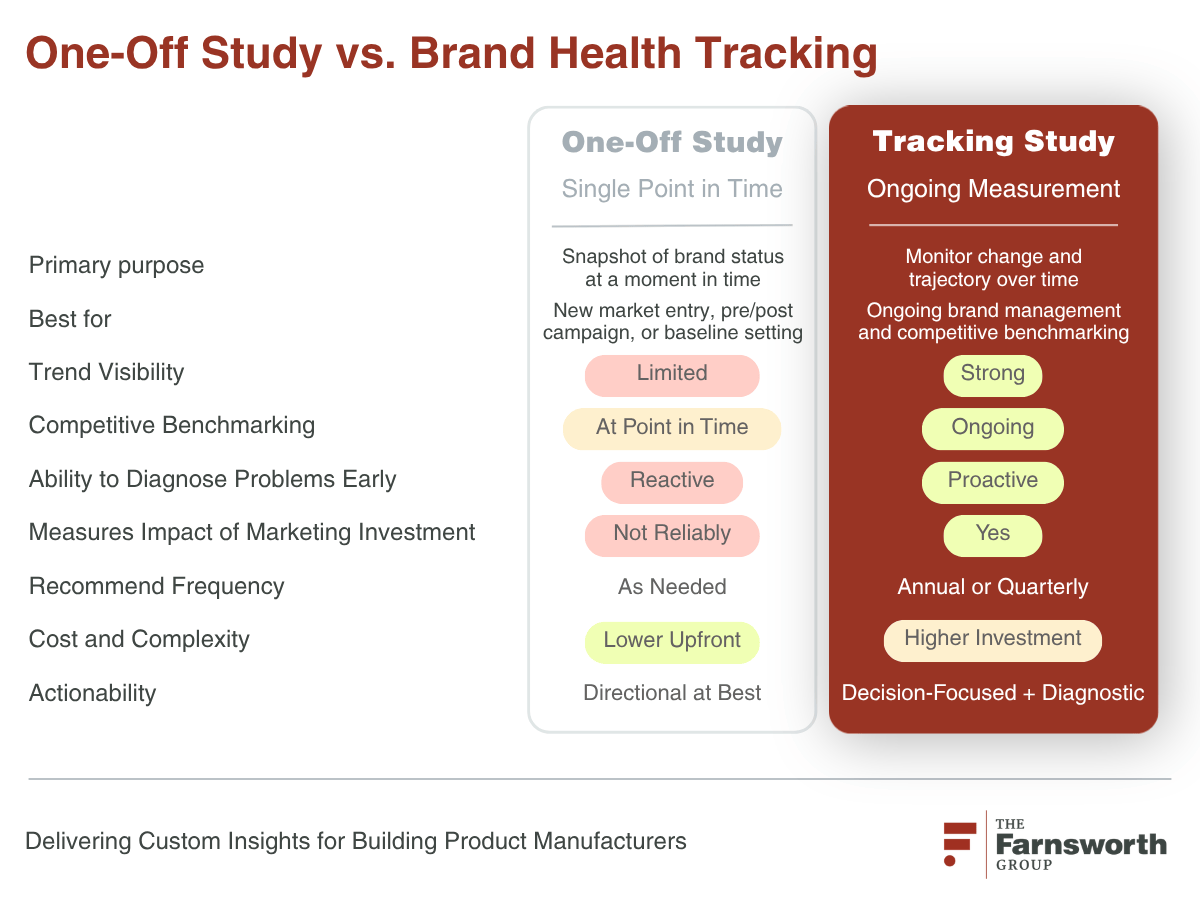
Implementing a brand health tracking program enables brands to make data-driven decisions, track progress over time, establish a benchmark against competitors, identify (and correct) problems promptly, and uncover opportunities for growth and improvement.
How to Utilize Brand Health Tracking for Home Improvement Brands
Traditionally, the tools to track brand health have been focused on awareness, generic attributes, descriptive analysis, and data delivery.
At The Farnsworth Group, we have developed a brand health tracking process that is decision-focused, diagnostic, and driven by customer usage, with a goal of developing effective strategy and taking concrete action. This can help building products manufacturers:
- Identify where they’re losing business
- Align brand to real customer needs
- Improve conversion across funnel
- Justify marketing investment
- Track real change over time
One of the best methods for brand health analysis is a module-based and customizable approach to customer surveys that include both quantitative and qualitative metrics. This allows for faster scoping and proposal development, as well as more consistent pricing and execution.
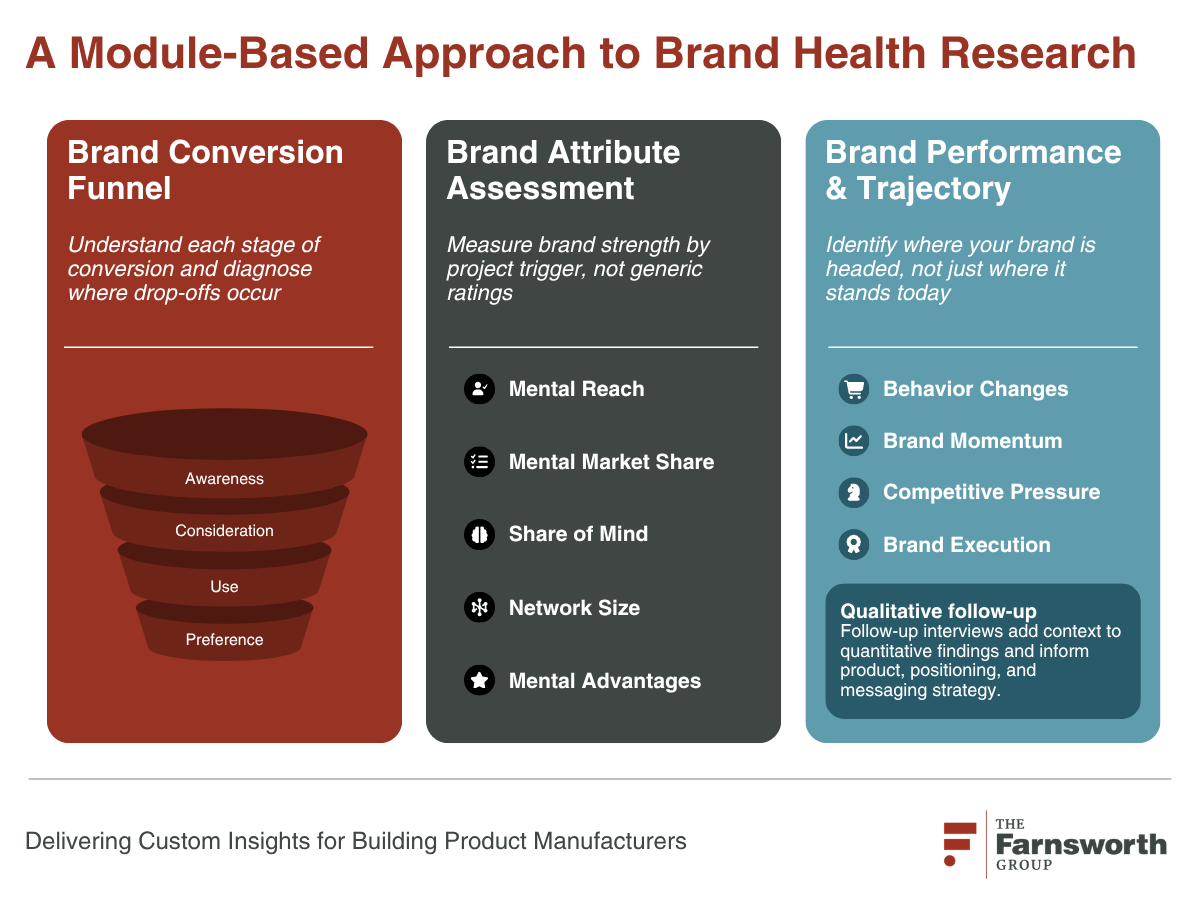
Here are some of the components of brand health that are targeted in this methodology:
1. Brand conversion funnel
Researching the brand conversion funnel is key to understanding each stage of customer conversion and diagnosing where there are drop-offs along the way. It measures:
- Awareness (why customers are aware of your brand but not considering it)
- Consideration (why customers are considering your brand but not using it)
- Use (why customers are using your brand but it’s not preferred)
- Preference (why customers prefer your brand)
Questions in customer surveys should be specific to where customers are falling off in the funnel. This can help brands diagnose why they’re under-performing and where they should focus on improvement.
2. Brand attribute assessment
One way to compare your brand health among your competitors is through brand attribute assessments. The challenge with generic attributes and rating scales is that they lack differentiation and actionability. Our methodology includes an assessment of consideration based on project needs and specific triggers. It measures:
- Mental reach (the percent of respondents who associate your brand with at least one attribute/occasion)
- Mental market share (how often your brand is considered across occasions and attributes versus your competitors)
- Share of mind (how often your brand is considered versus competitors)
- Network size (average number of associations per brand)
- Mental advantages (actual score versus expected score by attribute)
Not every product can be everything to everyone, so it’s important to dial in on specifical projects needs and triggers and identify what considerations people make when selecting a product for a job.
It’s critical to understand your brand’s share of mind and mental market share because if you have high share of mind, but low mental market share, that indicates your brand is strong with a small audience. Meanwhile, high mental reach and low mental market share indicates that your brand and/or home improvement products are widely known, but not very compelling.
3. Brand performance and trajectory
To measure brand health effectively, you want to gain insight into not just where you are, but also where you’re going. In order to do this, surveys should include behavior change questions and diagnostics in order to analyze larger trends and impacts of specific brand initiatives. This part of brand health research measures:
- Behavior changes and the “why” behind them
- Brand momentum
- Competitive pressure
- Brand execution
For home improvement manufacturers, these benchmarks explore whether your brand is improving, stable or declining, and if other brands are improving in any significant ways. From there, brand health tracking tools can be used to implement a qualitative deep-dive, moving beyond data and into understanding.
Follow-up interviews to quantitative research can help add context to the findings, explain why patterns exist, and inform potential activation strategies related to your brand’s product, positioning, or messaging.
Tracking Brand Health Over Time with Market Research
From brand awareness to brand usage and brand satisfaction, these metrics are used to show a brand’s health and monitor change being impacted through marketing campaigns and product development. Whether the problem is low brand awareness, competitors’ high brand use or you aren’t getting loyal customers, brand health is crucial to understanding equity, perceptions and satisfaction across brands.
If you want to know your brand share, which brand customers prefer or how your brand is perceived, then you need customized brand health research. At The Farnsworth Group, our team can help you track awareness, preference, consideration, and loyalty over time. Our outputs pinpoint how your brand stacks up to competitors and where to focus efforts to strengthen brand perception and market share.

