
Demand for battery-powered outdoor power equipment (OPE) is steady, showing particular strength in handheld product categories, including blowers and trimmers.
However, when shopping for battery-powered products, homeowners have a more specific set of criteria and considerations compared to OPE as a whole, based on data from The Farnsworth Group’s 2026 Homeowners Perspectives on Outdoor Power Equipment Report. They are factoring in not only power, performance, and price, but also battery longevity, charging time, and compatibility. They are looking for unified battery platforms and cross-compatibility when it comes to battery-powered equipment, so they can more easily integrate new tools into their inventory without having to get an entirely different supporting system.
These are just some of the insights that can be uncovered through customer usage and attitude (U&A) research, which can help OPE brands identify what’s most important to the customer and guiding product development and marketing.
What are Key Usage and Attitude Trends Among Homeowners for Battery-Powered OPE?
There are several nuances to how homeowners are shopping for and using battery-powered OPE compared to gas-powered alternatives. Understanding these nuances is important to connecting with customers who may be open to adopting your brand and products. Here are a few trends related to battery-powered products for OPE manufactures and retailers to consider going into 2027:
1. Battery is Preferred Among Most Handheld OPE
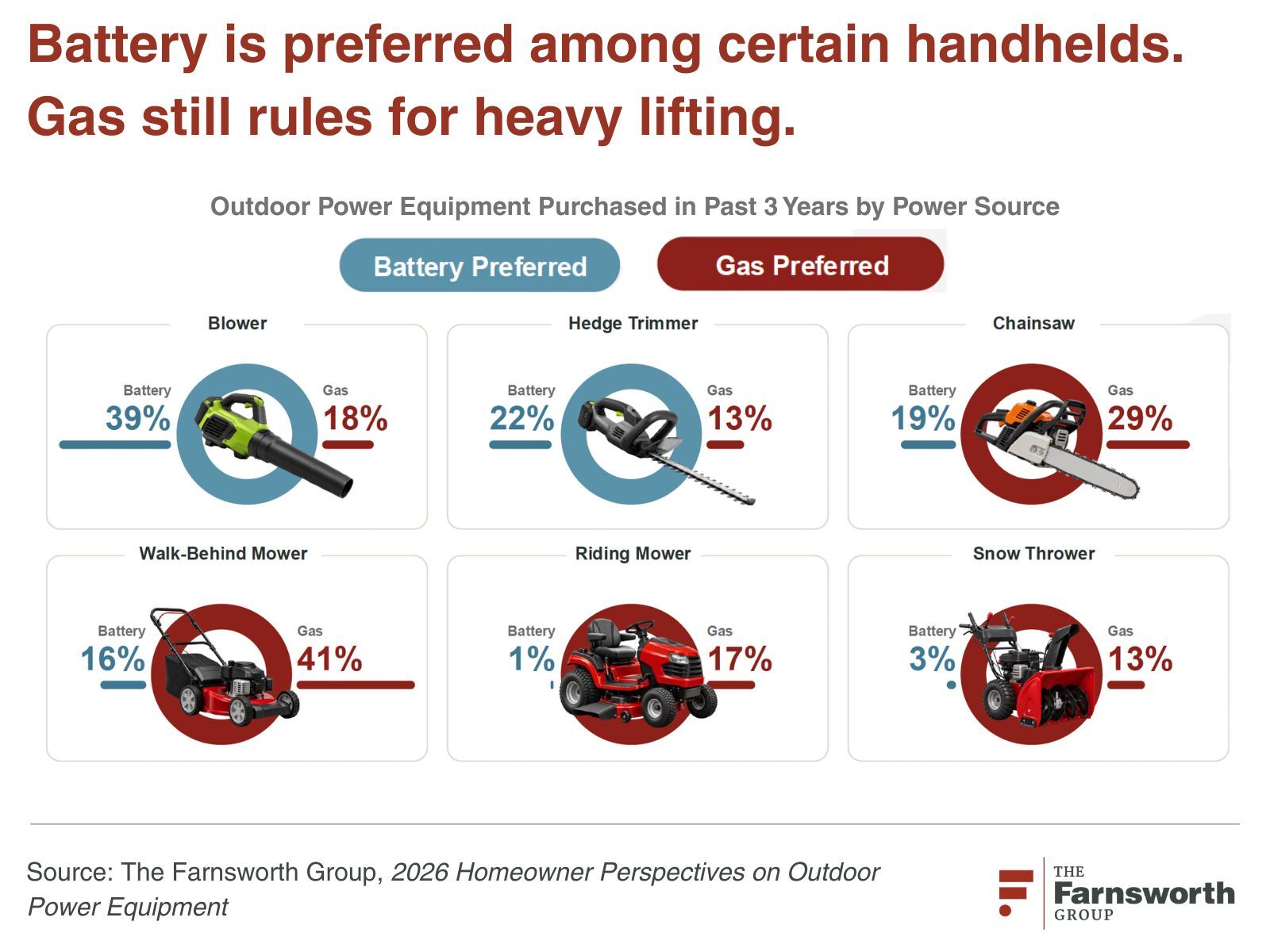
Battery is established in most handheld equipment, while chainsaws and riding mowers—and other heavy lifters—are mostly gas and have more room to shift.
The equipment homeowners have purchased in the past three years include:
- Blowers (39% battery vs. 18% gas)
- Lawn trimmers/edgers (32% battery vs. 31% gas)
- Hedge trimmers (22% battery vs. 13% gas)
- Chainsaws (19% battery vs. 29% gas)
- Walk-behind mowers (16% battery vs. 41% gas)
Compared to data from our 2024 Consumer Attitude on Battery Report, there have been slight increases in each of these categories for battery-powered products, demonstrating that demand for battery as a power source is remaining steady, if not rising, when it comes to handheld equipment.
Swaying gas-powered buyers
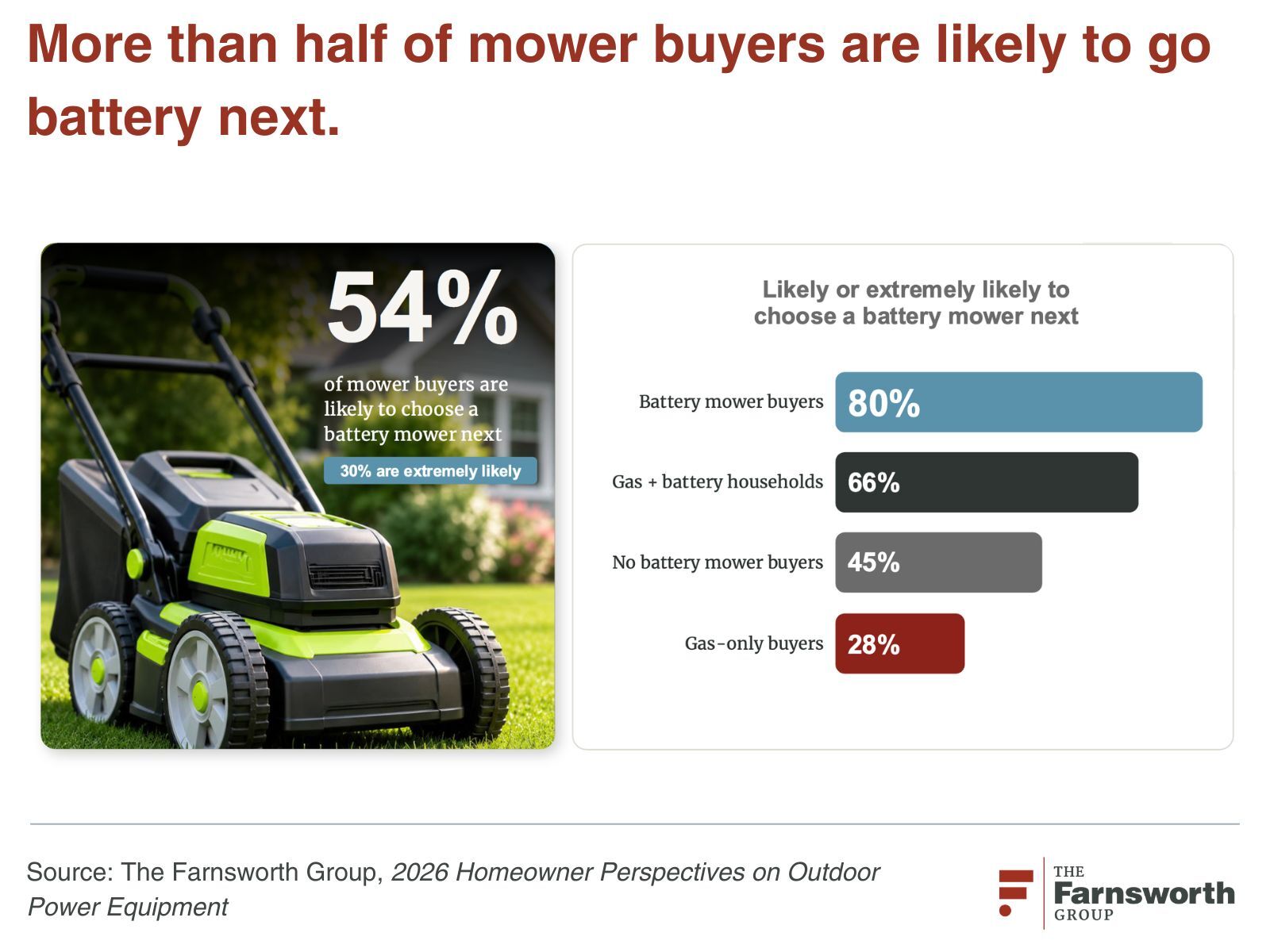
As there are stronger preferences for gas-powered chainsaws and walk-behind mowers, those provide the most room for potential shift. For example, more than half of mower buyers, or roughly 54%, say they are “extremely likely” or “likely” to choose a battery-powered mower next. This data is drawn from homeowners who have purchased a mower in the past three years. Additionally, about 80% of battery-mower buyers say they would choose battery again, and about 45% of those without a battery mower reported that they are likely to switch.
2. Power and Performance are Driving Purchase Factors
Power or performance is by far the most important factor among homeowners when choosing OPE, selected by 71% of respondents in the OPE study. Other important factors include:
- Strong brand reputation (49%)
- Competitive pricing and/or cheapest pricing (56%)
- Low maintenance (41%)
- Warranty (34%)
- At my preferred retailer (19%)
When just considering homeowners who purchased battery-powered OPE, the top factors include:
- Power or performance (66%)
- Strong brand reputation (45)
- Competitive pricing (44%)
- Brand offers high-capacity batteries (34%)
- Low maintenance (33%)
- Works with my current battery platform (26%)
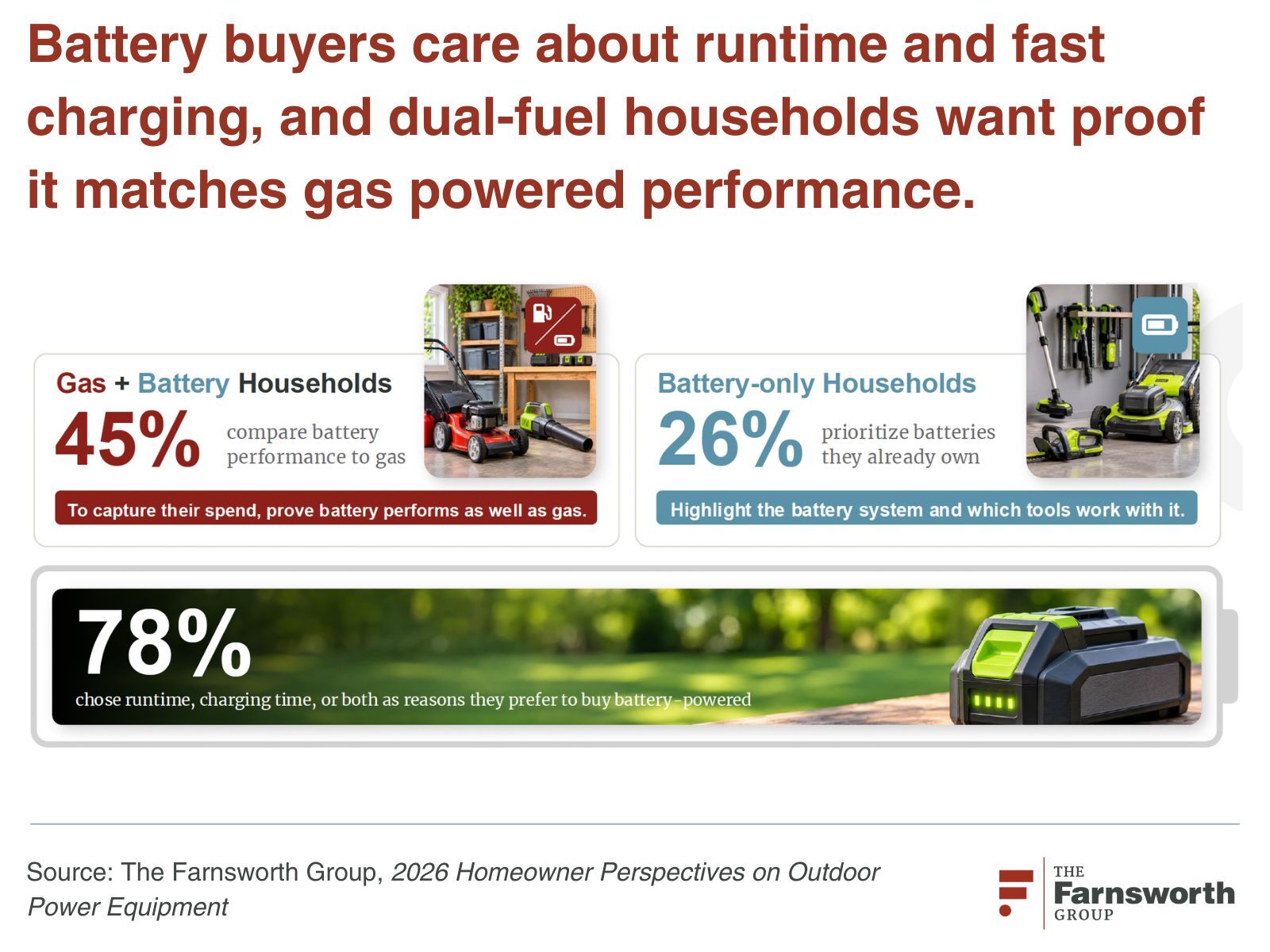
For dual-fuel households, or those switching between gas- and battery-powered OPE, homeowners want proof that a battery-powered option will match the performance of the gas-powered product. About 45% compared battery performance to gas as part of their purchasing journey. This concern remains consistent with data from our 2024 Consumer Attitude on Battery Report, which revealed that a predominant attitude among homeowners was that gas will always be more powerful than battery. While that perception may be shifting, it’s still top of mind for OPE shoppers. To capture their spend, manufacturers must prove that the battery-powered product in question will perform as well as gas.
3. Battery Buyers Prioritize Runtime and Fast Charging
Among homeowners who purchased a battery-powered product in the past three years, about 78% chose battery runtime between charges, charging time, or both as reasons they picked the option that they did.
Other factors that have influence on their decision include:
- Power or performance compared with gas-powered equipment (41%)
- How long the battery lasts before needing replacement (36%)
- Ability to use the same batteries across multiple products (30%)
- Compatibility with batteries I already own (20%)
Overall, 41% of respondents selected at least one of the last two factors, which both related to battery compatibility.
Additionally, 26% of battery-only households prioritize batteries they already own, and among battery buyers, 54% chose high-capacity batteries or platform fit as top purchase factors, compared to 25% of all homeowners. For manufacturers and suppliers seeking to increase share, it’s important to highlight the battery system and which tools work with it.
4. Brand Preference is Stronger for Battery Households
Among all homeowners, about two-thirds lean towards brands they already own. However, only one in five are firmly loyal to a particular brand. Meanwhile:
- 46% generally prefer brands they own, but will consider others
- 30% consider several brands and choose the best fit
- 4% say brand has little influence on their decision
That offers plenty of room for brands to sway homeowners when they’re shopping for OPE by understanding their preferences and attitudes, as well as how they’re using these products in their day-to-day lives.
Brand preference based on household power type
Our research shows that loyalty is stronger among battery (no gas) households, with 80% preferring the same brand, while that percentage is approximately 60% among gas (no battery households). Meanwhile, only 17% say they consider several brands and choose the one that best meets their needs. For OPE manufacturers and suppliers, that means familiar brands have an advantage, but most buyers remain open to alternatives. Battery compatibility may help turn preference into stronger loyalty.
5. Homeowners Use Online-only Retailers More for Battery-Powered OPE
Supplier preferences for battery (no gas) products closely those of the overall OPE market. Home improvement centers, such as Home Depot or Lowe’s, are the leading place of purchase, used for roughly two-thirds of purchases. Where there is more variation is with online-only retailers, such as Amazon. About 14% of battery-only product purchases come from this supplier, compared to only 2% for gas (no battery) OPE and 4% of gas/battery hybrid products. On the flip side, hardware stores and farm or rural supply stores are used less for battery-powered products than the other categories.
While home improvement centers should be a top priority for battery-powered OPE brands, it’s important to also ensure your products are being adequately marketed through online-only platforms. These offer a potentially valuable means of connecting with both current and prospective customers.
Utilizing Custom Market Research to Compete in the Battery-Powered OPE Market
For manufacturers and suppliers, custom market research can deepen your understanding of the OPE market and what data is relevant for developing business strategies for all areas of operation, from product development to packaging, marketing, and messaging.
At The Farnsworth Group, our customer U&A research helps you quantify product usage to define market opportunities, prioritize selection criteria, and learn where your target audience is shopping, when and why. Additionally, our product development studies can be used to explore product uses and needs to establish viable concepts, define optimal price and feature combinations, and determine preferred messaging and packaging to attract buyers.
Our industry knowledge, paired with research expertise, uniquely equips us to deliver research solutions that get you insightful answers to your specific needs. Schedule a consultation to see how U&A or product development research can help you reach new customers in the OPE market.

Frequently Asked Questions
1. Which outdoor power equipment categories are leading battery adoption?
Battery adoption varies by equipment category. The Farnsworth Group’s 2026 Homeowner Perspectives on Outdoor Power Equipment study found that approximately two out of five homeowners purchased battery blowers in the past three years, compared with 18% who purchased gas models. Battery purchases also exceeded gas purchases for hedge trimmers, while lawn trimmers and edgers were nearly evenly split. Gas remained more common for chainsaws and walk-behind mowers, indicating that manufacturers need different product development and marketing strategies for different types of outdoor power equipment.
2. What factors matter most to homeowners buying battery-powered OPE?
Power and performance remain the leading purchase considerations, selected by 66% of homeowners who purchased battery-powered outdoor power equipment. Competitive pricing, brand reputation, high-capacity batteries, and low maintenance also influence decisions. When evaluating battery options, homeowners pay close attention to runtime and charging speed: about 78% cited runtime between charges, charging time, or both. Manufacturers should demonstrate practical performance benefits while clearly explaining battery capabilities, rather than relying on convenience claims alone to persuade shoppers.
3. Why is battery compatibility important to OPE buyers?
Battery compatibility helps homeowners add equipment without investing in an entirely new battery system. The Farnsworth Group’s research found that 41% of battery buyers considered the ability to share batteries across products, compatibility with batteries they already owned, or both. For manufacturers and retailers, this makes platform information an important selling point. Clearly identifying compatible tools, batteries, and chargers can help shoppers evaluate purchases and understand how new equipment fits into their existing tool collection.
4. Are battery-powered OPE owners more loyal to brands?
Battery-only households show stronger brand preference than households using gas equipment exclusively. About 80% of battery-only households prefer brands they already own, compared with approximately 60% of gas-only households. However, preference does not necessarily mean exclusive loyalty. Across all homeowners, only about one in five are firmly loyal to a particular brand. Manufacturers can strengthen customer relationships by understanding performance expectations and platform needs, while competing brands still have opportunities to attract buyers considering alternatives.
5. How can market research help brands compete in battery-powered OPE?
Custom market research helps manufacturers and retailers understand how homeowners use equipment, what influences purchases, and where unmet needs create opportunities. Customer usage and attitude research can identify priority features, shopping channels, and barriers to adoption. Product development research can evaluate concepts, preferred feature combinations, pricing, packaging, and messaging. Together, these approaches help brands make informed decisions about battery platforms and product positioning, rather than assuming every homeowner values the same benefits or faces challenges.

Contributors

Grant Farnsworth
Grant has worked on every area of market research at some point – coding paper surveys, running tabs, programming surveys online, getting sample, managing fielding, generating reports and preparing analysis and presentations. Grant has been working with The Farnsworth Group since he was a teenager, learning the craft of custom market research and how to uphold the highest of standards in research design and data collection.
For the past 20 years, Grant has been involved with various associations, trade shows, committees, publishers, manufacturers, retailers, and suppliers in the home improvement, lawn & ranch, and building products spaces. For Grant, one of the most satisfying feelings is to know they helped a client to succeed when he sees the results of The Farnsworth Group work on store shelves, on new homes, and in the homes of friends and family. Based in Denver, Grant is a music buff who believes that life should be fun. In all his pursuits, Grant’s sincerest appreciation goes out to his wife – the most kind and patient person on earth.

Taylor Pence
Taylor has been serving clients and managing quantitative market research studies with The Farnsworth Group since 2015. Taylor also supports internal team development and training efforts to ensure the research team at The Farnsworth Group is current on best practices and equipped to deliver on high standards.
Taylor’s interest in the home improvement space began when he was about 10 years old upon discovery of ‘This Old House’ and Norm Abram’s ‘ New Yankee Workshop.’ Fast-forward a couple of decades and he still enjoys these sources of inspiration while tackling the perils of DIY in his own workshop. Taylor is proud husband to Lauren, and father to three awesome kids. Whenever possible, Taylor shares his hobbies with his kids, including playing music, tennis, golf, going fishing or putting his hands to a new project in the shop.