
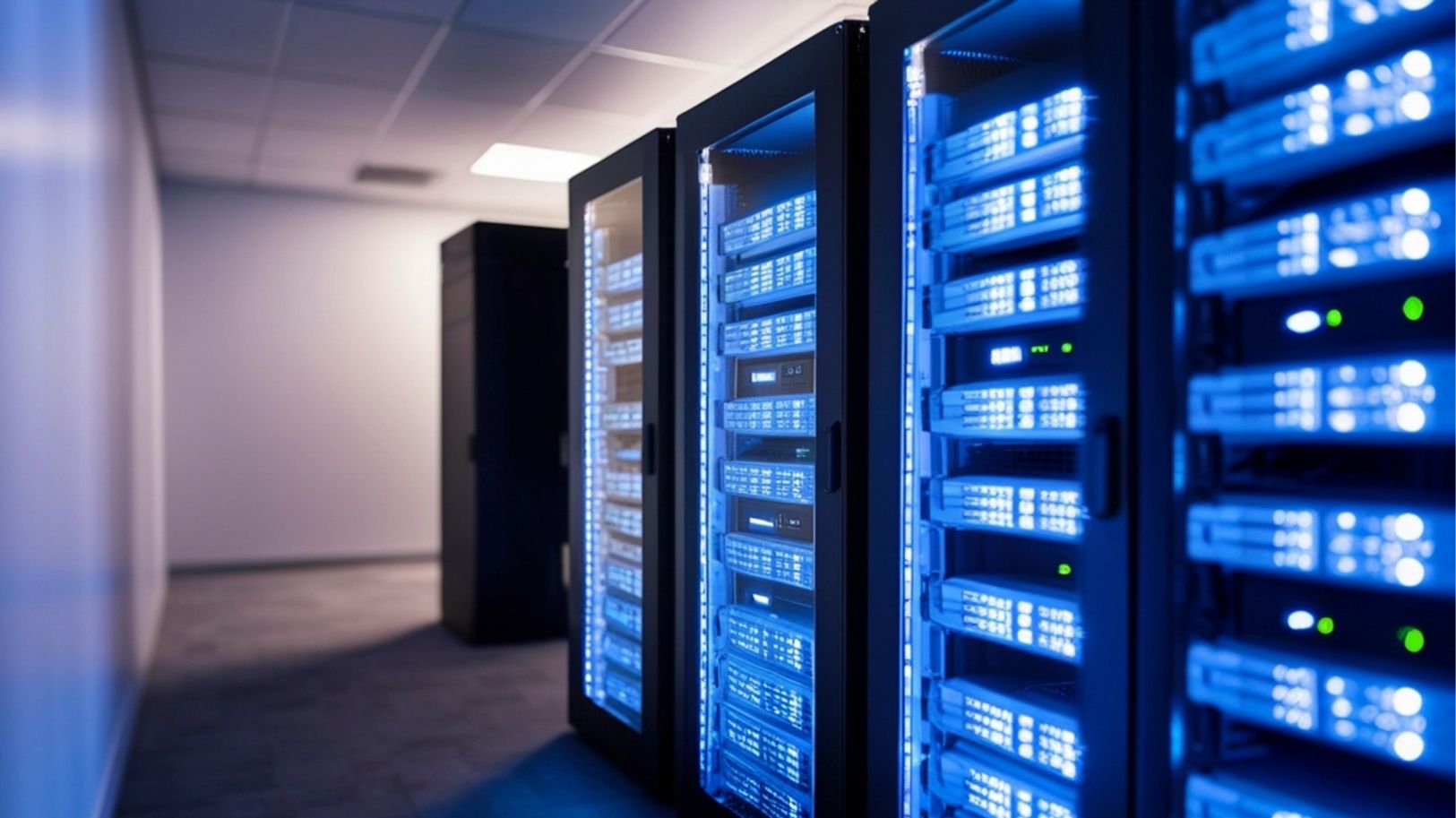
Data center construction is projected to increase to over $40B in 2026, a rapid replacement of the demand for commercial construction projects. The shift to large data centers versus other non-residential projects brings unique new equipment demands at scale.
Data center cooling is emerging as one of the most rapidly evolving forces in commercial HVAC. As hyperscale and AI facilities expand, cooling infrastructure is reshaping system design, product development, and service models for all of us in the HVAC industry.
According to the IEA, by 2030, data centers could account for nearly half of U.S. electricity demand growth, driven largely by the expansion of AI workloads, cloud computing, and hyperscale facilities. This level of energy consumption and byproducts have made data centers one of the fastest-growing - and most scrutinized - segments of built environment infrastructure. Setting debates about energy and environmental impact aside begs the question: what does this growth mean for the HVAC industry - and specifically for data center cooling strategies?
Why Data Centers Matter to the HVAC Industry
In commercial real estate, data centers are not just another building type; they are heavy mechanical infrastructure wrapped in a shell. In data centers, mechanical, electrical, and plumbing (MEP) systems represent a large share of project cost, and data center HVAC systems sit at the center of that investment. The top four tech firms (Microsoft, Alphabet, Meta, Apple)have a combined capex >$210B this fiscal year. As multi-hundred-million- and billion-dollar projects break ground nationwide, keeping data systems cool puts HVAC front and center. They are mission-critical, and their demands are reshaping equipment design, project execution timelines, service expectations, and product roadmaps for HVAC manufacturers, engineers, and contractors alike.
Data Center Construction Is Accelerating Nationwide
Recent project data illustrates just how quickly this sector is scaling. The following stats are from NAIOP:
Largest nonresidential projects breaking ground in December 2025
- $1B Google Data Center, West Memphis, AR
- $750M CyrusOne Data Center, Whitney, TX
- $714M SNA Data Center, Cedar Rapids, IA
Largest commercial projects entering planning in January 2026
- $500M IEP Data Center, Monongahela Township, PA
- $400M Mountain Road Technology Park Data Center, Glen Allen, VA
- $350M Bitfarm Data Center, Nesquehoning, PA
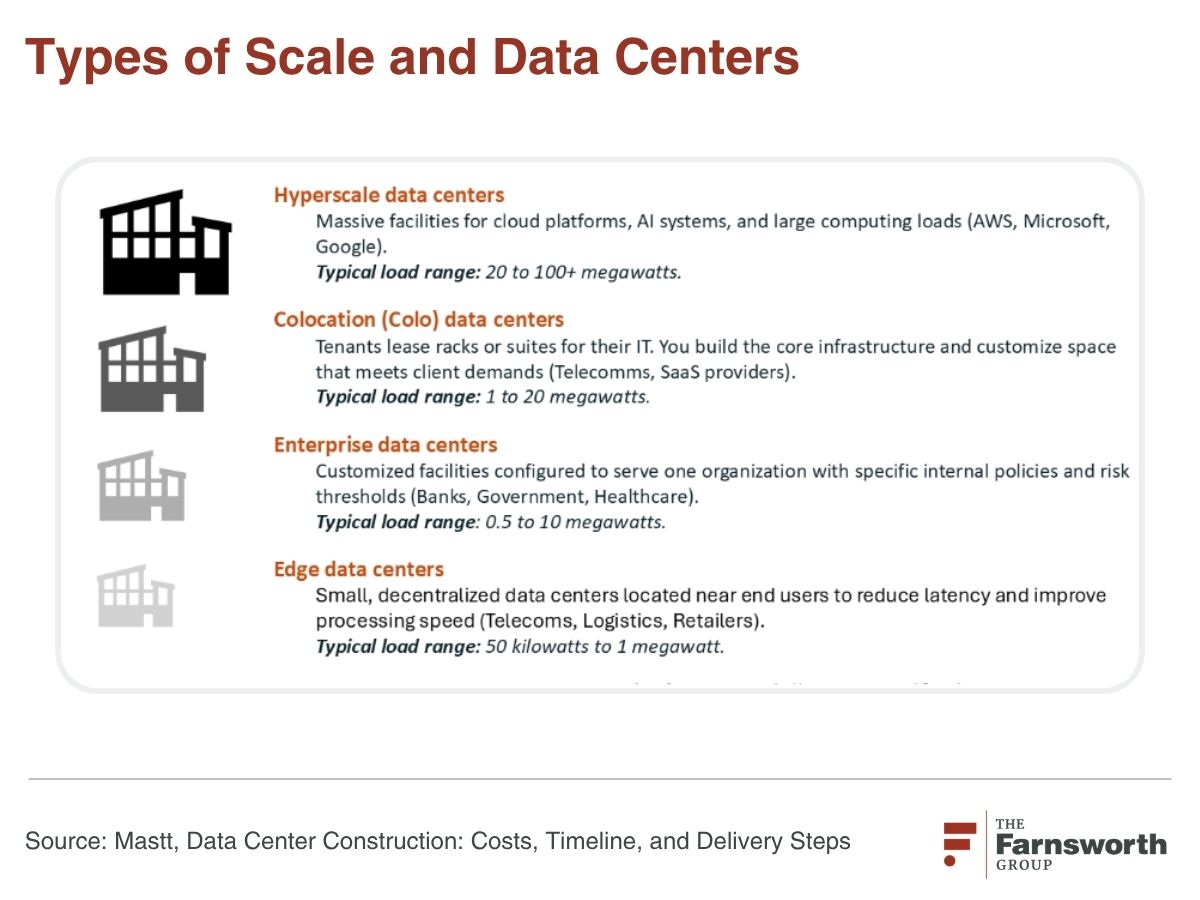
Highlighting these massive projects understates the scale of development. These are not isolated investments, but part of a broader pattern of capital flow-one that continues to elevate demand for scalable data center cooling systems. From Hyperscale projects listed above to enterprise and edge data centers, the data center implications to HVAC are substantial.
How Much of a Data Center Budget Goes to HVAC?
Industry cost benchmarks suggest that data center cooling and HVAC systems can represent approximately 15%–20% of total construction cost in air-cooled data centers, and 22%–33% or more in high-density or data center liquid cooling configurations. Unlike typical office or retail construction, where architectural finishes and tenant fit-outs dominate budgets, data centers allocate a disproportionate share of cost to mechanical cooling infrastructure.
For a project with a $500 million budget, that translates into $75M–$150M or more in HVAC and cooling systems - before factoring controls, redundancy, or lifecycle service contracts.
That investment supports more than just tonnage; it supports:
- Mission-critical reliability
- Redundancy (N+1, 2N)
- Advanced controls
- High-efficiency chillers and heat rejection systems
- Commissioning and testing
- Long-term service agreements
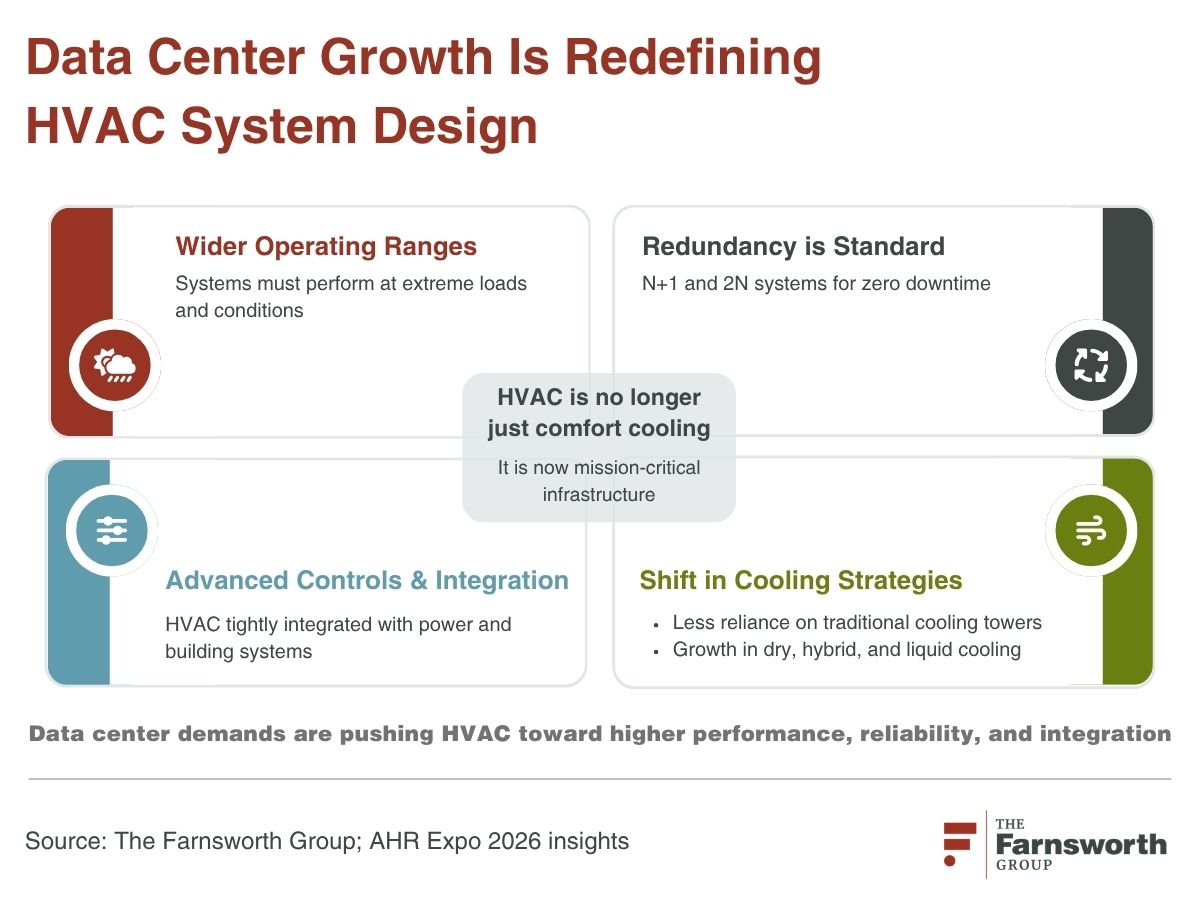
While HVAC has long-been essential to every commercial application, the role of data center HVAC has moved well beyond “comfort cooling” into true mission-critical infrastructure backbone.
How Data Center Cooling Is Influencing HVAC System Design
As part of a larger trend in the industry of building ecosystems, the story at AHR Expo 2026 underscored how rising demand for data center cooling is influencing broader HVAC trends and accelerating investment in advanced cooling technologies.
Expanded Operating Envelopes
Modern chillers, compressors, and heat rejection equipment are being engineered to operate efficiently across wider ambient conditions and part-load ranges. Data centers don’t run at a steady design point; they require performance at extremes- very high load, very low load, and everything in between. Geography is limited, and data centers will need to be located in both warm and cool climates in North America.
Redundancy and Uptime
Downtime isn’t an option for a data center – it can cost millions per hour. That’s why mission-critical cooling systems are now being specified with multiple fault paths, resilient hardware, robust diagnostics, and monitoring systems as standard expectations (see controls and integration below).
Water and Sustainability Pressures
With increased scrutiny on both energy and water impact, traditional cooling towers are no longer the default choice. Donor cities and states are tightening water usage regulations, prompting owners to explore dry or hybrid cooling strategies, dry coolers, adiabatic systems, and alternative heat rejection approaches. At the same time, despite the higher cost, facilities are accelerating interest in data center liquid cooling as part of a shift toward more efficient, scalable data center cooling architectures.
Controls and Integration
Data centers demand tight integration between HVAC, power distribution units (PDUs), generator sets, and building management systems (BMS). This has pushed the industry toward more capable controls, smarter commissioning tools, and deeper data integration -trends that are increasingly shaping both data center HVAC design and broader commercial applications.
Timeline and Schedule Considerations for Data Center HVAC
Delivering large data centers is a multi-stage process:
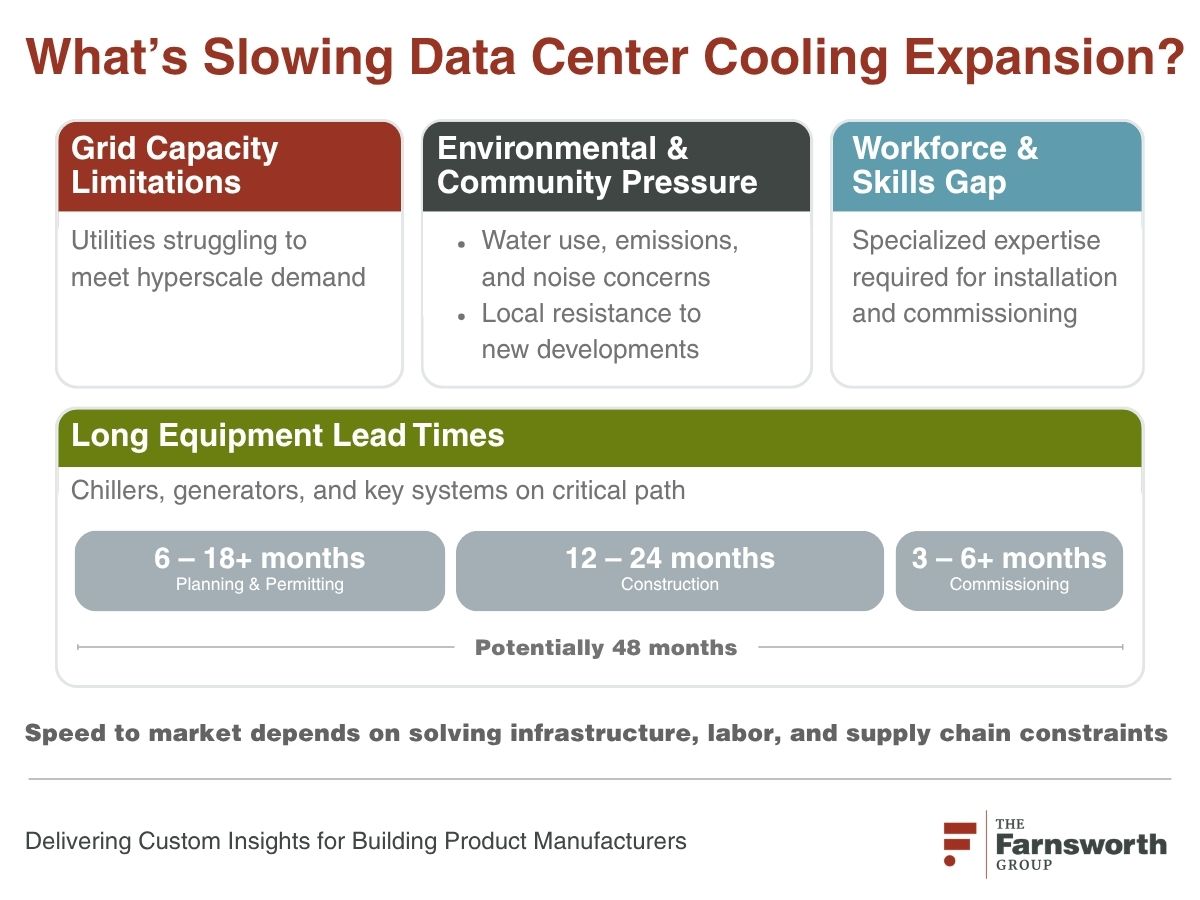
- Planning and permitting: often 6–18+ months
- Construction: typically 12–24 months for core and shell
- Commissioning: 3–6 months or more before “lights on”
Because data center cooling equipment is often on the long-lead critical path, it must be specified and ordered early in design. This means HVAC engineers and manufacturers need to be engaged sooner than in many traditional commercial markets.

Challenges Facing Data Center Cooling Expansion
Even as demand accelerates, several headwinds could reshape future deployment:
Community resistance – noise and environmental impact are driving many communities to reject data center development. Additionally, many of these facilities are facing scrutiny for the lack of contribution to the local economy.
Environmental and permitting pressures - Local jurisdictions are paying closer attention to noise, emissions, and water use, which can directly impact data center cooling design decisions.
Electric grid readiness - Utilities in some markets are struggling to keep up with power delivery timelines required to serve hyperscale loads, influencing both facility siting and cooling system strategy.
Skills gap and workforce capacity - Data center HVAC requirements are more complex than typical commercial installs, requiring specialized design, installation, and commissioning expertise.
Lead times – For hyperscale data centers, a massive demand is created in a very short window for products such as generators, switchgear, chillers, and specialized cooling components. This may require extended lead times and amplifying schedule risk across mission-critical builds.
What This Means for HVAC Manufacturers and Contractors
The rapid growth of data centers presents both challenge and opportunity:
- The reduction in traditional commercial construction requires a shift in production and SKU demand for HVAC manufacturers. Understanding the size of the market is crucial.
- Product lines must span from comfort cooling to robust mission-critical HVAC platforms, incorporating scalable and resilient data center cooling systems.
- Service and lifecycle support are becoming core revenue drivers, especially in high-density environments using advanced or liquid cooling technologies.
- Skills development is essential. Firms that build commissioning, controls, and diagnostics expertise in data center HVAC applications will be better positioned to compete. Understanding the contractor mindset will help companies plan for this transition.
- Sustainability is strategic, not optional. Water constraints and energy regulations will continue shaping the next generation of advanced data center cooling technologies (Read more from EPRI Study Summary). Additionally, placement of data centers is becoming increasingly contentious among communities, so ensuring environmental stewardship will be crucial to expanding the number of data centers.

The Future of Data Center Cooling and Mission-Critical HVAC
It’s clear that data centers are not a fringe application with HVAC positioned an afterthought; they are a market force reshaping priorities for technologies, specification practices, and business models across the industry. At The Farnsworth Group, we’re looking to see how these trends will influence consumer and commercial applications of HVAC. Whether in heat rejection strategy, controls integration, or lifecycle service, companies that understand the evolving demands of data center cooling and mission-critical HVAC will be stronger competitors across all market segments.
Data and projections referenced are derived from publicly available industry research and market reports as of 2024–2026.

Written By Eric Voyer
Director and Senior Consultant
Eric brings nearly 30 years of experience in market research, business development, and strategic consulting within the home improvement, building products, and outdoor industries. He spent decades in syndicated research for consumer durables, where he helped leading brands turn complex data into actionable insights that drive growth. Eric's expertise spans both quantitative and qualitative methodologies. At The Farnsworth Group, Eric focuses on client engagement, project design, and strategic storytelling to ensure insights lead to clear, confident decisions.
Originally from Orlando and now based in Louisville, KY, Eric studied Business at Transylvania University, where he also competed as a collegiate goalkeeper. Outside of work, Eric still enjoys playing soccer, loves to Ski and Scuba and has a new passion for playing ice hockey.