
Drywall is considered a core building product, used in a vast majority of both commercial and residential projects, which offers a level of stability to the ongoing demand within this market segment.
It is used in new home construction, as well as a wide range of home improvement activities, from expansions, new room additions, improving insulation, or upgrading to fire- and moisture-resistant materials to address specific needs and challenges.
While manufacturers and retailers can garner some assurance from the near-universal appeal of drywall, the market is not immune to changing dynamics and trends, from challenges and opportunities within the housing industry to the behaviors and preferences of both DIYers and building professionals who utilize drywall for their projects.
Keeping abreast of key trends and drivers, product innovations, and customer usage and attitudes can help your brand identify and pursue opportunities for growth within related to this high-demand product category.
What Dynamics are Affecting the Market for Drywall?
As with many building products and materials, the demand for drywall in the U.S. is affected by a range of economic factors, housing/remodeling activity, material trends, and the preferences and behaviors of distinct customer segments.
Here are some current market trends and dynamics for drywall manufacturing brands to consider as they strategize for the coming year:
1. U.S. Drywall Market Shows Signs of Growth
The United States drywall market size was valued at roughly $16.42 billion in 2025, based on data from Expert Market Research. The market is projected to experience a compound annual growth rate of 5.4% between 2026 and 2035, reaching a value of $27.78 billion by 2035. Home improvement activities of an aging housing stock, from maintenance to repairs and remodeling, and green energy trends are contributing to this growth.
2. Multifamily Housing Rates are Trending Up
The multifamily (MF) housing sector saw a rebound in 2025 in response to low single-family affordability and high new home inventory. This has been an opportunity to take advantage of new households being formed without the ability purchase their own home. As a result, MF starts were up approximately 14% in 2025. As those multifamily starts get closer to completion in 2026 and 2027, it is likely this will impact demand for drywall and finishing products within the market.
3. Home Construction and Buying are Constrained in 2026
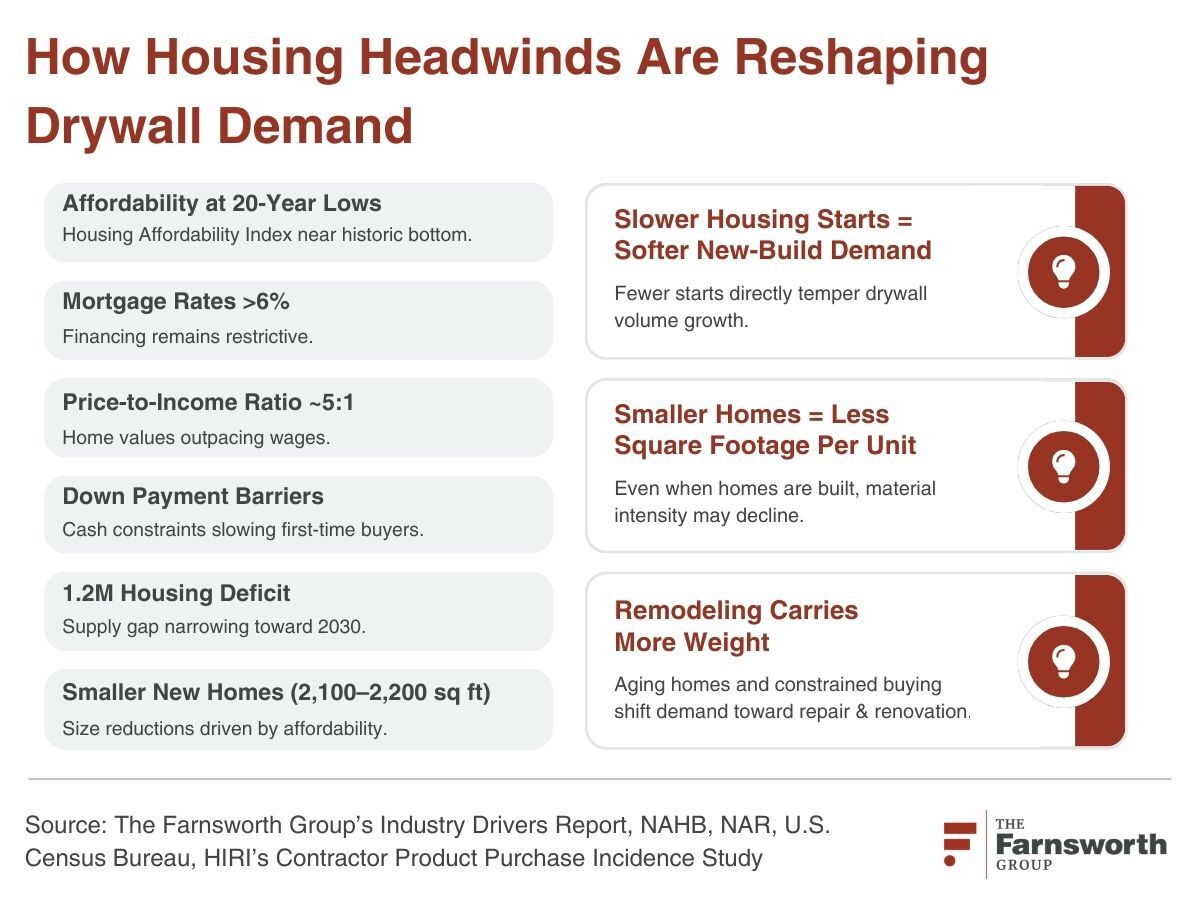
Along a similar vein, housing prices remain high and inventory is tight, which is a large systemic problem that only more housing can fix. The National Association of Home Builders (NAHB) estimates a roughly 1.2 million housing deficit, but the gap is narrowing, with some expectation that it will close by 2030. There are several factors at play here. In June 2025, the Housing Affordability Index was near its lowest point in over 20 years due mostly to high home prices and high mortgage rates, based on data from the National Association of Realtors, included in our Construction and Remodeling: Industry Drivers and Forecast report. The 30-year fixed rate mortgage continues to hover above 6% and the housing price to income ratio remains close to 5:1, with down payments being a big issue. As a result, a majority of prospective home buyers feel it’s a bad time to purchase a house. This will have an effect on single-family housing starts over the next couple of year and could impact the demand for drywall, used heavily in new construction.

4. Average Home Size Has Started Leveling Off
Another housing market dynamic that could affect drywall demand is that new home sizes, as measured by square feet, have been dropping over the past decade in light of affordability concerns. This impacts the drywall market. However, the typical size for new homes has started to level out since 2024, which is positive for building products manufacturers. Currently, the average size is between 2,100 and 2,200 square feet, based on data from the U.S. Census Bureau and NAHB. The math is simple, smaller homes require less square feet of drywall.
[CTA for Industry Drivers and Forecast Report]
5. Residential Remodeling Outlook Shows Steady Growth
The remodeling sector, on the other hand, remains more stable and opportunistic, propelled forward by an aging housing stock, aging in place trends, and pent up demand. The average age of the housing stock in the U.S. continues to creep up, and older homes need more maintenance and upgrades, driving growth in the remodeling, repair, and maintenance market. In slow growth, financially strained markets, home maintenance and repair outperform larger, more discretionary remodels. When market pressures ease, look for homeowners to engage with larger projects they have been putting off as they remain in their home due to limit inventory selection, high home equity, and low locked-in mortgages.
6. DIYers and Professionals Both Utilize Drywall for Renovations and Remodels
On a positive note, core building materials remain the backbone of purchasing, especially for contractors and other industry professionals. Along with items like adhesives, fasteners, and lumber, drywall shows near-universal demand, as revealed in the 2025 Contractor Product Purchase Incidence Study for building materials and structural systems, produced by the Home Improvement Research Institute (HIRI). Contractors working in the remodel segment are feeling generally positive about their company’s ability to get new business in the next six month, and about two-thirds expect their revenue to increase over the next year, based on findings in our Contractor Index for Q1 2026. On average, they are booked out 8.4 weeks. For the DIY homeowner market, overall home improvement activities held steady throughout the end of 2025. Maintenance continues to be the greatest driver of home improvement projects, while renovations—including improvements, updates, and remodels—being more limited. Only 23% of homeowners were planning renovations for the next three months, according to our Quarterly Homeowner Activity Tracker. About one-third were planning home repairs, such as fixing or restoring damaged, broker, or dysfunctional parts their house.
7. Material Prices, Availability and Quality Pose Challenge for Builders and Remodelers
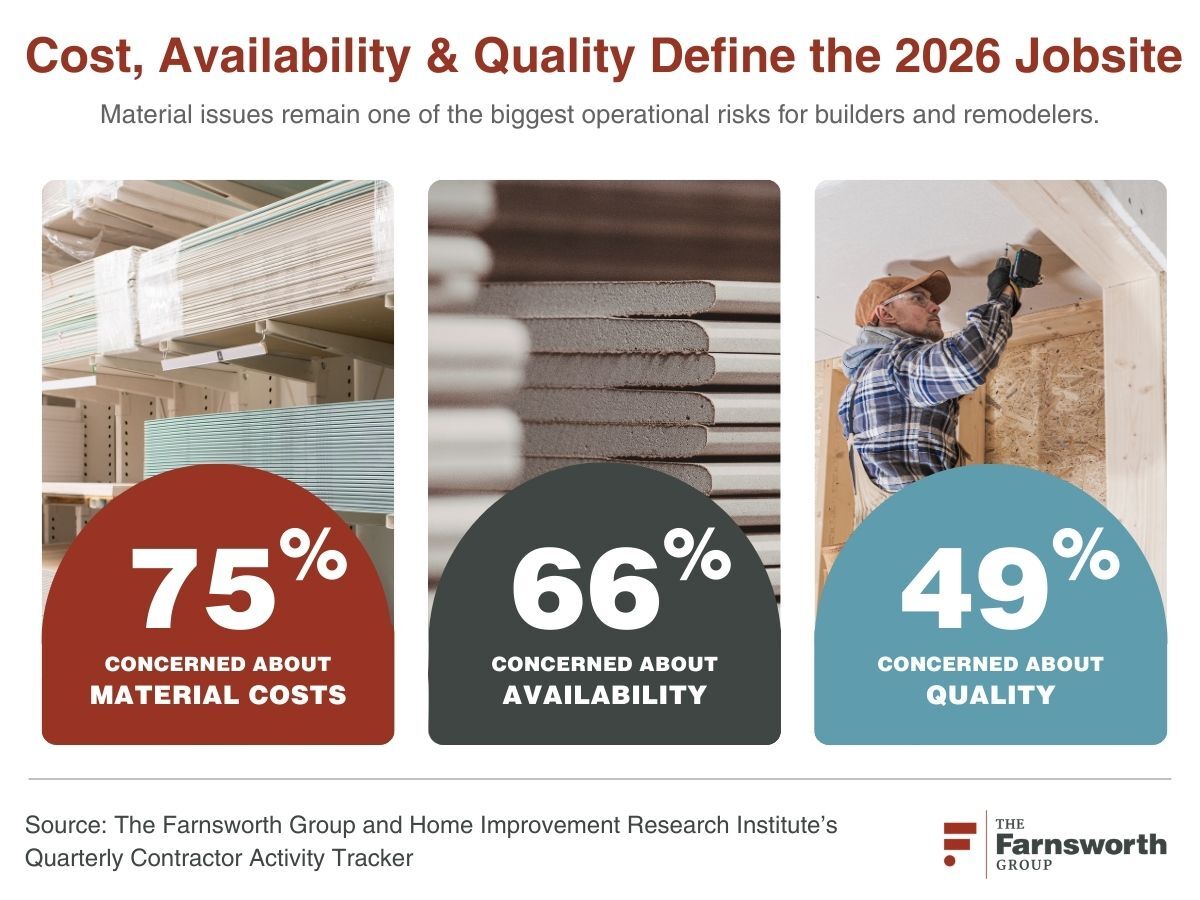
Remodeling professionals have expressed optimism about finding the materials they need for their jobs in 2026, according to our Contractor Index for Q1 2026. On average, they are also feeling cautiously optimistic—albeit to a lesser extent—about the stability of materials costs. However, along with labor, material issues continue to one of the greatest challenges facing industry professionals, in terms of both cost and availability. Additionally, throughout 2025, they expressed increasing concern about the quality of materials, based on our Quarterly Contractor Activity Tracker for the fourth quarter of 2025. Of pros who experienced challenges related to materials, 75% cited costs, while 66% and 49% mentioned availability and quality, respectively.
8. Both Homeowners and Pros Rely on Big-Box Stores for Drywall
For homeowners, big-box retailers remain the dominant channel for purchasing home improvement products, with about three-quarters of DIYers shopping from these channels. The same can be said for professionals, especially when it comes to core product categories, like drywall and lumber. Smaller, generalist firms lean heavily on big-box outlets, but also diversify through local stores for expertise and availability. Larger firms, and specialists display greater engagement with lumber dealers and specialty suppliers, based on findings from HIRI’s Contractor Product Purchase Incidence for Building Materials and Structural Systems Study. Pros also show a propensity for cross-purchasing drywall, insulation, adhesives, paints, and fasteners, particularly in the finishing phases of construction.
9. Energy Efficiency and Green Building Practices Spur Product Innovations
Demand for energy-efficient buildings and a growing trend toward green building practices is contributing to growth in the U.S. drywall market. National Gypsum Company, for example, manufactures a variety of sustainable drywall products with Leadership in Energy and Environmental Design (LEED) certification, and USG Corporation, another industry leader, has a range of drywall products that provide insulation, which can help mitigate energy costs and consumption. Brands are also considering environmental, social, and governance (ESG) principles and figuring out how to integrate them into product development, supply chain management, and operational priorities as they relate to the drywall market.
What Questions You Should Be Asking in 2026?
These housing, economic, and customer trends give a broad look at what factors currently are and could potentially influence the drywall market in the U.S. in 2026 and beyond. However, understanding what is happening is only the first step. Leading building product manufacturers can go deeper and gain more meaningful insights by asking the right questions about their customers, products, and growth opportunities.
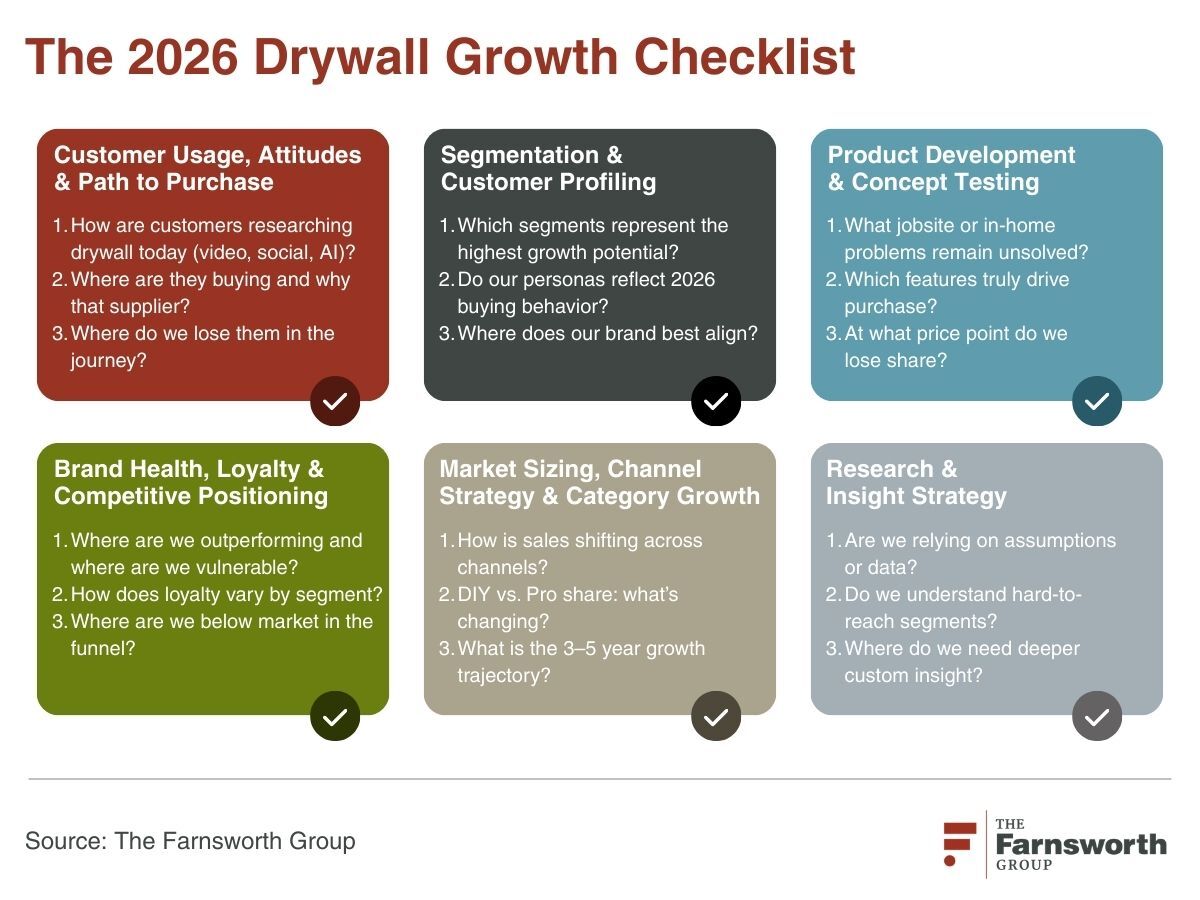
Below are some of the critical questions that marketing leaders, product managers, brand managers, and insights teams should be asking in 2026 across five core areas:
Customer Usage, Attitudes, and Path to Purchase
- How are our customers discovering and researching the drywall product category?
- What role do YouTube, social media, and AI (like ChatGPT) play in their decision-making journey?
- Where do they typically purchase drywall products and why do they choose supplier?
- Where do customers get stuck in their journey, and where are we losing them?
Segmentation & Customer Profiling
- Which segments (Generational, Attitudinal, Occasion-Based) represent our highest-value growth opportunity?
- What share of the drywall market do our ideal segments represent?
- Do our current personas reflect the reality of 2026 (video-first, digital-first, availability-driven)?
- With which segment does our brand or product best align?
Product Development & Concept Testing
- What jobsite or in-home problems are customers still trying to solve that we have not addressed?
- What features related to various drywall materials and products do users actually value and what can be deprioritized?
- Does our packaging or in-store-facing content clearly communicate product benefits?
- At what price point do we lose share on shelf?
Brand Health, Loyalty, and Competitive Positioning
- Where are we strong and where do competitors outperform us (quality, reviews, availability)?
- Where in the sales funnel are we below the market?
- How does loyalty toward specific drywall products and brands vary across demographics and segments?
- What gaps do we need to close to improve our market perception?
Market Sizing, Channel Strategy & Category Growth
- How are sales shifting across channels (big-box, local hardware, Amazon, D2C online-only) when it comes to drywall?
- What is the share of sales across DIY and Pro segments?
- What is the true size and growth trajectory for drywall products over the next three to five years?
- What share do we have in the overall market versus key competitors?
Conducting Custom Market Research for Drywall Products
While there is consistent demand for drywall materials for construction and building applications, manufacturers and suppliers have to look beyond surface trends to develop and market products that will meet the shifting demands of their particular audience, especially when competing in a low-growth or no-growth market environment.
The Farnsworth Group specializes in providing customized research solutions to building products manufacturers to help you compete well. We will work with you to study even hard to reach customer segments to get the data and insights you need to pave the way for more effective business strategies.


By Grant Farnsworth
President, Senior Consultant
Grant has worked on every area of market research at some point – coding paper surveys, running tabs, programming surveys online, getting sample, managing fielding, generating reports and preparing analysis and presentations. Grant has been working with The Farnsworth Group since he was a teenager, learning the craft of custom market research and how to uphold the highest of standards in research design and data collection.
For the past 20 years, Grant has been involved with various associations, trade shows, committees, publishers, manufacturers, retailers, and suppliers in the home improvement, lawn & ranch, and building products spaces. For Grant, one of the most satisfying feelings is to know they helped a client to succeed when he sees the results of The Farnsworth Group work on store shelves, on new homes, and in the homes of friends and family. Based in Denver, Grant is a music buff who believes that life should be fun. In all his pursuits, Grant’s sincerest appreciation goes out to his wife – the most kind and patient person on earth.