

Garage doors play a role not only in the insulation, protection, and energy efficiency of a home, but also its overall style and curb appeal.
These are all factors considered by homeowners and professionals when choosing garage door brands and products for both new construction and remodeling projects. Not to mention the emergence of fresh technologies and innovations that provide a range of options to meet customer desires.
Manufacturers and retailers who are looking to expand market share for this product category can take advantage of custom market research to identify opportunities and barriers, as well as exploring the distinct behaviors and preferences of their customer base to inform and optimize product development and marketing strategies.
How is the Garage Doors Market Performing in 2026?
The global garage and overhead door market was estimated to be around $8.14 billion in 2025, according to data from Fortune Business Insights. The market is forecast to experience a compound annual of growth rate (CAGR) of 5.2%, expanding to approximately $12.84 billion by 2034. North America currently has the largest share in the garage and overhead door market, or roughly 59.3%. In the U.S., demand for this product category is expected to grow over the next few years as a result of investment into residential infrastructure.
With the median age of the housing stock in the U.S. now upwards of 40-plus years, it is anticipated that property owners will invest on renovating older residential properties and updating key features, which may include garage door replacements to integrate new materials and technologies. This could contribute to market growth in the coming years. Another anticipated contribution is the need for housing inventory. While 2026 Single Family (SF) housing starts are projected to be flat over 2025, it's widely accepted that SF housing is deficient by upwards of 1.5 million homes, depending on which report you read. While lot sizes and interior square footage of new homes have come down, the demand for auxiliary spaces, such as garages, remains steady.
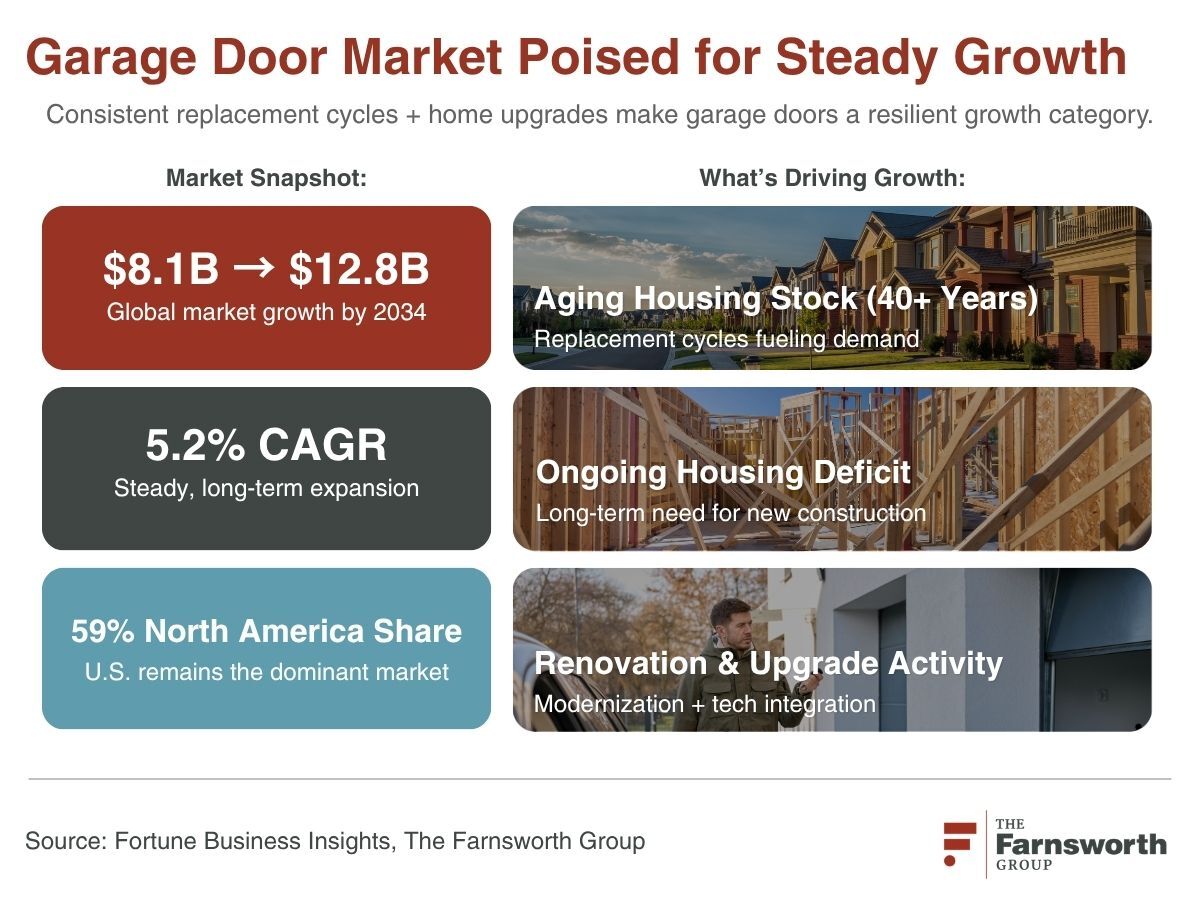
The average cost to replace or install a new garage door is about $1225, although the price tag for this type of project can vary significantly based on the material used, the size of the door, extra features, and other factors.
What Market Dynamics Impact Demand for Garage Doors?
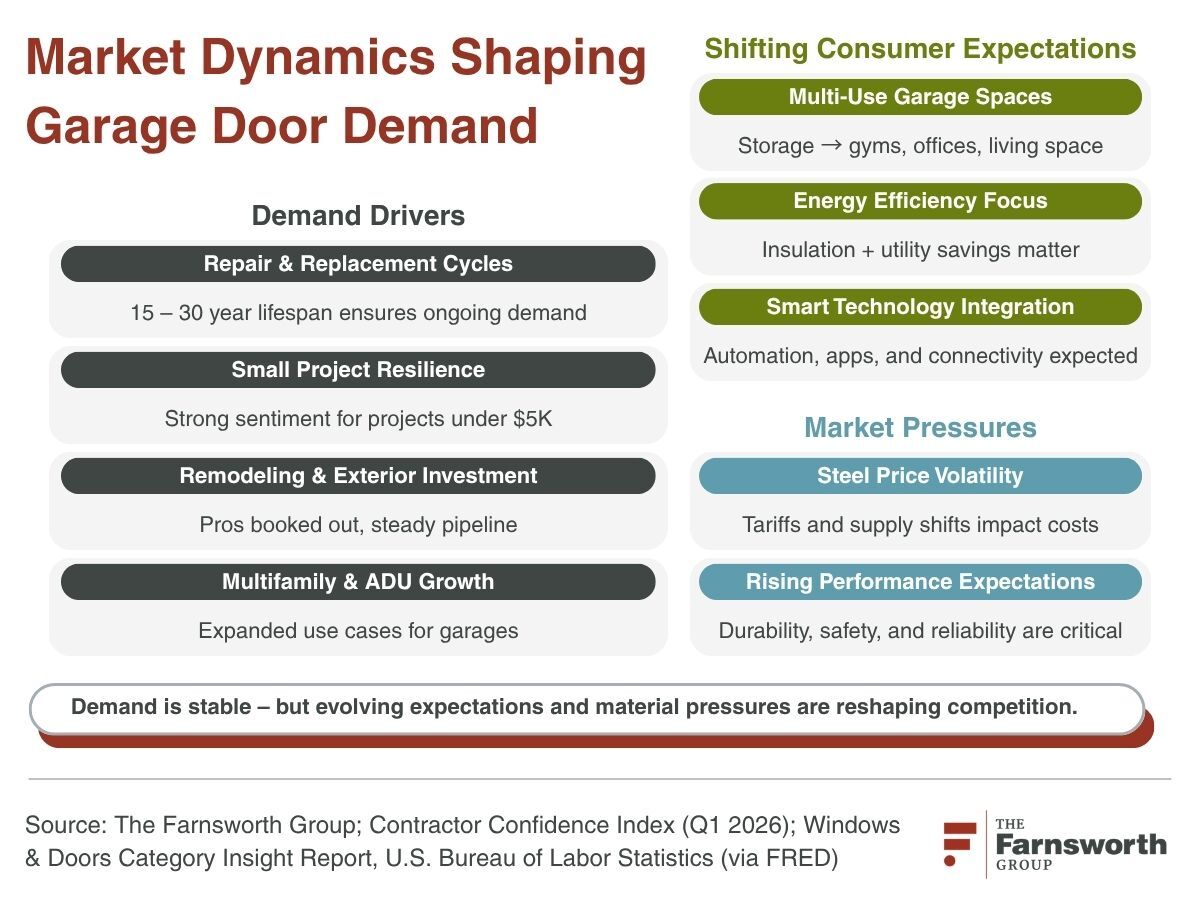
As a product category, garage doors are utilized in both new construction and specific remodeling projects and renovations. Additionally, the typical lifespan of a garage door is 15 to 30 years (depending on the material used, the climate of the region, the frequency of use and other factors). Consequently, manufacturers and suppliers can expect some continual demand as property owners complete this cycle.
However, there are several other variables that could impact the garage door market in 2026 and beyond, including housing trends and customer preferences. Here is a look at a few of these factors:
1. Maintenance and Repair Projects Drive Market
The market growth in the garage door sector is likely to be propelled by investments into residential infrastructure, from new construction to remodeling older homes. There is a desire among homeowners to replace their current garage door systems with more technologically advanced, durable, and long-lasting products. Our Quarterly Homeowner Activity Tracker shows that home maintenance continues to dominate the home improvement market in terms of type of project, followed by home repairs. In the fourth quarter of 2025, 50% of homeowners reported that they had planned a maintenance project within the next 90 days. About 33% were planning repair projects, which include fixing or restoring damaged, broken, or dysfunctional parts of a home.
2. Consumer Sentiment Remains Stable for Small Projects
Garage door installation falls into the small-sized project category, or projects under $5,000. The good news for industry stakeholders is that while consumer confidence is currently a bit volatile, owing to a range of economic variables, homeowners are still feeling relatively positive about undertaking home improvement activities in the $5,000 or less range, according to our Windows and Doors Category Insight Report. In the fourth quarter of 2025, about 34% claimed they thought it was a “good time” to start a project in this range, with 37% feeling neutral.

3. Multifamily and Multifunctional Opportunities
In response to the ongoing housing deficit in the U.S., multigenerational and multifamily living is a viable solution. Multifamily (MF) starts surged in 2025, experiencing double-digit growth. Although they’re now leveling off to their pre-COVID-19 levels and expected to have only moderate growth in 2026, the projects started in 2025 will be finalized over the next year or so, which should have positive implications for the garage door market. Additionally, changing household formations and how people are using their garages will also continue to influence the garage door market. As homeowners try to optimize their limited residential space, garages are being used not only for storage and vehicle protection, but also other functions, such as gyms, workspaces, and even additional living space, or Accessory Dwelling Units (ADUs). Manufacturers must satisfy the desired balance of protection and insulation without sacrificing style and performance. Additionally, glass and window inserts are seeing a surge in popularity in line with a desire for natural light to make these spaces more habitable.
4. Demand for Energy Efficiency and Eco-Friendly Options is Growing
There is also opportunity in the market for garage door products that are more sustainable and environmentally sound, as well as energy efficient, which are concerns that often overlap. In fact, according to our Windows and Doors Category Insight Report, energy efficiency is one of the most important factors in brand choice, along with reliable performance durability. This is in large part due to the desire of reducing utility costs among many financially constrained consumers. While an energy ROI is often the leading motivation behind efficient or environmentally friendly products, customers are also in search of products made from sustainable materials, such as recycled steel, composite wood, and bamboo. Manufacturers for garage doors who want to capitalize on this trend through their product development should take into consideration the energy competence of their products, as well as factors such as how well they protect and insulate indoor spaces and the types of materials used, with an emphasis on incorporating recycled and/or sustainable materials. Utilizing low-emission processes and reducing waste when manufacturing garage doors is another worthwhile consideration to create differentiation and appeal to a niche consumer segment.
5. U.S. Trade Policy on Steel Complicates Market Forecast
Steel continues to be the dominant material type for garage doors because of durability and relative cost-effectiveness. Other benefits of steel for garage doors include its quality of performance in a range of climates and weather changes, as well as its low maintenance requirements. Since jumping significantly from November 2020 to December 2021, the Producer Price Index for steel products, from the U.S. Bureau of Labor Statistics via FRED, dropped back down in January 2023—albeit, not to its former level. The steel market has been more volatile over the past couple of years, due in part to the ongoing trade policy and tariffs enacted by the United States federal government. As the legality of the tariffs is still under question, this could have further implications for markets that rely on steel, such as garage door manufacturing. Additionally, it could potentially make other materials more competitive in this market.
6. Smart Technology Integration and Automation is Increasing
As smart home automation and connectivity become the norm, homeowners have come to expect certain features to be included in their garage doors systems, such as monitoring, remote operation, and notifications if issues arise. Some manufacturers are taking it a step further, including garage doors into more wide-scale smart home systems, offering homeowners options like keyless entry, programming timers, and advanced remote operation through smart phone apps. One of the challenges will be keeping on top of emerging technologies and innovations, ensuring they’re compatible across various platforms, and marketing them at a price point that is appealing to customers.
7. Safety and Security are Top Priorities for Garage Door Considerations
Because garage doors provide an entryway into residential structures, safety and security are top concerns for homeowners when selecting these products. They want to mitigate the vulnerability of their home. As a result, proper installation and durable design are critical components for manufacturers, retailers, and service providers to address. For example, ease of maintenance may weigh into homeowners’ decision-making when selecting garage door brands and products, as well as knowing they have adequate support and even warranty coverage from manufacturers if an issue arises. Other safety features that are gaining popularity include smart alerts, keypad control, reinforced tracks, and camera support.
What Questions You Should Be Asking In 2026 to Boost Garage Door Sales?
These are just a few of the trends shaping the garage door market in the U.S. in 2026, but there is more specific and relative data to be gleaned. Leading building product manufacturers can go deeper by asking the right questions about their customers, products, and growth opportunities and using the answers to inform strategic decision-making.
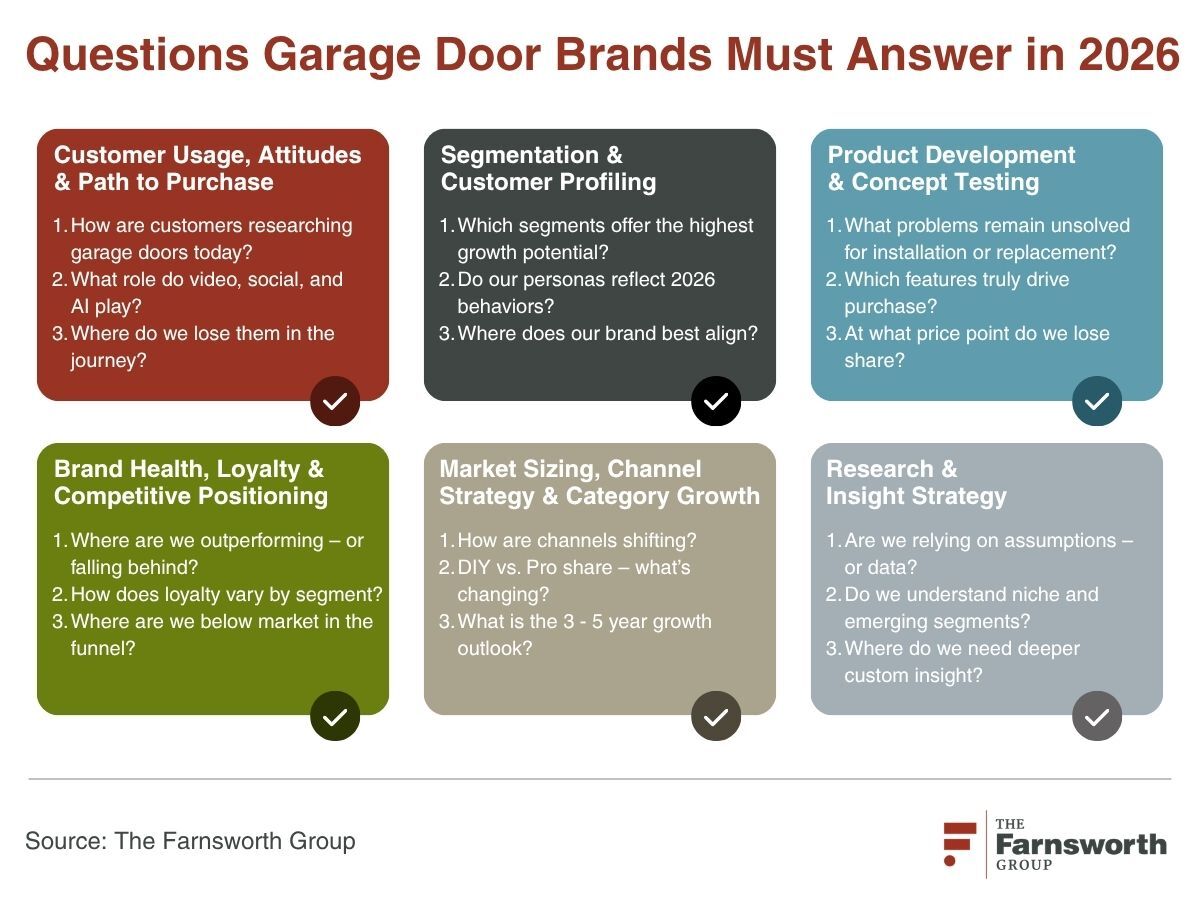
Below are some of the critical questions that marketing leaders, product managers, brand managers, and insights teams should be asking in 2026 across five core areas:
Customer Usage, Attitudes and Path to Purchase
- How are customers discovering and researching garage door options for their particular project?
- What role do YouTube, social media, and AI (like ChatGPT) play in their decision-making journey?
- Where do they typically purchase the garage door for their installation, and why do they pick that supplier for this specific project?
- Where do customers get stuck in their journey, and where are we losing them?
Segmentation and Customer Profiling
- Which customer segment represents our highest-value growth opportunity?
- What share of the market do ideal segments represent?
- Do our current personas reflect reality in 2026 (video-first, digital-first, availability-driven)?
- Which segment does our brand or product best align?
Product Development and Concept Testing
- What jobsite or in-home problems are customers still trying to solve when installing or replacing their garage door that we have not addressed?
- What features do users actually value and what can be deprioritized?
- Does our packaging or in-store-facing content clearly communicate the benefits of our brand’s garage door options?
- At what price point do we lose share for this product category?
Brand Health, Loyalty and Competitive Positioning
- Where are we strong and where do our competitors outperform us (quality, reviews, availability)?
- Where in the sales funnel are we below the market?
- How does loyalty vary across demographics and segments?
- What gaps do we need to close to improve our perception in the garage door market?
Market Sizing, Channel Strategy and Category Growth
- How are sales for garage doors and related products shifting across channels (big-box, local hardware, Amazon, D2C online-only)?
- What is the share of sales across DIY and Pro segments?
- What is the true size and growth trajectory of garage doors over the next three to five years?
- What share do we have in the overall market versus our key competitors?
Making Strategic Decisions in the Garage Door Market
Conducting regular market research to understand your buyers, evaluate your brand messaging, and determine your best go-to-market strategy will remain increasingly important as you look to gain a bigger share in the garage door market in 2026.
It’s important to go beyond macro trends impacting the home improvement and construction industries and get specific data relative to garage doors as a product category, as well as tailored insights into your target customer base. Our expert researchers can help. Tell us more about what questions you're needing to answer by booking a consultation.


By Grant Farnsworth
President, Senior Consultant
For the past 20 years, Grant has been involved with various associations, trade shows, committees, publishers, manufacturers, retailers, and suppliers in the home improvement, lawn & ranch, and building products spaces.
Grant has worked on every area of market research at some point – coding paper surveys, running tabs, programming surveys online, getting sample, managing fielding, generating reports and preparing analysis and presentations. Grant has been working with The Farnsworth Group since he was a teenager, learning the craft of custom market research and how to uphold the highest of standards in research design and data collection.
For Grant, one of the most satisfying feelings is to know they helped a client to succeed when he sees the results of The Farnsworth Group work on store shelves, on new homes, and in the homes of friends and family. Based in Denver, Grant is a music buff who believes that life should be fun. In all his pursuits, Grant’s sincerest appreciation goes out to his wife – the most kind and patient person on earth.