

Three data points, read together, tell a story the landscaping industry has been slow to confront.
1. Full-time wage and salary employment in landscaping, lawn service, and groundskeeping has fallen to approximately 86,000 workers nationally as of early 2025, a decline of nearly 30% from the sector's peak of roughly 121,000 in 2020.
2. At the same time, the number of landscaping service establishments remains robust, with Florida, California, and New York alone accounting for more than 29,000 businesses competing for available labor.
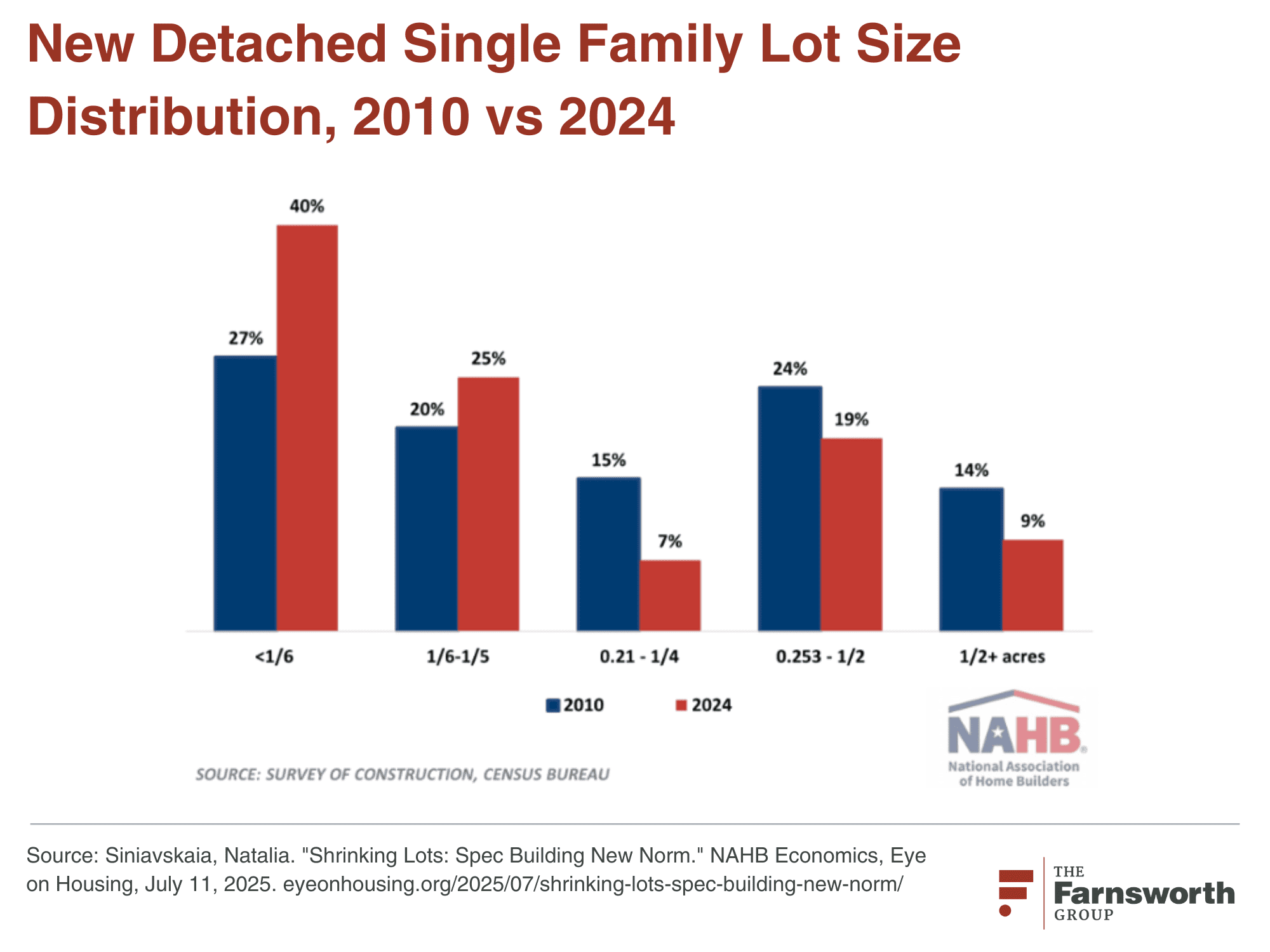
3. And the residential market those businesses serve is splitting in two, with high-volume entry-level properties trending smaller while the custom and mid-size segments trend larger, forcing operators to make clearer choices about who they are actually serving.
The result is a structural squeeze: a shrinking labor supply, a dense and growing competitive field, and a customer base that is diverging rather than converging. For operators, the implications are significant.
The Labor Contraction Is Not a Blip
The workforce trend line in BLS data is worth examining carefully. Landscaping employment has always carried seasonal volatility; the characteristic peaks and troughs visible in quarterly data reflect spring demand surges and winter contractions. But the 2025 figure of 86,000 full-time workers sits well below the trough of previous cycles. Even during the 2008 to 2009 recession, employment fell to the low 80,000s before recovering sharply. The current contraction is happening without a comparable macroeconomic shock to explain it.
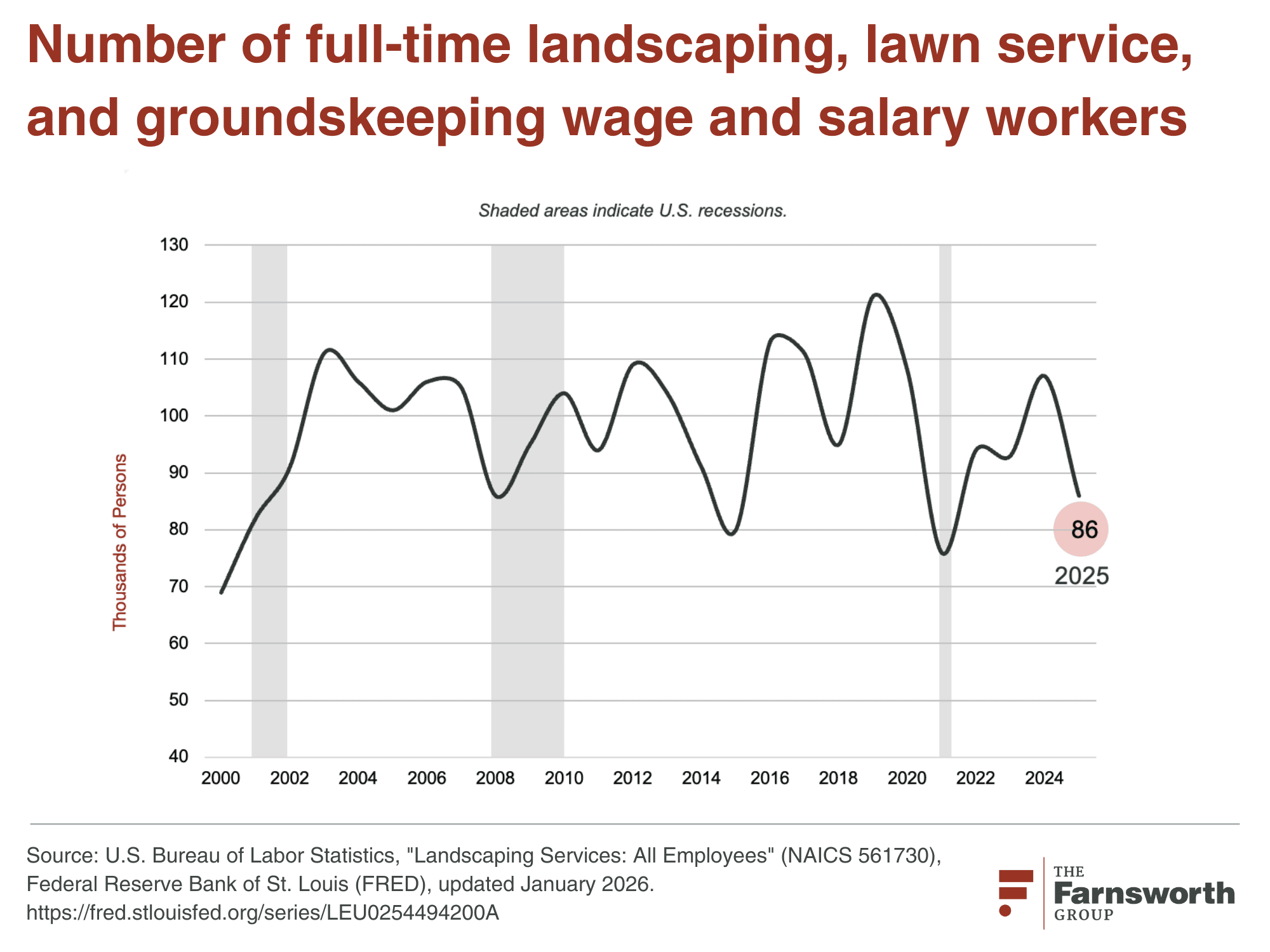
The more plausible driver is labor supply restriction tied to immigration policy. The landscaping and groundskeeping workforce is disproportionately foreign-born. Tightening H-2B visa caps, increased enforcement activity, and broader policy uncertainty around work authorization have all constrained the pipeline of workers that the industry has historically relied upon. Unlike construction or agriculture, sectors that have attracted more political attention around workforce needs, landscaping has largely absorbed these pressures quietly, through longer job vacancies, route consolidation, and in some cases, service reductions.
What the BLS data suggests is that this quiet absorption may be reaching its limits.
Geographic Concentration Amplifies the Pressure
The distribution of landscaping establishments across the U.S. is not uniform, and that matters for how labor scarcity plays out in practice. Florida leads all states with 11,623 establishments as of Q2 2025. California follows with 9,944, and New York with 7,657. These three states account for a substantial share of the national business count despite representing a fraction of the country's land area.
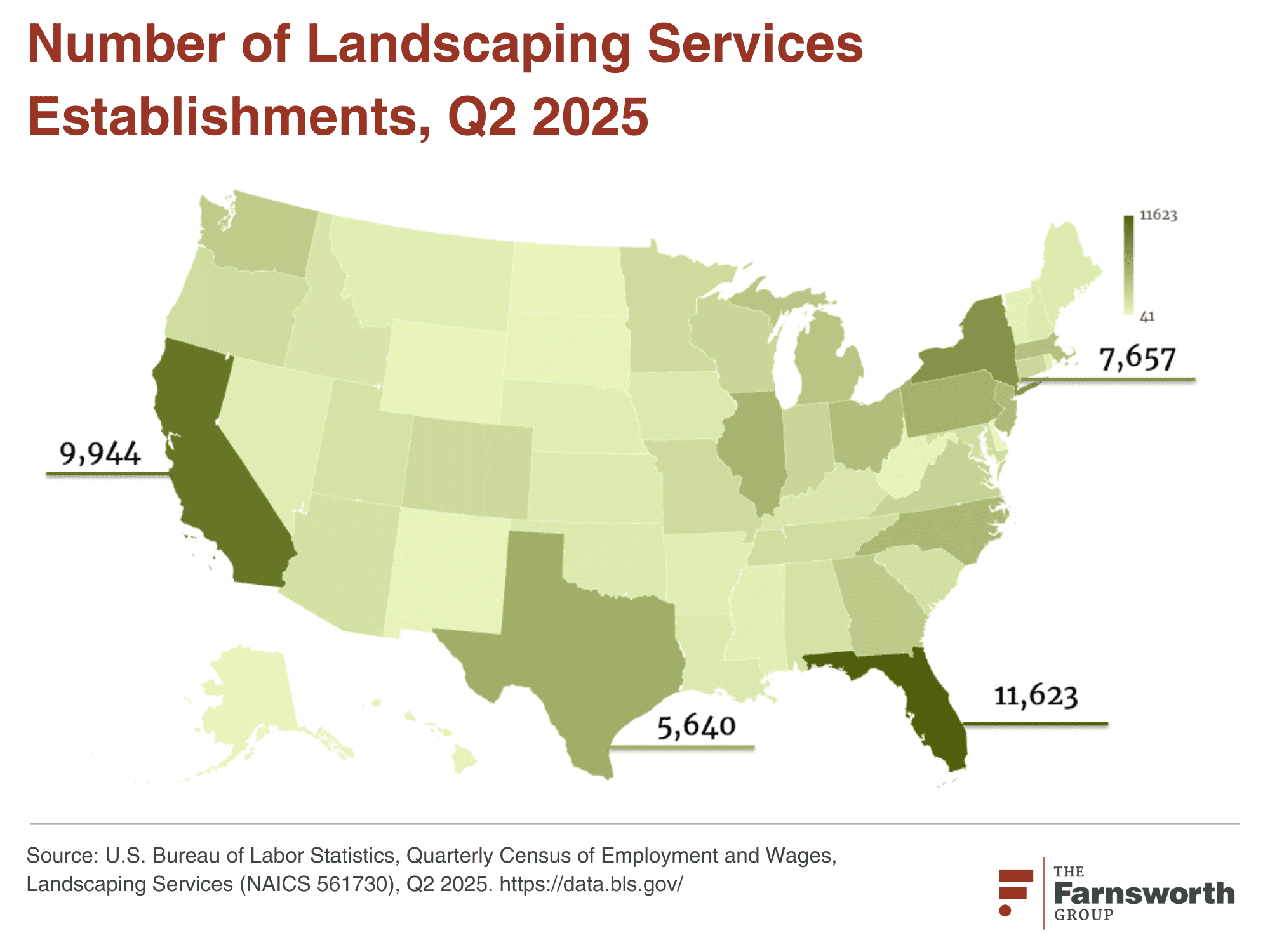
What they share is a combination of high population density, year-round or near-year-round outdoor maintenance seasons, and large concentrations of residential and commercial properties with active landscaping demand. They are also, not coincidentally, states with high costs of living that make recruiting and retaining workers structurally more expensive.
In markets like South Florida or the Los Angeles Basin, operators are not just competing for a shrinking national labor pool. They are competing for a shrinking local one, in high-cost environments, against dozens of other businesses offering similar services to the same customer base. Pricing power may offer some relief, but it also accelerates customer attrition toward DIY solutions or service deferrals.
A Residential Market Splitting in Two
The third variable in this equation is the most nuanced, and the most important to get right. A straightforward reading of lot size growth data suggests expanding workloads for landscapers. But NAHB’s own analysis of the same underlying Survey of Construction data adds a critical counterpoint: two out of three new single-family detached spec homes sold in 2024 occupied lots under 9,000 square feet, roughly one-fifth of an acre, matching record highs. The median lot size for a new spec home sold in 2024 was just 8,506 square feet. By volume, the residential new construction market is trending smaller, not larger.
At the high end, custom homes tell a different story entirely. The median lot size for custom single-family detached homes started in 2024 is one acre, more than five times the spec home median. These properties represent the higher-value, higher-margin end of the residential landscaping market. And the 2013 to 2023 growth data shows that mid-size lot categories expanded significantly over the decade. The quarter-to-half-acre category grew 40.3% nationally, with sharp increases in the East South Central (+62.6%), West South Central (+64.9%), and South Atlantic (+48.0%) regions. The half-to-one-acre category expanded 20.1% nationally, with strong growth in New England (+49.4%) and West North Central (+49.1%).
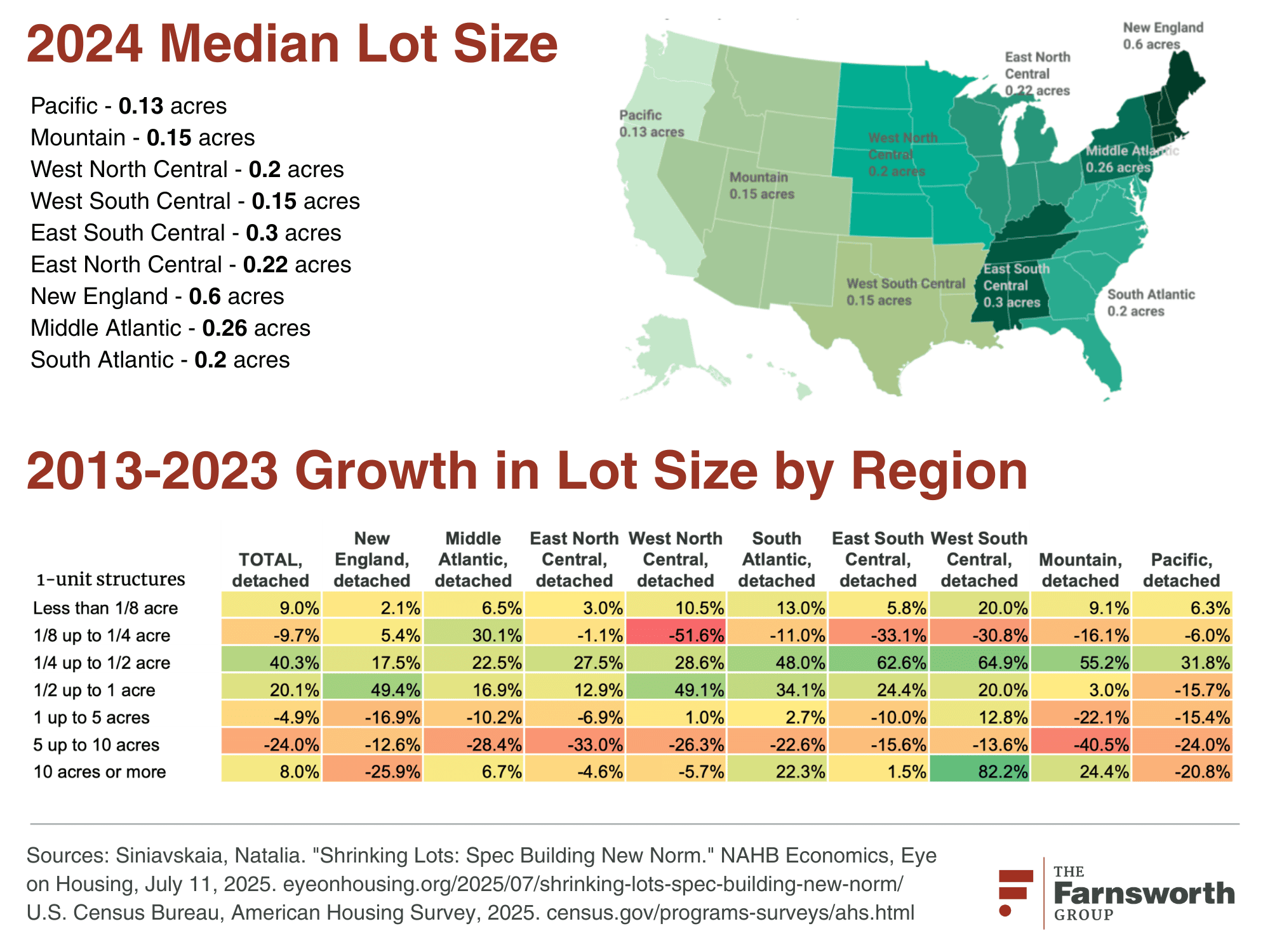
What the combined data describes is a bifurcated residential landscape. At the volume end, spec and entry-level homes are getting smaller and more densely built, driven by affordability pressures and lot shortages. At the custom and upper-middle end, properties remain large and are growing in number. For landscaping operators, these two segments require fundamentally different business models: different equipment, different crew configurations, different pricing structures, and different service offerings.
The businesses that will struggle are those trying to serve both without distinguishing between them. The operators best positioned are those who have made a deliberate choice about which segment they are in and built their operations accordingly.
What Operators Should Be Watching
Taken together, these three trends, namely labor contraction, market crowding, and a bifurcating customer base, argue for a strategic reassessment across several dimensions.
Pricing and contracts.
Annual contracts priced on historical labor cost assumptions are increasingly vulnerable. Operators should model scenarios in which crew availability falls further and factor that into renewal pricing now.
Technology and equipment investment.
Robotic mowing, route optimization software, and GPS-based fleet management are no longer productivity bonuses. They are partial offsets to a labor supply that cannot be counted on to recover to prior levels. The ROI calculus has shifted, and the right equipment mix looks very different depending on whether a business is primarily serving small urban lots or larger custom properties.
Segment clarity.
The bifurcation of the residential market means that operating across both ends without a clear strategy is increasingly untenable. High-density small-lot routes reward efficiency and volume. Large custom properties reward expertise, relationship depth, and service breadth. Trying to optimize for both simultaneously rarely works. The operators gaining ground are those who have picked a lane. You have to deeply understand your specific customer segments.
Workforce development.
The businesses best positioned for the next five years are likely those investing now in training pipelines, apprenticeship programs, and compensation structures that reduce turnover, not those waiting for the labor market to loosen.
The data does not describe a crisis. It describes a slow-moving structural shift that rewards operators who read the trend lines early. The numbers are available. The question is whether the industry acts on them.

What This Means for Landscaping Product Manufacturers
The structural pressures reshaping landscaping businesses do not stop at the operator level. For Outdoor power equipment manufacturers serving this space, the evolution of the landscaping business model has direct implications for product development, sales strategy, and customer relationships.
The landscaping operator of 2026 is not the same buyer as the one from five years ago. They are running leaner crews, absorbing higher input costs, and in many cases actively deciding which segment of the residential market they want to serve. A business that has pivoted toward high-density small-lot urban routes has very different equipment needs than one focused on large custom estates. Both are making purchasing decisions under cost pressure, but the products that solve their problems, and the messages that resonate, are not the same.
Outdoor power equipment manufacturers that understand these shifts at a granular level, what landscapers are worried about, how their businesses are structured, which segment they serve, and where they see growth, will be better positioned to develop products that solve real problems and build sales approaches that resonate. Those that treat the landscaping operator as a monolithic buyer, or that continue to market to a version of the customer that no longer exists, will find the message lands poorly.
The industry is changing, and it is changing in more than one direction at once. Understanding the mind of the modern landscaping operator is not a research exercise. It is a competitive necessity.

Questions Worth Asking: A Market Research Lens on the Landscaping Sector
The structural dynamics described above are useful context. But they don’t answer the questions that matter most to any individual manufacturer or operator including:
- How well is your brand recognized in the segment you are targeting?
- What are landscaping professionals in your key markets actually buying, and why?
- How are their purchasing criteria shifting as crews shrink and margins compress?
These are not questions that off-the-shelf industry-level data can answer on its own. Answers to these kinds of questions require custom market research directed at the right respondents. As you assess where your business stands in light of the forces reshaping this industry, some of the most productive questions to explore include:
Who exactly is your customer?
Understanding the split between high-density small-lot operators and large-property custom operators in your actual customer base will directly inform product development, messaging, and sales resource allocation. Aggregate market data obscures this distinction; custom research among your own buyers can surface it.
Where are you winning and losing at the point of decision?
A competitive intelligence study among landscaping operators, covering brand awareness, purchase consideration, and the reasons behind final equipment decisions, can reveal gaps and opportunities that aggregate market data obscures. In a crowded field with a shrinking buyer pool, understanding why you lose a sale is as valuable as understanding why you win one.
How is your brand perceived among the landscaping professionals you most want to reach?
As the market bifurcates, brand positioning that worked for a broadly defined “landscaping operator” audience may need to be retooled for a more specific segment. Brand health research that distinguishes between operator types can reveal where your brand has permission to lead and where it faces friction.
What role do your products play in landscapers’ efforts to offset labor shortages?
Operators making purchasing decisions under crew pressure are evaluating equipment differently than they were three years ago. Understanding what specific problems they are trying to solve, and how they measure ROI on landscaping equipment investment, is essential for effective product development and sales messaging.
What is the total addressable market for your product in each segment?
Market sizing research that distinguishes between volume operators serving small lots and custom-property specialists will give you a more actionable picture of where real revenue opportunity is concentrated—and where your current customer base is over- or under-represented relative to the market.
Taking the Next Step: Conduct Market Research with The Farnsworth Group
The Farnsworth Group is a custom market research firm with more than 35 years of experience serving manufacturers, retailers, and brands in the outdoor power equipment, lawn care, home improvement, and building products industries. We specialize in reaching hard-to-find professional audiences, including landscaping operators, OPE dealers, contractors, and specialty-channel buyers, and translating what they think and do into actionable insights for our clients.
We help clients understand the buyers who matter most to their business: how they make purchasing decisions, where specific brands fit in their consideration set, how markets are structured by segment and geography, and where real growth opportunities exist. Every project is backed by deep category expertise that allows us to move faster and go further than generalist research firms.
If the trends described in this article raise questions you want answered with data, about your brand’s position in a bifurcating market, how landscaping operators are evaluating equipment under new cost pressures, or the size of the segment you are targeting, we would welcome the conversation. Reach out to start a project, or simply have a conversation about what's going on in the industry.

Data sources:
U.S. Bureau of Labor Statistics, "LandscapingServices: All Employees" (NAICS 561730), Federal Reserve Bank of St. Louis(FRED), updated January 2026. https://fred.stlouisfed.org/series/LEU0254494200A
U.S. Bureau of Labor Statistics, Quarterly Census ofEmployment and Wages, Landscaping Services (NAICS 561730), Q2 2025. https://data.bls.gov/cew/apps/table_maker/v4/table_maker.htm#type=1&year=2025&qtr=2&own=5&ind=561730&supp=0
Siniavskaia,Natalia. "Shrinking Lots: Spec Building New Norm." NAHBEconomics, Eye on Housing, July 11, 2025. https://eyeonhousing.org/2025/07/shrinking-lots-spec-building-new-norm/
U.S. Census Bureau, American Housing Survey, 2025. https://www.census.gov/programs-surveys/ahs.html
.png)
Written By Taylor Pence
Senior Advisor
Taylor has been managing quantitative market research studies at The Farnsworth Group since 2015, while also supporting team development and training to uphold high research standards. Inspired early on by home improvement shows, he brings a lifelong passion for DIY and hands-on problem solving to his work. Taylor is a proud husband and father of three who enjoys sharing his hobbies, including music, sports, fishing, and workshop projects, with his kids.