

Ask any brand manager how their brand is performing, and chances are they'll pull up a scorecard. Quality: 7.8 out of 10. Durability: 8.1. Innovation: 6.4. These numbers feel important, but when it comes time to make a real decision (e.g. where to invest, what to communicate, which segment to prioritize) they have a tendency to leave teams staring at a wall.
The problem is not the data. It is the question the data is answering.
At The Farnsworth Group, we've spent over 35 years conducting primary market research in the building products industry among homeowners, professional contractors, architects, designers, and the dealer networks that connect them. That experience has led us to a clear conclusion: generic brand attribute ratings are hard to action against, and there's a better way.
The problem with rating scales
Traditional brand attribute research asks respondents to rate brands on a set of descriptors such as quality, value, reliability, ease of install. The logic is intuitive. The problem is that it treats brand choice as if it happens in the abstract.
Nobody selects a siding brand in a vacuum. A remodeler upgrading a design-forward home in an affluent neighborhood is navigating entirely different priorities than a production builder putting siding on 200 entry-level homes. Generic attributes collapse that nuance into a single average that represents no one's actual purchase decision particularly well.
Consider a manufacturer with a strong quality rating across the board. Encouraging - but what is "quality" doing in that number? Does it mean the product holds up in coastal conditions? That it installs clean and fast? That it makes the homeowner proud of the upgrade? Without knowing which quality the buyer is valuing, and in which purchase context, that score cannot drive action.
What are project triggers?
The framework at the center of our updated brand attribute methodology is what we call project triggers - related to what others call category entry points (CEPs) or jobs-to-be-done (JTBD). The core idea: buyers don't choose brands in general. They choose brands for something specific.
For a homeowner, this trigger may change throughout their lifetime as their situation, motivations, and resources evolve. Did they just move into their first home, cash-strapped and looking for a quick replacement for their broken window? Are they trying to wow guests with a showstopper kitchen remodel? Has their washing machine been so unreliable they just want to upgrade to a low-maintenance solution?
For a pro, project triggers might be slightly different:
- Quick, reliable delivery to job sites — a pro working against a hard project deadline
- Distinctive curb appeal for standout homes — a luxury builder, architect or designer selecting for aesthetics first
- Able to meet tight budget constraints — an entry-level or workforce housing contractor managing cost per unit
- Holds up in harsh or high-exposure conditions — a coastal or extreme-climate contractor where long-term durability is non-negotiable
- Reliable performance that minimizes callbacks — homeowner-driven specification where ease of ownership matters
- Easy installation with readily available parts — installer-driven, where labor time is the primary concern
Each trigger represents a distinct decision context with its own needs, constraints, and brand associations that operate independently from each other. Generic attributes blend all of this together.
Defining your project triggers
A common early question: how do we know what the right triggers are for our category? Not every brand team has done the path-to-purchase research needed to articulate all the decision contexts their buyers are navigating.
The answer is that triggers can be discovered when they're not already known. Identifying and sizing these scenarios will help determine the right set of project triggers to measure for your category. Both internal stakeholder interviews and direct qualitative research with buyers can help uncover the potential triggers for your specific product category. Often, hands-on sales teams are able to share expertise about, when, how, and why products are chosen. This can be validated through additional qualitative exploration with homeowners and pros (builders, remodelers, and specialty trades) designed to surface their underlying decision contexts; what kinds of projects are buyers typically shopping for, what constraints are shaping their choices, and what would lead them to choose one brand over another for this job? This type of path-to-purchase research will ensure the wide range of project scenarios are uncovered.
Quantitative research then unlocks visibility into how large each segment actually is. When respondents tell you which triggers are most relevant to their typical project mix, you can quantify how much of the market is driven by each job.
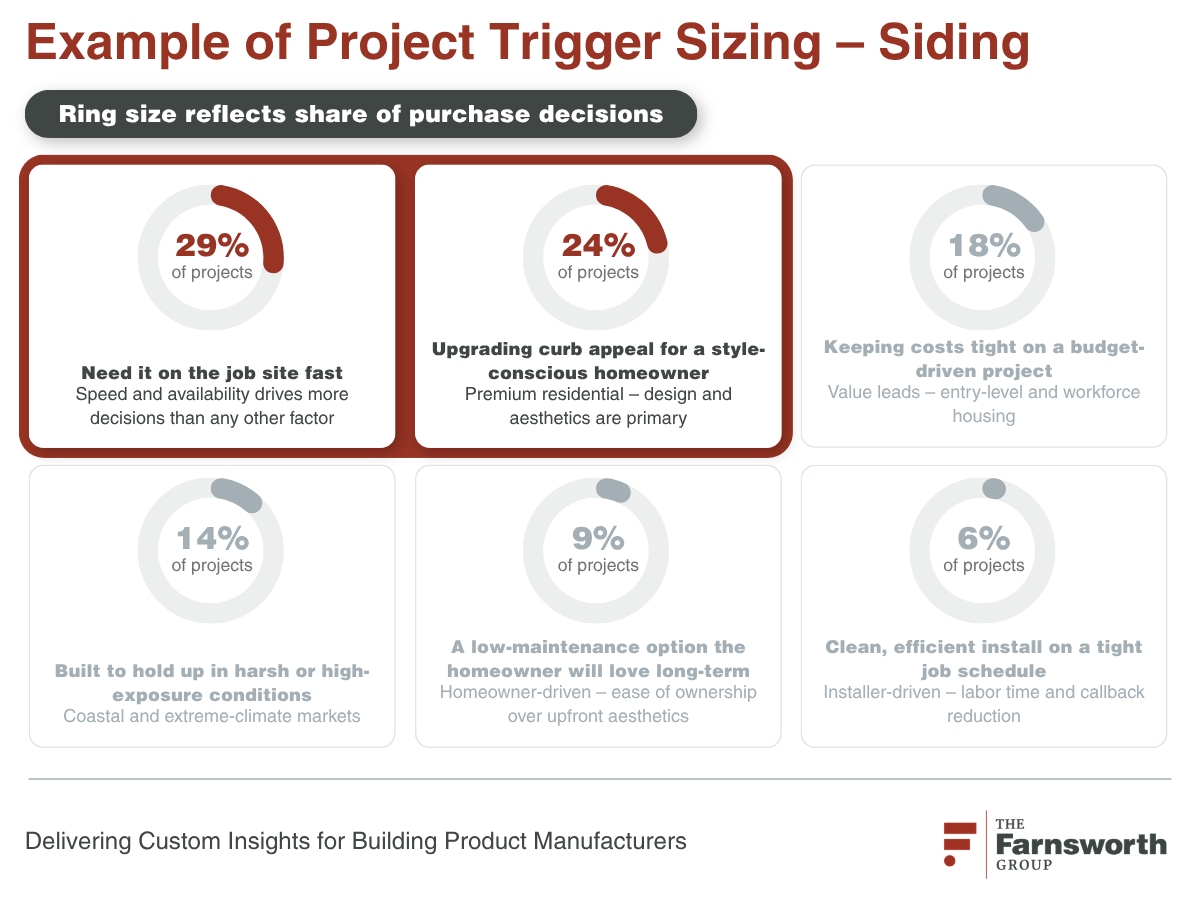
This matters enormously, especially for brands serving professional audiences. Are you positioned to win with the largest project triggers? Where is there opportunity to grow? Brand positioning and growth goals can also be directly informed by market sizing and segmentation research - quantifying total addressable market and identifying the highest-value customer segments to pursue.
For brands that already have path-to-purchase data or strong internal positioning documentation, that existing work often provides enough input to structure a trigger set without additional exploratory research.
Either way, the goal is the same: arrive at eight to twelve triggers that represent real, distinct purchase contexts — not abstract qualities, but specific jobs the product is being hired to do.
Measuring your portfolio performance
Once you know which triggers exist and how large they are, you can measure each brand's strength within each one. This is where the competitive and portfolio picture gets interesting. Simply measuring for which project triggers your brand(s) are thought of as a part of regular brand health tracking can provide multiple insightful views of where and how you play in the category:
- How many people think of your brand overall vs. for specific project needs?
- How much 'mental share' does your brand have versus competitors?
- How broadly are you considered for different project needs?
- With which project triggers are you over- and under-indexing?
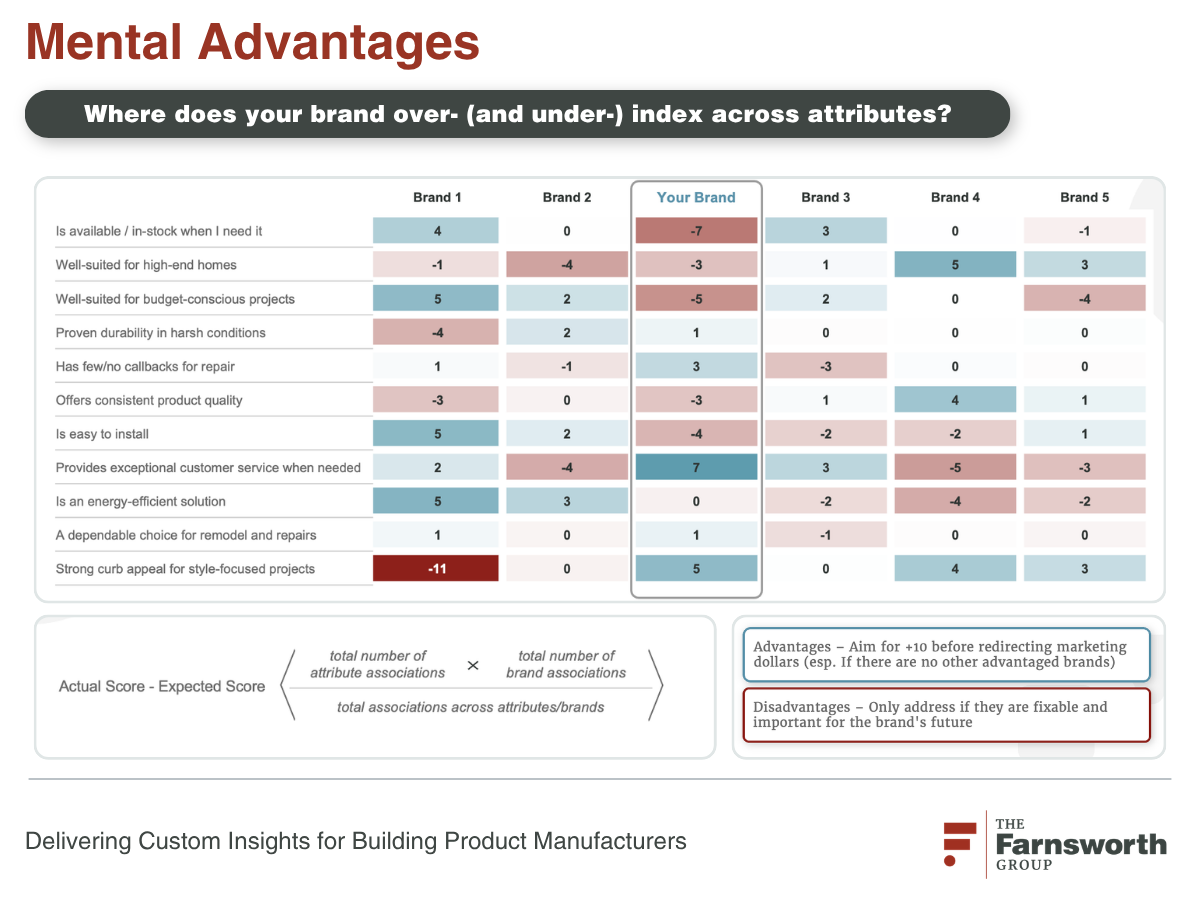
A view like this reveals something generic attribute data simply cannot. It's not just that Brand A outperforms Brand B on quality — it's that one product line owns the speed and availability trigger while another has a clear claim on the premium curb appeal space, and a third covers the value end. These are not interchangeable positions. They point to different customers, different channels, and different messaging priorities. Including attributes specific to your brand positioning allows you to measure marketing performance in a new way. Are your brands truly owning the unique spaces you have been messaging against?
It also surfaces white space. The "dependable choice for remodel and repairs" trigger in the example above is a large-sized need with no brand clearly owning it — that's a quantified opportunity, not a vague hunch. For brands with complex portfolios, the same map shows where two of your own product lines may be competing for the same job and creating internal cannibalization.
A real-world example: siding
One of our clients in the siding category came to us with a familiar challenge. They had years of brand attribute data showing strong performance on quality and reliability, and a clear strategic aspiration to own the premium residential segment. But they were struggling to connect those two things. Were they actually winning in that space? Was their positioning landing?
We built a tracker grounded in project triggers relevant to how pros actually select siding brands. What the data revealed was both validating and sobering. The client was, in fact, performing well in the curb appeal and premium design trigger — better than some on the team had feared. But there was a critical vulnerability hiding in plain sight: perceptions of availability and speed of delivery were significantly below both market expectations and key competitors.
For a pro audience, unreliable availability isn't a minor inconvenience — it can be a disqualifier. No matter how strong the product, if it isn't on the job site when it needs to be, it doesn't get specified. This finding, invisible under a traditional attribute rating approach, became the centerpiece of a concrete strategic response. Operations, sales, and marketing aligned around an availability narrative. And because the tracker was built to measure trigger-level performance over time, the team had a clear mechanism to track whether those investments were actually moving perception.
Why this matters, especially in building products
The building products industry has characteristics that make trigger-based research particularly valuable here.
Multiple audiences, multiple trigger sets.
Unlike consumer goods, building products are specified, purchased, installed, and lived with by different people. A siding product may be specified by an architect, priced by a builder, installed by a trade contractor, and evaluated by a homeowner. Each audience has a different set of triggers. Research that only tracks generic attributes across a blended audience systematically misses the distinctions that drive purchase decisions at each stage.
Complex portfolios that need clear positioning.
Many of our clients manage broad product lines intended to serve different market segments. When research reflects the jobs buyers are actually hiring products for, portfolio decisions (line extensions, brand architecture, acquisition integration) become far more grounded in real customer need.
Pro buyers think in context.
Why should you be tracking your brand based on project triggers over generic attributes? Because Pro buyers think in context.
Contractors, builders, and designers are experienced buyers acutely aware of what they need a product to do for a given application. Generic attributes smooth over the nuances that actually drive pro specification. Project triggers meet the pro buyer where they make decisions.
For building products brands navigating a competitive market, the question isn't just how buyers feel about your brand in the abstract. It's which jobs they're hiring products to do, which brands have earned the right to be considered for those jobs, and which opportunities remain unclaimed. Project triggers are the unit of analysis that makes that precision possible.
Interested in exploring whether this approach could sharpen your brand or research strategy?


Written By Karen Barnes
Senior Advisor
Karen brings 15 years of experience in brand consulting, market research design, and advanced analytics, helping organizations across industries answer critical business questions. She has worked with leading global insights firms and a wide range of clients, including those in home improvement, CPG, technology, finance, and healthcare. Based in Denver, Karen enjoys hiking, exploring local food and drink spots, and traveling the world with her fiancé, Adam.