

How to Activate Research Throughout Your Large Company
Every research engagement produces a deliverable. The real question is what happens after the research is complete.
Case Study: When Lack of Research Activation Resulted in Loss of First-Mover Advantage
Here's just one such example: A client came to us with a clear objective: identify the optimal feature mix for a new product line catering to multifamily applications before going to market. We ran a conjoint study, a rigorous methodology for understanding which product configurations customers actually prefer, not what they say they want, but how they make real trade-offs between features and price.
The findings were clear and a specific configuration rose to the top that was highly preferred, competitively differentiated, and validated by strong statistical confidence.
When we delivered the readout, the findings were well received, but since the organization wasn’t primed to receive the research, the quagmire began. Internal alignment meetings followed; then budget discussions; competing priorities emerged, and the organizational process took its course.
A few months later, the client’s team walked a trade show and saw something disheartening: one of their competitors had launched a new product with the exact recommended feature configuration that had come to light from The Farnsworth Group's custom research.
The research did its job and found the core insight that the company should take action on, but product change of that scale was only achievable within that window if teams moved with urgency. The intelligence was there to act on, but by the time the organization was ready to move, one of their competitors had released what the market wanted first. This meant a loss of first mover advantage among other factors.
Case Study: When Proactive Research Activation Saved Millions by Preventing a Failed Product Launch
Now contrast that with a different outcome. A different building products brand was deep into product development when they decided to conduct research with The Farnsworth Group and actually put the new product in the hands of contractors before launching publicly. What those contractors said during the research project changed everything for this client. To contractors, the product felt wrong when they held it because it felt thinner than described and less substantial than expected. They called it flimsy.
So based on the insights gained from The Farnsworth Group's research, this client acted quickly: The product launch was pulled, and the product went back for redesign.
Pulling back a launch is never comfortable, and it certainly was not for this manufacturer either. Ultimately, that moment they took to conduct research first and actually act on the findings almost certainly saved their company tens of millions of dollars in production, distribution, and product return costs, not to mention preventing erosion of channel relationships and brand trust from a failed product launch. The research findings gave clear insights and the client's cross-departmental teams reached a decision exactly when the decision could still be changed.
That is what insights activation looks like at its best. Not just research that gets done, but research that gets used.
The difference between those two outcomes is sometimes about data quality, like in these real life examples, which is still a challenge you can hear more about in this video. Much of the time, though, the difference in research activation outcomes is about how the research engagement was designed, managed, and communicated by the client throughout their internal teams and across company departments.
The cycle below is a practical framework for closing that gap at every stage: before the research is designed, during fieldwork and analysis, through delivery, and well beyond it.

Ensuring Research Activation Throughout the Research Lifecycle
Research activation can be a challenge throughout the research lifecycle.
At the front end of a research project, the failure is often framing:
- Was the right hypothesis formed and questions asked?
- Did the research have a clear intended action when it was commissioned, meaning a decision to inform, a hypothesis to test, or a strategy to validate?
- Or was the study designed to gather information with no clear understanding of what would come next?
At the back end of a research project, the failure is often follow-through:
- Once the findings existed, were they distributed through the organization?
- Were the insights tailored to be easily understood by each core department in a way they would be able to best act upon the insights?
- Did the insights reach the people who needed to act on them, in a form those people could actually use?
- Or did the engagement end when the final deck was delivered and the report presentation meeting window closed?
In any of these cases, you can address each long before the data is collected. Here's how:
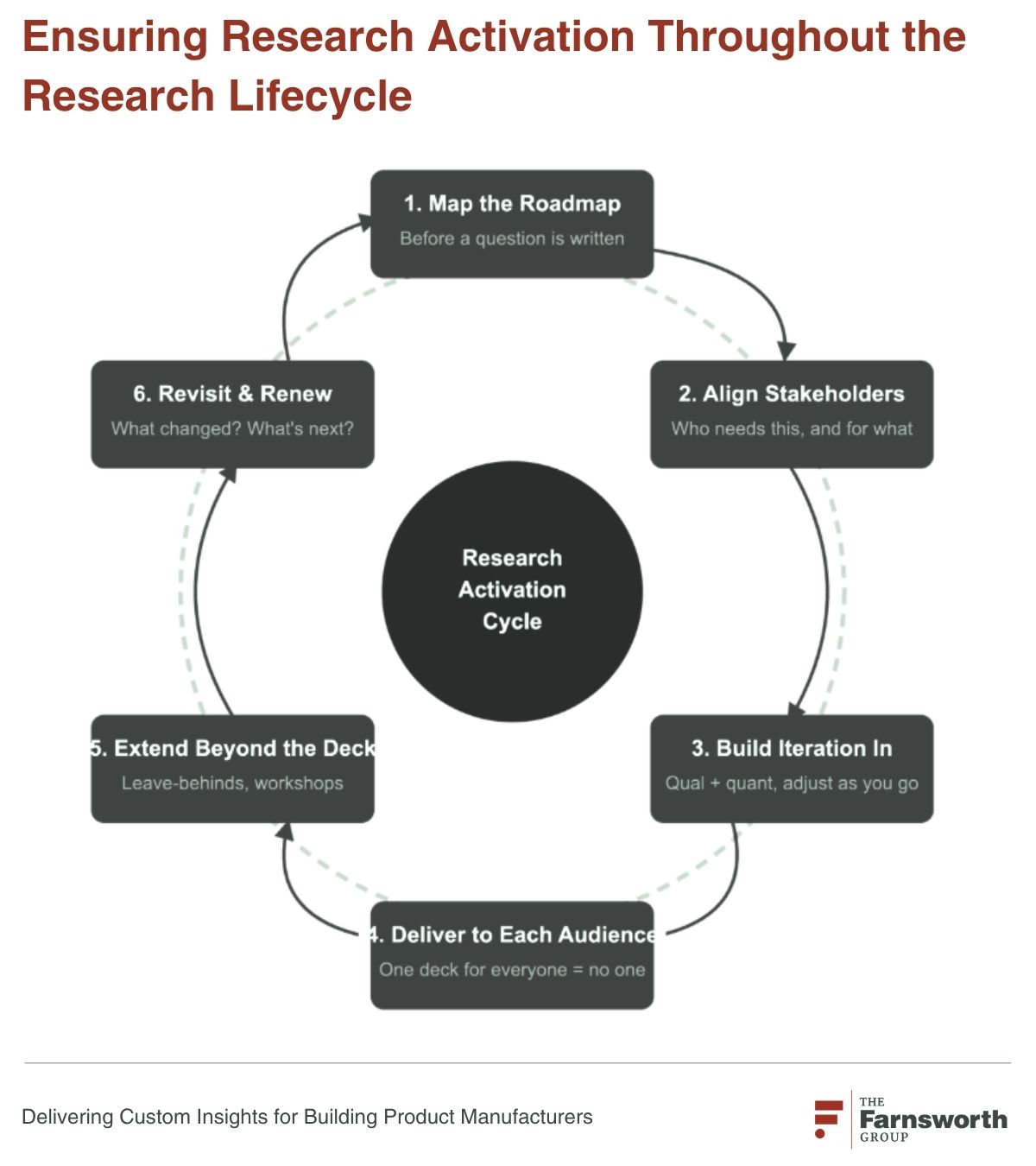
Phase 1: Map Your Research Roadmap
Einstein is often credited with saying that if he had an hour to solve a problem, he would spend fifty-five minutes thinking about the problem, and only five minutes thinking about the solution. The same principle holds in research in that the quality of the answer is largely determined before fieldwork begins.
That means asking the bigger questions first. Questions like,
- What is the business trying to achieve over the next year?
- What is already known, and where are the real gaps?
- What research is already completed or in progress, and what is genuinely missing?
For teams at building products manufacturers and retailers, start by taking stock of what already exists before commissioning new work. Dig into prior research, trade and syndicated sources (including leading resources like The Home Improvement Research Institute), and accumulated category expertise. Existing and syndicated insights from your internal and external sources can help narrow the gap considerably so you know exactly what you genuinely need to commission custom market research for to get answers. Understanding what is already answerable focuses your research investment and often reveals that the actual question you have is more specific than it first appeared.
Keep in mind: A research roadmap may be fifty percent accurate and fifty percent adjusted on the fly. That is not a failure. That is how good research programs work.
The roadmap does not need to be fixed to be useful. A new finding redirects focus and a validated assumption speeds things up. Further, an unexpected result sends you back to reconsider previous beliefs and/or assumptions. What the roadmap prevents is duplication and drift: asking the same questions twice, or missing gaps that only become visible when the full picture is in view.
Phase 2: Align Internal Stakeholders
The most underused setup practice in market research is the stakeholder interview, which should be conducted before a hypothesis is formed and should focus not on research design but on the humans who will eventually use the findings.
There are three reasons this matters.
1. Providing Accurate Context
Building products research in conducted among specialized audiences - like contractors, builders, electricians, plumbers - who use technical vocabulary in precise ways. They way your audience speaks about their problems and solutions may differ from the way your internal teams speak about them.
Language is only part of it. When we conduct custom market research projects for our clients, understanding a client's distribution model, their current target customer, what they have already heard from the channel, and what they already know internally shapes every research design decision that follows. A research questionnaire built without that context is solving for the stated question, not the actual one.
2. Solidifying Scope
The question a client articulates to our research advisors at the outset is rarely the question that would most inform their decision. For example, if a client comes to us wanting to “understand brand health,” their need may actually be three separate questions held by three different teams, each with a different hypothesis. Surfacing that complexity before the research design is finalized means the research can actually address the root questions and provide the desired answers.
3. Securing Buy-In
Furthermore, when internal stakeholders have a voice at the beginning of a research project, they arrive at the report readout as participants and are more likely to be engaged in activating the insights from the research. They have their own questions, have contributed something to the project, they have context, and they have a reason to care about the result.
Phase 3: Build Iteration Into Your Research Design
Good research does not wait until the report is presented to be useful. Instead, the most effective research programs build in explicit moments to assess what is emerging during the course of the research and adjust as relevant to secure the most insightful findings.
In Qualitative Research
In qualitative work, that often starts with a debrief after day one of fieldwork to assess:
- Are respondents interpreting questions the way we intended?
- Did something come up that the discussion guide does not currently address?
- Is there a thread that seems more important than anticipated?
A conversation at the end of day one of IDIs, before day two of interviews begin, creates the opportunity for small adjustments in framing or sequencing that can meaningfully change what the study ultimately captures.
In Quantitative Research
The same principle applies in quantitative work. Sharing directional findings before full analysis is completed, not as a formal presentation but as a working conversation with internal project leads creates a critical checkpoint to assess:
- Does this surprise you?
- Does it conflict with something you already know from the field?
- Should we go deeper on any of this before we complete fielding?
Clients carry business context that shapes how findings should be interpreted. Getting their reaction early prevents investing time documenting the wrong things.
That is the payoff of building iteration in. Not just faster updates, but research that gets sharper as it moves.
Phase 4: Curate Insights Unique to Each Internal Stakeholder
A 70-slide findings deck is a complete research record. It is not a internal communication strategy.
In practice, using the same deck for everyone means you've shared out a deck designed for no one.
To be able to apply the findings well,
- Sales teams need implications for customer conversations.
- Marketing teams need implications for messaging and marketing strategies.
- Product teams need findings that translate into product roadmap decisions.
- Executive leaders need a clear strategic narrative, not a data summary.
Building distinct summaries and insights readouts for each internal audience will dramatically increase the odds that research findings result in the decisions they were designed to inform.
Case Study: Activating Insights for Regional Sales Reps
We recently completed brand health research for an exterior building products company across two divisions.
- The readout cascade began with a commissioners-only session first, not to present findings but to collaborate on framing them for a broader audience.
- Then a 40-person all-hands readout occurred across functions and leadership levels to understand and digest the research as a whole.
- Then there were three strategy-specific activation sessions, each organized around one of the client’s core business priorities.
- Finally, regional sales breakouts were tailored to each market’s competitive landscape and distribution footprint.
By the time a regional sales rep was in their session, they were not hearing generic findings. They were hearing insights that were relevant to them and their conversations with customers. They gained insights like, "here is how your market is performing, here is who you are competing with, here is what customers in your territory say they need." That is the kind of information that is useful in a Monday morning sales conversation.
Phase 5: Extend Beyond the Deck
Most often, PowerPoint requires a presenter, but the most durable deliverables travel without one. While the options are endless and often dependent upon the methodology and need, here are a few of our favorites:
1. Persona leave-behinds.
Persona placemats on a conference table. Customer profile cards on a wall. The people making decisions are rarely representative of the customers they serve, and artifacts that keep the customer visible in the room help close that distance.
2. Infographics.
Critical findings distilled into a single visual carry insights into the contexts where people actually absorb information. A one-page summary shared in a team channel will reach more decision-relevant conversations than the full deck.
3. Interactive simulators.
For conjoint or feature prioritization work, a simulator that lets teams explore configurations in real time turns a static deliverable into a living decision aid. What happens to preference if we shift the price point? What segment gains or loses if we change the feature mix?
4. Video clip digests.
A two-to-three-minute highlight reel from qualitative sessions brings the voice of the customer to stakeholders who were not in the room. A clip of a contractor explaining why a product feels wrong is more memorable than any bar chart.
5. Journey mapping.
Walking customer personas through a structured experience exercise surfaces emotional texture and opportunity that quantitative data rarely captures on its own, often generating ideas the organization did not know it was missing.
6. Activation workshops.
Two to four weeks post-delivery is a particularly valuable window: the research team is out of the weeds of analysis, but the findings are still fresh. When researchers and company stakeholders are brought back together 2-4 weeks later, it's not to re-present data but to instead ask what is still resonating and what from the research they can take action on, knowing what they know now.
The most productive workshop exercise connects research-quantified opportunities to operational reality. A size-of-prize versus cost-to-act discussion makes the conversation explicit: what does this opportunity appear to be worth, and what would it take to capture it? A second structure separates findings into two buckets: act now with existing resources, or plan for later. That sorting step makes urgency visible and gives it organizational permission.
The output is not another deck. It is a decision log: what the team decided, what was deferred and why, and what questions remain open. That document is more valuable than the most polished presentation, because it is the record of research turning into action.
Phase 6: Revisit and Renew
Every good research project opens more questions than it closes. The most important one to ask at the end of any engagement: what do we need to know next?
That question is not an afterthought, and instead is the beginning of the next loop. When new findings redirect focus, when validated assumptions let the organization move faster, or when unexpected results require revisiting the foundation, your research insights activation cycle is working as it should.
Going back to the examples we shared earlier, the contractor who called the product flimsy was not an endpoint - he was the beginning of a product redesign. The brand health wave that detected a competitor gaining ground was not a conclusion - it was the prompt for a pulse study. Research that treats the final report as the finish line captures only the first loop of a cycle that compounds with every pass.
Think about it: the cost of unused research rarely shows up on a budget line. It shows up later, in a launch that missed the mark, a competitor who got there first, a sales team still working from instinct. Every engagement that ends at the deck leaves that cost on the table. These practices exist to collect on the investment instead.
About The Farnsworth Group
With nearly 40 years of custom market research expertise, The Farnsworth Group provides extensive insights and recommendations across the Building Products, Home Improvement, and Lawn & Garden industries. Our research solutions span across market sizing, customer segmentation, product development research, customer experience measurement, brand health tracking, and insights for strategic growth initiatives.
We help organizations understand customer challenges, purchasing behaviors, channel dynamics, and market opportunities so they can make more confident business decisions.
Our team takes the time to understand each client's unique objectives, leveraging decades of industry knowledge and customized research solutions to guide strategy and identify opportunities for growth.


Written By
Karen Barnes
Through her expertise in brand consulting, market research design, and advanced analytics, Karen has been helping answer critical business questions for the past 15 years. She has had the privilege of working with many of the top global insights organizations and applying best practices across a myriad of clients in CPG, technology, finance, healthcare, and of course home improvement, including developers, building products manufacturers, and retailers.
An Iowa native, Karen was upgrading from riding mowers to full combines at the annual John Deere employee fair by age 7. Now in Denver, she fills her off hours hiking the Rocky Mountains, uncovering the best local food & drink spots, and traveling as much of the world as humanly possible with her fiancé, Adam.