

The existing home market is a diverse and large opportunity for suppliers and manufacturers. The Farnsworth Group team works alongside companies who are actively involved in the building products, home improvement, and lawn and garden space, helping them conduct market research to inform their strategic decision-making.
Qualitative research is a vital part of the process that enables manufacturers, suppliers, and other industry stakeholders to better understand the choices their customers make and why they feel the way that they do. Dawn McElfresh, Director of Qualitative Research, and Robin Graziano, a Senior Project Manager with The Farnsworth Group, recently sat down for a Shop Talk session to discuss how qualitative research is evolving and how it can provide real value to building products brands and others in the construction and home improvement space.
What is Qualitative vs. Quantitative Research?
For The Farnsworth Group, quantitative phone surveys can deliver reliable data from hard-to-reach industry professionals. Some of the components of this research style include:
- Structured questionnaire
- Focused on measurable data and statistical analysis
- Interviewers stay close to the script for consistency
- Larger sample sizes
Meanwhile, qualitative research involves technical conversations that can unlock deeper insight. Some components of qualitative interviews include:
- Open discussion guide
- Focused on deeper motivations and experiences
- Moderators explore topics flexibly
- Smaller, in-depth sample
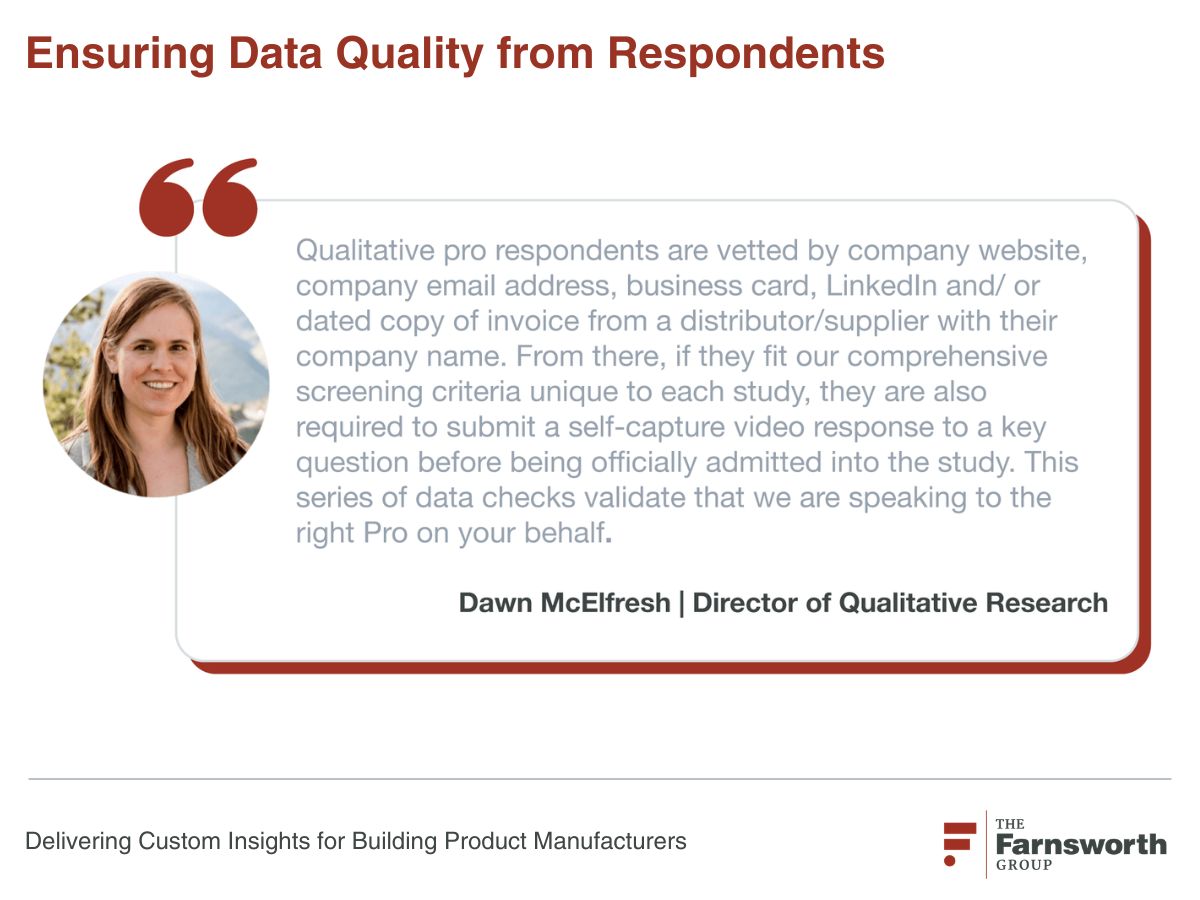
The Farnsworth Group’s qualitative team provides executive-level moderator expertise and a focus on building materials that offers meaningful support during live interviews and behind the scenes. Using category-specific market understanding, and detailed probes that uncover nuances, emotional drivers and perceptions, these in-depth interviews and focus groups allow clients to hear live how their customers feel and why.
Qualitative Trends Evolving in the Building Products Industry in 2026
Here are some of the key trends and observations discussed:
1. The Use of Qualitative Research is Changing
Qualitative research is becoming more important in the building products industry, and how it is being used is changing. Here are some key shifts:
- Qualitative research is moving away from being project-based and towards something that companies do in a more recurring fashion.
- Now, the process is part of continuous input into decision-making that guides companies’ global strategies over time.
Implications: There’s been a shift in how organization’s value and implement qualitative research.
2. AI is Becoming Deeply Entrenched in the Qualitative Research Process
Although qualitative research focuses on talking with other people, artificial intelligence (AI) is now embedded in the entire process, from transcription to coding to identifying themes. Here are some of the main impacts (both positive and negative) that can results from AI’s heavy use in the qualitative research process:
- What used to take weeks can now happen in days, or even hours, as AI speeds up the process.
- AI helps with efficiently organizing data.
- AI can miss important nuances because it doesn’t fully understand content, especially in a niche space, such as the building products industry.
Implication: The role of the researcher has evolved into interpreting what AI is outputting, finding the meaning and not just summarizing data.
3. Qualitative Research Seeks to Bridge the Gap Between Stated Preferences and Actual Behaviors
There is a gap between what industry professionals express as their preferences and how they actually behave, or the choices they make when it comes to building products. This brings to the surface implications of achieving trustworthiness of qualitative research.
- Instead of digging into preferences, questions asked in qualitative research have evolved to include: What did you actually use on your last job? Who or what influenced that decision?
- Part of the reason for this gap between “say” and “do” is because decisions are constrained (i.e. contractors and other industry professionals can’t always choose based off preference).
- Other factors that influence actual behavior include supplier availability, product availability, the consumer’s relationship with their distributor and the supplier, what the crew knows, and what works on a particular job site.
Implication: Behavior is closer to the truth, and if brands rely only on what customers say they want, and not what they do, there’s a risk of completely misreading the market.
4. Numerous Manufacturers are Misinterpreting Channel Problems as Product Problems
A product doesn’t exist in isolation; it exists in an ecosystem. What are the nuances of this ecosystem?
- In the building products industry, the “customer” is rarely one person.
- Everyone from builders and contractors to distributors, suppliers, specifiers and engineers play a different role in the decision-making process.
- It’s critical to understand who’s initiating, who’s influencing the decision, who’s ultimately making the decision, and who’s installing.
Implication: Multi-audience qualitative research is becoming essential, because if you’re not studying the whole system, you could be missing real drivers.
5. Balancing Speed and Depth Requires a Restructuring of the Research Process
In the building products industry, decisions are high stakes, which increases the importance of getting nuanced, reliable data through qualitative research. In the fast-paced environment of 2026, clients want faster insights, but they also need confidence, especially when making a big investment. The solution to achieve speed and depth involves structuring the research differently. Here is what that might look like:
- Taking a hybrid, mixed-mode approach enables manufacturing brands to see quality before quantity.
- A two-phase project produces directional insights to refine quantitative survey writing, while also incorporating deep dives.
- Key insights uncover not only context and real-time directions regarding an investment decision, but they also help refine the phase-two quantitative survey, which provides statistical data to answer the key objectives of the study.
Implication: The most effective organizations are building tiers of insight through a hybrid qualitative and quantitative research process.

6. Effective Research Projects Take into Account the Multiple Influences on Decision-Making
There are multiple parties who can influence decisions about what products are selected for a building or home improvement project.
- Architects, designers, engineers and other professionals are shaping specification decisions on the front end.
- However, installers are critical because they are the ones ultimately interacting with a product or brand.
- Additionally, there is a growing focus on trust and relationships, and some individuals and companies will make purchasing decisions based on loyalty or reliability, rather than specific features.
Implication: It’s important to understand both specifiers and installers through research, so you’re not missing a key part of the decision-making process. Additionally, relationship building, trust, and ongoing support can be just as critical as offering new features.
7. How Research Insights are Being Delivered is Changing
Manufacturing brands who are conducting research need to feel the customer experience and not just read about it. That’s altering how insights are delivered.
- Clients want video clips, customer voices, a story-driven narrative, etc.
- Research reporting much not only be accurate but also effectively communicate impact so clients can decide if an insight should drive action within the organization.
- With the right delivery, companies can use research to actively shape strategy and innovation.
Implication: Looking ahead, companies that get it right will be those that can balance speed and scale with depth and human understanding.
Shaping the Best Strategies for Your Building Products Brand
The biggest opportunity in qualitative research is not just collecting insights but also understanding what you might be missing as a brand. This could include the gap between what customers say and what they do, the overall role of channel, and the early stages of influence. By filling in those gaps with meaningful research, you’re shaping an overall better decision for your brand.
The Farnsworth Group provides custom market research for the building products, home improvement, and lawn and garden industries. Our commitment to remain focused on specific industries ensures you get proven research solutions combined with deep industry insights that will help you create successful customer, product, brand and channel strategies.

