
Outdoor power equipment (OPE) is a niche part of home improvement products market. Not all homeowners are frequently purchasing from this category, and those who do show varying levels of loyalty.
In general, most homeowners who have purchased OPE are willing to consider new brands, and strong brand reputation is a motivating factor for nearly half of them, as well, based on data from The Farnsworth Group’s 2026 Homeowner Perspectives on Outdoor Power Equipment. For this study, we conducted quantitative research among U.S. homeowners to understand outdoor power equipment purchasing, usage, and preferences. A total of 411 homeowners completed the online survey. Fieldwork was conducted from Sept. 21 to 28, and included individuals who own a single-family (SF) detached home with a yard, are 21 to 74 years old, completed at least some DIY projects, and purchased OPE within the past three years, among other criteria.
With brand loyalty somewhat flexible in the OPE market, it presents both a challenge and an opportunity for manufacturing brands to improve their market position and capture a larger share (as well as retaining loyal customers).
How Does Brand Loyalty Impact OPE Purchasing?
From brand awareness to brand usage to brand satisfaction: All of these metrics are used to show a brand’s health and monitor change being impacted through marketing campaigns and product development.
Here are a few key statistics from the OPE study, along with questions and considerations for manufacturers to take into account when developing business strategies that support strong brand loyalty:
1. Brand Reputation Factors into OPE Decisions for Nearly Half of Homeowners
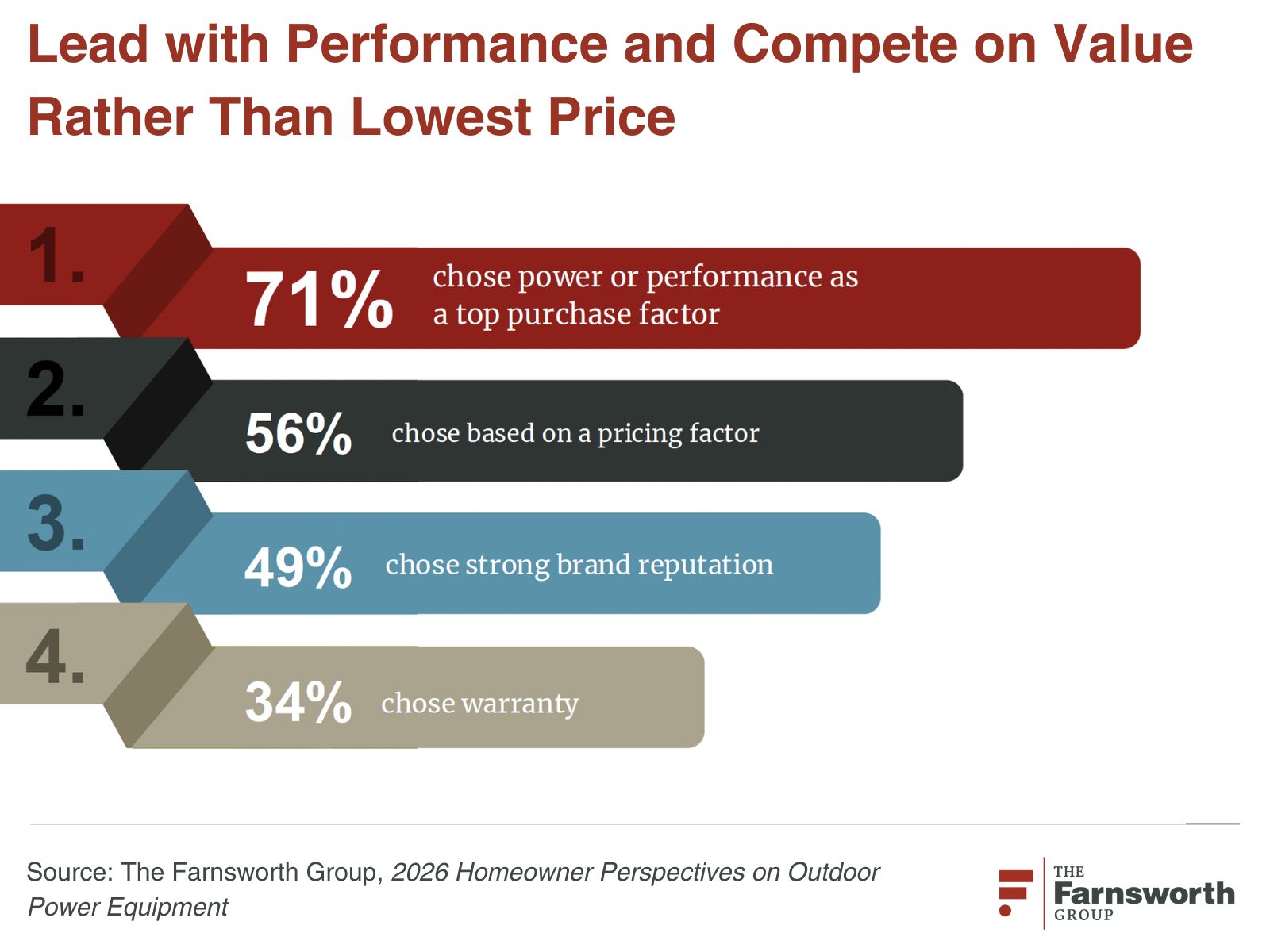
Strong brand reputation is a significant factor for homeowners when choosing an OPE product, cited by nearly 49% of homeowners. Other important factors include:
- Power or performance (71%)
- Competitive pricing (45%)
- Low maintenance (41%)
Cheapest citing also was chosen by 17%, and a total of 56% of respondents selected either pricing factor (competitive pricing and/or cheapest pricing). Reiterating that it's not about being the cheapest, but about the value proposition carried by the brand.
With brand reputation an influential factor in OPE decisions, it’s critical to stay on top of brand health metrics, such as brand awareness, brand reputation, and brand satisfaction. Is the fact that 49% of homeowners taking brand reputation into consideration working in your favor? Do you have a strong position in the market in comparison to your competition? What is your share of voice in the OPE space? How do your products measure up when it comes to the factors that drive decision-making among homeowners?
2. Despite Cost Challenges, Performance is Key
Data from The Farnsworth Group’s Quarterly Homeowner Activity Tracker for Q3 2026 shows that home improvement participation has steadily declined over the past five quarters, with 51% of homeowners doing projects in Q3 2025 compared to 37% in Q3 2026. Cost continues to be the leading project challenge, rising slightly quarter-over-quarter. Looking ahead, homeowners are also planning fewer yard, garden, and outdoor projects. In Q3 2026, only 37% of homeowners were planning projects in this area, compared to 65% in the same quarter last year, representing a -28% decline.
Even with budget and financial concerns affecting the outlook for yard, garden, and outdoor project, and spurring more cancellations and postponements, it’s important for OPE brands to stay focused on what homeowners care most about when shopping for this product category. Performance is still the driving factor, so manufacturing brands should compete on value, rather than the lowest price.
3. Only One in Five Homeowners are Firmly Loyal
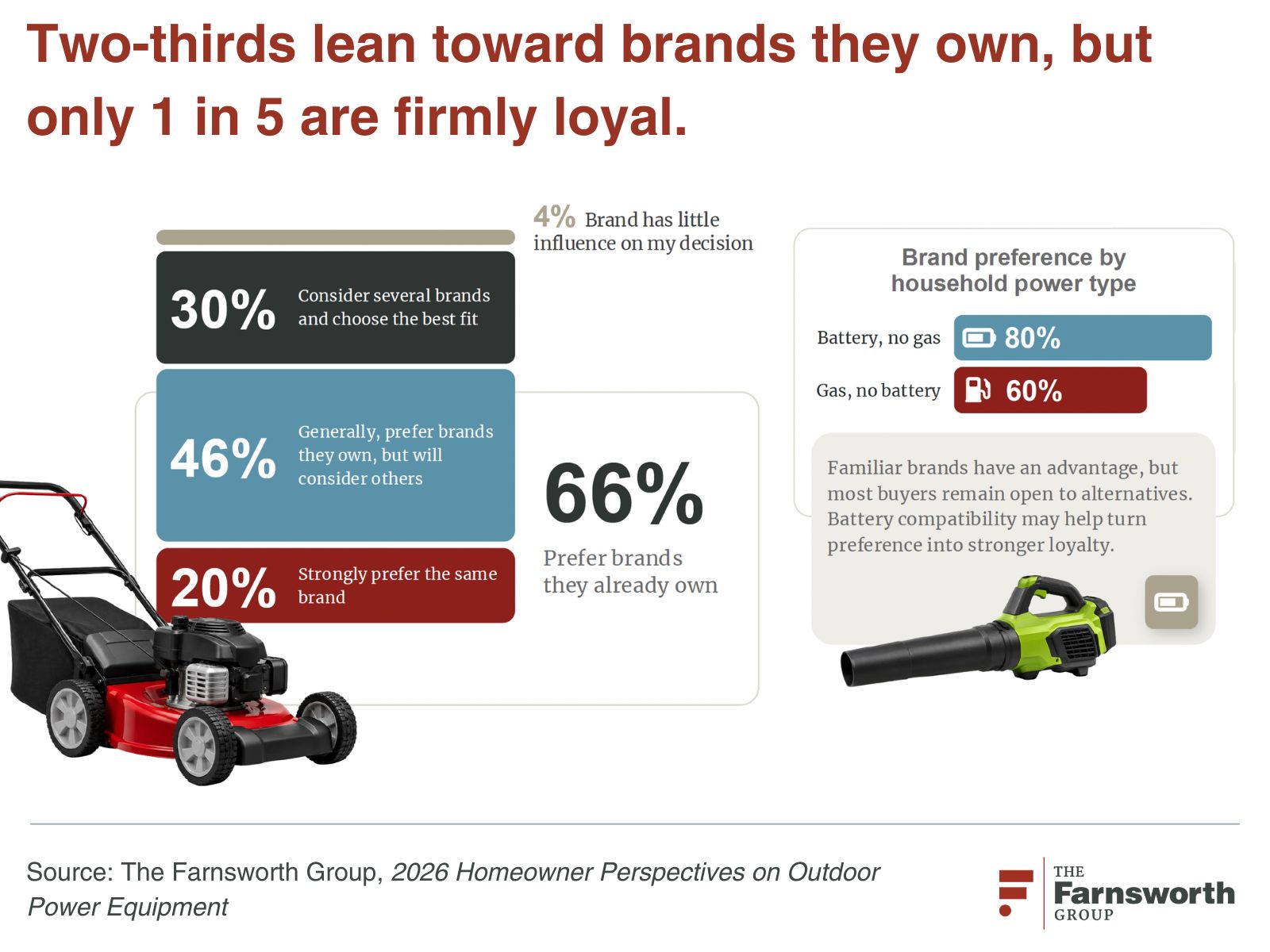
When it comes to how homeowners choose an OPE brand, only 20% say they “strongly prefer to stay with the same brand.” Meanwhile:
- 46% generally prefer brands they already own but will consider others
- 30% consider several brands and choose the one that best meets their needs
- 4% say brand has little influence on their decision
That means, overall, 80% are open to trying other brands to some degree or another. As loyalty is soft for most homeowners when shopping for OPE, there is room to win customers from other brands. Meanwhile, battery platforms, which capture the greatest sense of loyalty, can reinforce it in various ways. For example, are you providing compatibility across platforms (a factor that is becoming more important for power tools)? Are you getting adequate feedback from your loyal customers to inform product development and marketing strategies that can help with retention?
4. Brand Loyalty Varies by Power Type
The 2026 OPE study also reveals that brand preference and loyalty varies slightly by power type and the specific type of equipment purchased. For the OPE power type purchased:
- 80% of those purchasing battery (no gas) products said they “prefer brands already owned”
- 65% of those purchasing gas/battery hybrid products said they “prefer brands already owned”
- 60% of those purchasing gas (no battery) products said they “prefer brands already owned”
The percentages include both respondents who said they “strongly prefer” to stay with the same brand, as well as those who “generally prefer” brands they already own but will consider other options.
Those purchasing battery (no gas) OPE products show the highest preference for sticking with the same brand, and they also are least likely to consider other brands when making a purchase. Meanwhile, about 8% of those purchasing gas (no battery) products report that brand has little influence on their decision.
Zooming in on mower type, our research found that:
- 69% of those purchasing riding mowers said they “prefer brands already owned”
- 67% of those purchasing walk-behind only mowers said they “prefer brands already owned”
- The percentage of those who will consider several brands choose the on that best meets their needs is about the same (28% to 29%)
5. One-third of Homeowners are Influenced by Dealer or Retailer Recommendations
When asked how important dealer or retailer recommendations are when selecting OPE brands and products:
- 12% of homeowners said “extremely”
- 18% of homeowners said “very”
- 38% of homeowners said “moderately”
- 24% said “slightly”
- 7% said “not at all”
While only one in three homeowners feel that dealer or retailer recommendations are either “very” or “extremely” important, it’s still important to be cultivating strong relationships with your partners, providing them the support they need, and figuring out which specific products align with the strongest influence. For example, riding mower buyers value dealer or retailer advice the most (44%), while battery buyers (no gas) value it the least (15%).
Fostering Strong Brand Health Through Custom Research
Brand health is crucial to understanding equity, perceptions and satisfaction across brands who are operating in the OPE arena. Some of the questions you’ll want to investigate include:
- How familiar are customers with our OPE brand and how often is it used?
- What does the market think of our brand and how do we compare?
- What's important to customers and how well does our brand meet those needs?
Our team at The Farnsworth Group can help you find the answers to these and other questions through customized brand health research. By tracking awareness, preference, consideration, and loyalty over time, our outputs pinpoint how your brand stacks up to competitors and where to focus efforts to strengthen brand perception and market share.
Frequently Asked Questions
1. How loyal are homeowners to outdoor power equipment brands?
About 20% of homeowners strongly prefer staying with the same outdoor power equipment brand, according to The Farnsworth Group’s 2026 OPE study. Another 46% generally prefer brands they already own but will consider alternatives, while 30% compare several brands to find the best fit. Just 4% say brand has little influence. For manufacturers, this means loyalty cannot be assumed: Most buyers remain open to competitors that better meet their performance, pricing, or product needs.
2. What factors matter most when homeowners choose outdoor power equipment?
Power and performance lead homeowners’ OPE purchasing decisions, cited by 71% of respondents in The Farnsworth Group’s 2026 study. Brand reputation follows at nearly 49%, ahead of competitive pricing at 45% and low maintenance at 41%. Although affordability matters, these findings suggest manufacturers should emphasize value rather than simply offering the lowest price. Brand research can help determine whether homeowners associate your products with the performance, reliability, and overall value they prioritize when shopping.
3. Does brand loyalty differ between battery-powered and gas-powered OPE buyers?
Yes. In The Farnsworth Group’s 2026 OPE study, 80% of homeowners purchasing battery-only equipment preferred brands they already owned, compared with 65% purchasing gas/battery hybrid products and 60% purchasing gas-only equipment. These figures combine strong brand loyalty with a general preference that still allows consideration of alternatives. For manufacturers, the findings highlight an opportunity to investigate how battery compatibility, existing equipment ownership, and satisfaction influence repeat purchasing across different power types and distinct customer segments.
4. How much do dealer and retailer recommendations influence OPE purchases?
Dealer and retailer recommendations are very or extremely important to 30% of homeowners selecting OPE brands and products, according to The Farnsworth Group’s 2026 research. Another 38% consider those recommendations moderately important. Influence varies by purchase type: 44% of riding mower buyers rate recommendations very or extremely important, compared with 15% of battery-only buyers. Manufacturers should examine where dealer support matters most and equip those partners with product knowledge that addresses buyers’ specific purchasing priorities.
5. How can OPE manufacturers measure and strengthen brand loyalty?
OPE manufacturers should track brand awareness, perceptions, consideration, preference, satisfaction, and loyalty over time rather than relying on sales alone. Custom brand health research can reveal how homeowners view a brand, how it compares with competitors, and whether its products meet customer priorities. Segmenting findings by equipment type, power source, and existing ownership helps identify retention opportunities. Manufacturers can then use those insights to guide product development, sharpen messaging, and strengthen dealer relationships with customers.

Contributors
Grant Farnsworth
Grant has worked on every area of market research at some point – coding paper surveys, running tabs, programming surveys online, getting sample, managing fielding, generating reports and preparing analysis and presentations. Grant has been working with The Farnsworth Group since he was a teenager, learning the craft of custom market research and how to uphold the highest of standards in research design and data collection.
For the past 20 years, Grant has been involved with various associations, trade shows, committees, publishers, manufacturers, retailers, and suppliers in the home improvement, lawn & ranch, and building products spaces. For Grant, one of the most satisfying feelings is to know they helped a client to succeed when he sees the results of The Farnsworth Group work on store shelves, on new homes, and in the homes of friends and family. Based in Denver, Grant is a music buff who believes that life should be fun. In all his pursuits, Grant’s sincerest appreciation goes out to his wife – the most kind and patient person on earth.

Taylor Pence
Taylor has been serving clients and managing quantitative market research studies with The Farnsworth Group since 2015. Taylor also supports internal team development and training efforts to ensure the research team at The Farnsworth Group is current on best practices and equipped to deliver on high standards.
Taylor’s interest in the home improvement space began when he was about 10 years old upon discovery of ‘This Old House’ and Norm Abram’s ‘ New Yankee Workshop.’ Fast-forward a couple of decades and he still enjoys these sources of inspiration while tackling the perils of DIY in his own workshop. Taylor is proud husband to Lauren, and father to three awesome kids. Whenever possible, Taylor shares his hobbies with his kids, including playing music, tennis, golf, going fishing or putting his hands to a new project in the shop.