

Outdoor living categories, including decking, fencing, and railing, benefit from remodeling spend and homeowner willingness to invest in high-visibility, lifestyle-enhancing projects that extend usable living space.
With advances in technology, decking, fencing, and railings are also becoming more affordable. Some of these innovations include 3D printing available for railings (making custom jobs less expensive), advances in wood treatment to extend the life of wooden decking, and more natural looking composite decking options.
What is the Market Forecast for Decking and Fencing Products in the U.S.?
In the United States, the decking, fencing and railing markets are all expected to increase in size in the next five to eight years. With repair and remodel activity expected to continue to grow during this forecast period, outdoor renovations are becoming more frequent.
According to data from Grand View Research, the U.S. fencing market size was estimated at $9.81 billion in 2025. It is projected to expand at a compound annual growth rate (CAGR) of 5.4% to reach $14.9 billion by 2033. Meanwhile, the size of the decking market in North America was valued at approximately $4.8 billion in 2025. With a similar CAGR, the market is projected to grow from $5.1 billion in 2026 to $7.4 billion in 2033.
What Factors are Driving Growth in the Fencing and Decking Market?
There are several factors driving growth in the fencing and decking market, including residential construction and remodeling and repairs. Homeowners are driven by the desire to improve the functionality and aesthetics of their outdoor living spaces, as well as interest in safety and security through fencing installations.
What are the Current Trends in Home Improvement for Decks and Fences?
The demand for deck and fencing materials and products is influenced by broader trends in the housing and home improvement industries, as well as a variety of economic factors that influence DIY homeowners and professionals when selecting items for their projects.
Heading into the second half of 2026, homeowners remain interested in upgrading their properties, including their outdoor living spaces, but they are dealing with less disposable income, making them budget conscious. Manufacturers and suppliers have to be innovative and strategic with their product development and marketing to capture share in an uncertain market.
Here are some of the current home improvement trends that are impacting demand in the decking, fencing and railing product categories:
1. Homeowner Confidence is Volatile, although Demand for Improvements is High
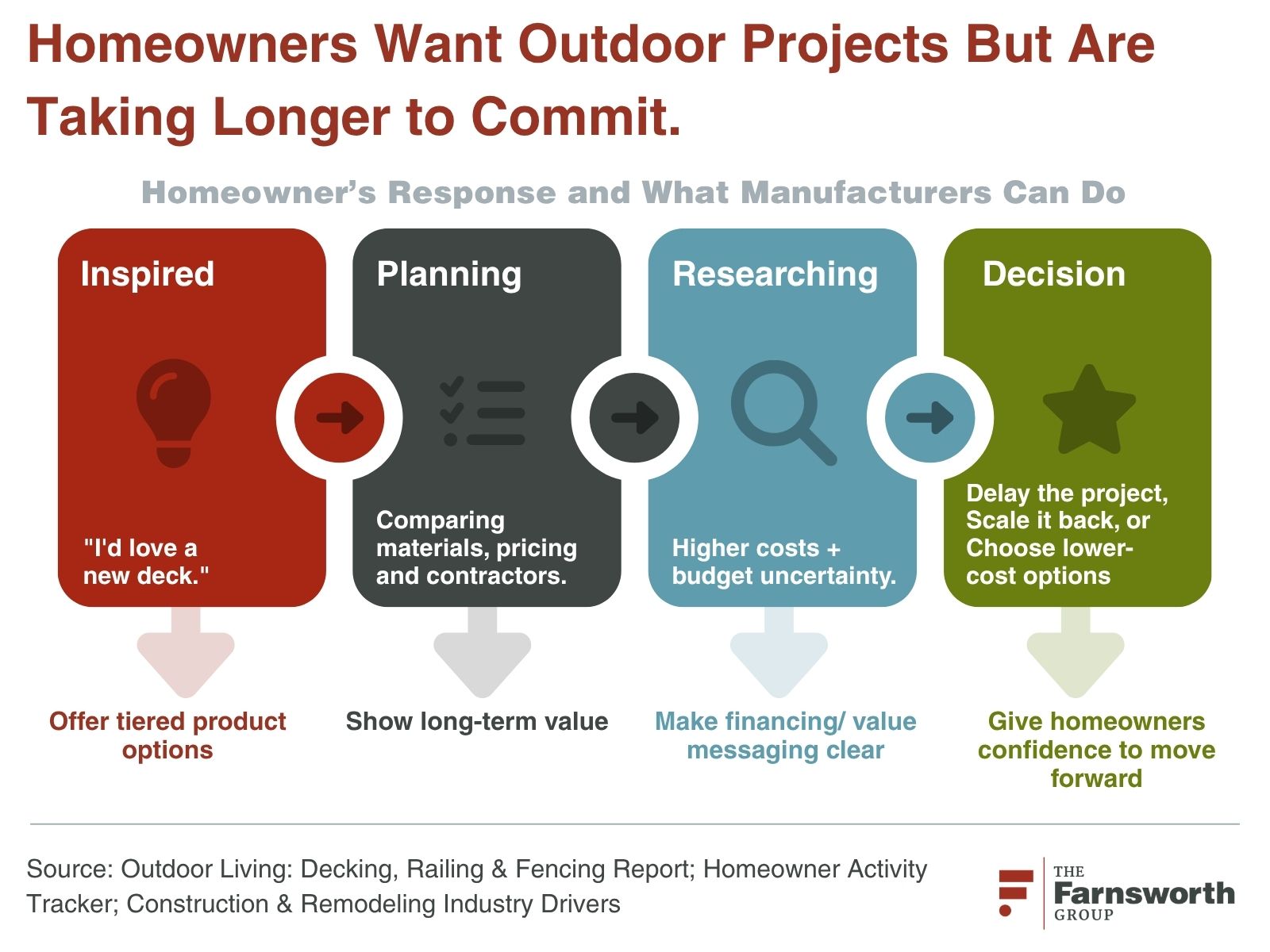
Homeowners remain motivated to improve their homes, but income growth continues to lag rising costs, keeping customers highly budget sensitive. Homeowner confidence is volatile, and they remain in a state of uncertainty, which causes postponed or trade-down activity, according to data from The Farnsworth Group’s Outdoor Living: Decking, Railing and Fencing Report. While homeowners want to do projects, they’re weighing their objects and being more deliberate with lower-than-normal disposable income. As a result, pros must provide value-oriented offerings that instill confidence consumer decisions.
Homeowners having the strongest positive sentiment toward starting a smaller home improvement project (in the $5K or less range), with 34% saying it’s a “good time” in quarter 4 of 2025. Additionally, project sentiment toward large projects is improving slightly. Only 40% feel now is a “bad time” to start a large-scale home improvement project (over $25K), which is at the lowest level in five quarters.
2. Decking and Fence Contractor Hiring Remains Consistent
While general contractors and plumbing contractors have the highest rate of being hired by homeowners, there has been consistency for hiring decking and fence contractors over the past year. About 7% of homeowners hired a decking/fence contractor in Q4 2025, compared to:
- 8% in Q3 2025
- 13% in Q2 2025
- 6% in Q1 2025
The increase in the second quarter of the year is in line with more homeowners starting outdoor projects in the spring and early summer.
When choosing decking, railing, and fencing projects, professionals rely most on their own judgement (32% of the time), with homeowners also carrying almost equal weight (29% of the time).
3. Homeowners Demonstrate Increased Need and Desire for Privacy and Safety
With a desire to have more outdoor living space, a need for privacy has become paramount for many homeowners. Having secure fencing, keeping pets and children safe, and being blocked from neighbor view are all wants from the homeowner that is driving the demand for fencing for new and existing properties.
Smart fences have become more popular to help with the safety and privacy concerns. Fences now have the technology to include sensors, remote access, alarms, integrated camera systems, and voice activation.
Along with an increase in demand among homeowners, a rise in demand for fencing around commercial buildings, universities, and educational buildings will also drive up the market size.
4. Weather Resistance is Top Factor Influencing Decking, Railing and Fencing Decisions
Homeowners have a couple primary reasons for continuing to purchase, install, or specify their preferred decking, railing, and fencing brand. The top factors influencing their brand choice for these product categories include:
- Weather resistance (50%)
- Homeowner preference (44%)
- Product availability (36%)
- East of installation (33%)
Professionals primarily use their preferred decking, railing, and fencing brand, only using a non-preferred brand 22% of the time. They would be willing to pay up to 20% more for products and materials before switching brands. Additionally, 54% would choose to go to a different supplier if their preferred supplier no longer carried their preferred brand.
Brands and suppliers must offer breadth and depth to provide pricing options and meet availability requirements. Both remain critical in a flat market, where budget and timelines matter.
5. New Technology Supports Customizable Aesthetic Options
With new technologies emerging in the decking, fencing and railing markets, homeowners have better access to options for creating aesthetically pleasing outdoor spaces. New fencing technologies allow for personal customization to reflect the homeowners’ style.
These can include geometric patterns, mixed materials, modular systems, light integrations, and even artwork and sculpture. Adding decorative fencing is also a way for the homeowner to increase the resale value of the home, a thought among many who are thinking of a move in the next few years. Railings have become more aesthetically pleasing in recent years to integrate more naturally with the decking and outdoor living spaces. Glass and cable railings are popular among homeowners, especially those that have integrated lighting systems.
As more homeowners in the U.S. are desiring integration with the outdoor world, allowing outdoor spaces to flow seamlessly to the outdoor environment is a growing need. Having natural woods, railings that blend into the background, and fencing that matches the current exterior of the home have become more popular.
What are Innovations in Railing and Fencing for Home Improvement?
The technological advances in the decking, fencing, and railing industries have and will continue to drive the increase in size of these markets in the U.S. in the next few years. These technological advancements are far reaching across various product categories and material types, giving homeowners and professionals increasing options when building new houses or remodeling existing properties.
Here is a look at some of the innovations in the decking, railing and fencing markets:
Advances in Composite Decking
- Advanced heat dissipation, which allows the deck to cool down more quickly (a top concern among those purchasing this type of deck)
- Use of anti-slip materials and manufacturing processes to ensure decking prevents falls (for example, designing with deep embossing and gripping finishes)
- Options that are more natural looking and wood-grain improvements
- An increase in color selections
- Material science advancements to combat fading and sun damage
Advances in Wood Decking
- Hidden deck fasteners to combat the water damage that is common among wooden decks
- Prefabricated deck piers that allow for same-day installation (saving time and money for homeowners)
- New types of joist tape to prevent premature decay
- Under-deck drainage systems to prevent water damage and mold concerns
Advances in Fencing
- Smart fences (voice activation, sensors, alarms, remote access)
- Innovative materials (particularly sustainable and eco-friendly materials, such as bamboo, recycled metal, and living green walls)
- Aesthetic fencing to reflect personal style and increase home value (patterns, mixed materials, sculpture, artwork)
Advances in Railings
- Advancements in production technology (3D-laser scanners for highly complex structures making customization easier and more affordable)
- Direct sales through websites to allow for easier ordering and lower prices
- Contractors having direct ties to manufacturers to get large volumes at low prices, passing those saving on to homeowners (allowing for new market penetration strategies and an increase in market share among professionals)
- Aesthetic railings that include LED light integration, cable, and glass material options
Drive Growth for Your Fencing and Railing Product Lines
As the market for fencing, decking, and railing evolves, it’s important to stay on top of specific trends, innovations, and market opportunities. Manufacturers who invest in custom research to identify the key industry drivers that will differentiate their products from competitors will have a leg up in this emerging market.
At The Farnsworth Group, we’ve helped hundreds of building products manufacturers, retailers, and industry associations go from a place of uncertainty about what to do next to a place of clarity in just a matter of months.
Our proven approach blends market intelligence consulting with primary market research to deliver actionable insights and grounded recommendations impacting your marketing and sales, brand, channel, and product teams. Because we work exclusively in the building, home improvement, and lawn and ranch industries, you can trust that our insights and recommendations take into account the complex variables that impact your end to end go to market situation in the complex building materials environment.

Frequently Asked Questions
What are the current trends in home improvement for decks and fences?
In 2026, homeowners remain interested in upgrading their properties, including their outdoor living spaces, but they are dealing with less disposable income, making them budget conscious. With a desire to have more outdoor living space, a need for privacy has become paramount for many homeowners. Having secure fencing, keeping pets and children safe, and being blocked from neighbor view are all wants from the homeowner that is driving the demand for fencing for new and existing properties. Additionally, smart fences have become more popular to help with the safety and privacy concerns.
What are the top materials used in modern railing systems?
The top materials used in modern railing systems include aluminum and composite, which are both frequently chosen for their durability and low maintenance. Additionally, vinyl is a popular railing material because of its budget-friendly performance. The Farnsworth Group’s Outdoor Living: Decking, Railing and Fencing Report explores current trends related to railing systems, as well as fencing and decking.
What factors are driving growth in the fencing market?
There are several factors driving growth in the fencing market, including residential construction and remodeling and repairs. Homeowners are driven by the desire to improve the functionality and aesthetics of their outdoor living spaces, as well as interest in safety and security through fencing installations. Having secure fencing, keeping pets and children safe, and being blocked from neighbor view are all wants from the homeowner that is driving the demand for fencing for new and existing properties.
