

Flooring contractors are experiencing a generally healthy operating environment in the final quarter of 2026, as they report consistent project pipelines and challenges consistent with other trades regarding labor and materials.
However, the size and scope of flooring projects have declined, along with revenues, when compared to other interior finish contractors and industry professionals as a whole. One factor that could be potentially contributing to this trend is the contraction of the new construction sector, where flooring contractors are more heavily utilized for large-scale installations.
Meanwhile, the remodeling sector has been stable over the past year, but homeowners are prioritizing maintenance and repairs over major renovations as budgetary and financial concerns heighten. They can also rely on their own skills to tackle these smaller projects as DIY.
As a building products manufacturer or supplier, understanding these evolving dynamics can inform decision-making around product development and marketing of flooring materials to meet the current demand for repairs and replacements driving the market.
What is the Outlook for the Flooring Sector?
Flooring contractors appear to have relatively healthy workloads, with longer average backlogs than finish contractors or contractors overall, but the composition of that work looks somewhat softer, based on findings from The Farnsworth Group’s Contractor Index for Q3 2026.
Flooring contractors are grouped with other finish contractors for the survey. It’s important to note that, as respondents, flooring contractors represent about 22% of the finish contractors represented in the survey. In all, 128 finish contractors took the survey, out of 561 total contractors. This is a relatively small sample size, so findings should be taken directionally.
Here are some notable insights from the report to give manufacturers and suppliers a deeper understanding of the flooring market heading into the final quarter of 2026 and the new year:
1. Flooring Contractors Have Consistent Project Pipeline
Flooring contractors appear to have work in the pipeline, but less momentum when it comes to the size and value of that work. For example, they are booked out an average of 11.1 weeks, compared with 9.6 weeks for finish contractors and 8.5 weeks for total contractors. They are also much more likely to be booked more than six months out, at 19% versus 11% among finish contractors and 7% overall. That difference is not statistically significant, but the pattern is fairly consistent.

2. Lead Generation is Softer, but Conversion is Not
Flooring contractors have lower reported lead volume and somewhat lower lead quality, but their actual ability to convert leads does not appear weak. For example:
- 48% of flooring contractors say their ability to close leads is improving, versus 42% of finish contractors and 35% overall
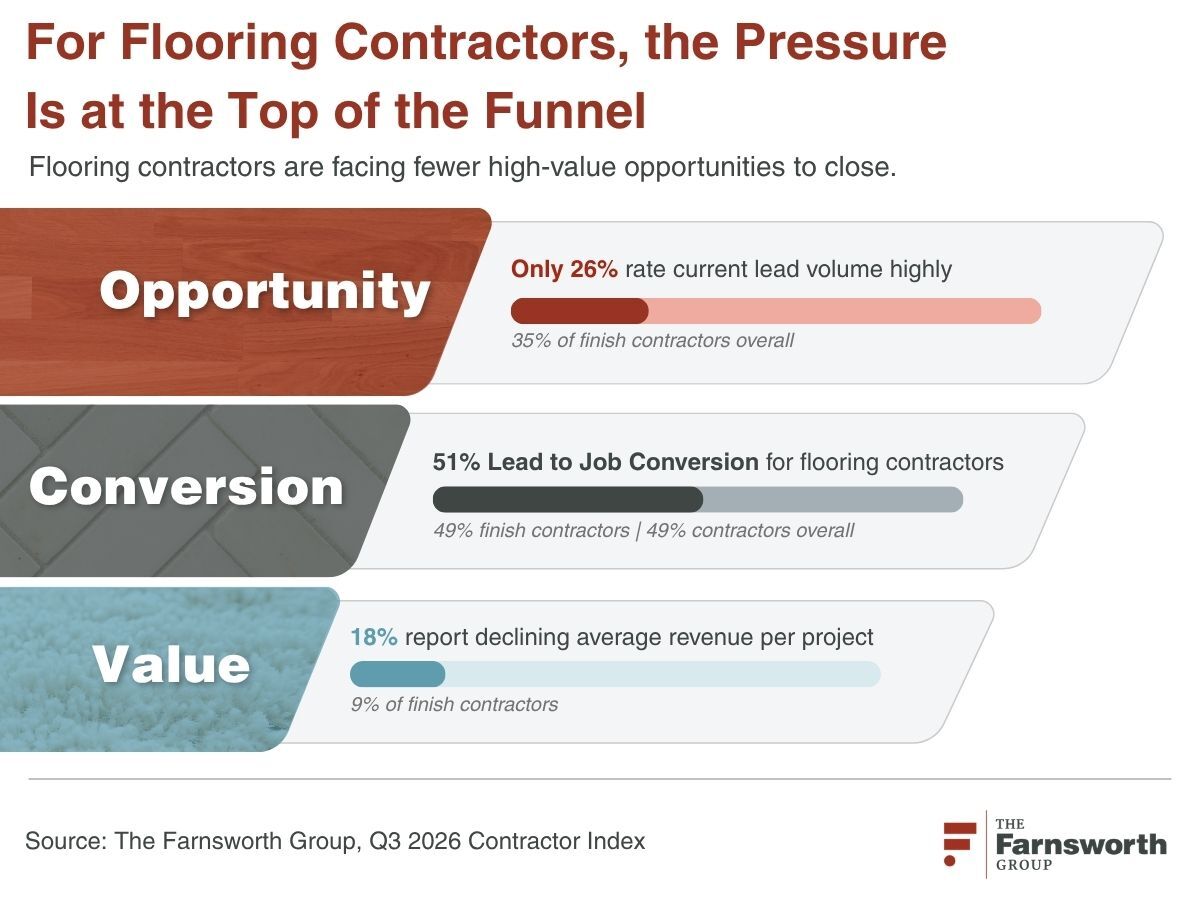
- Their average reported lead-to-job conversion is 51%, essentially identical to finish contractors at 49% and total contractors at 49%
- Flooring contractors report a 51% to 60% conversion rate at 90% confidence
This indicates that flooring contractors are not struggling to close business. The challenge seems related to the opportunity is coming through the funnel and the value of the jobs, rather than their effectiveness once they have a lead.
3. Size and Scope of Flooring Projects is Declining
Flooring contractors are more likely to report lower lead volume and a decline in the average revenue per project, according to data from Q3 2026.
Only 26% of flooring contractors rate their current lead volume highly versus 35% of finish contractors and 35% overall. Similarly, 57% are highly confident in getting new business over the next six months, compared with roughly 70% for both finish contractors and total contractors.
Additionally, approximately 18% of flooring contractors say average revenue per project has decreased over the past year, compared with only 9% of finish contractors. That difference is significant at roughly 90% confidence. This segment is also less likely to report growth in average project size. Only 27% say their average project size has gotten a little bigger over the past three months, compared to 42% among finish contractors (also at 90% confidence).
Taken together, these findings suggest the issue is not necessarily a lack of work. Flooring contractors may be carrying relatively healthy backlogs, but the value or scale of individual projects appears under more pressure than it is for the broader finish contractor group.
4. Operating Conditions are Generally Healthy for Flooring Contractors
Heading into the final quarter of 2026, operating conditions are relatively positive for flooring contractors. There is not much evidence that labor, materials, credit, or material-cost volatility are uniquely holding them back from growing their business or meeting demand for projects.
Based on responses in the Contractor Index, flooring contractors are:
- 62% confident in having enough labor, which is slightly above the average for finish contractors at 59%
- 59% highly confident credit is available, versus 55% among finish contractors
- 70% highly confident materials are available, compared with 76% among finish contractors
- 43% confident that material costs are stable, which is identical to finish contractors as a whole
Is the Contraction of New Construction Segment Affecting Flooring Contractors?
Flooring contractors skew somewhat differently in the type of work they perform. Their work averages about:
- 71% residential (compared with 76% for finish contractors and 78% of total contractors)
- 36% new construction (compared with 34% among finish contractors and 24% overall)
- 39% remodel, essentially identical to finish contractors but below total contractors at 47%
That higher exposure to new construction could potentially explain why their business outlook looks a little softer than the broader finish contractor group, as new construction has been notably slow over the past year, especially in the single-family market, based on research from The Farnsworth Group’s Industry Drivers and Forecast Report. New home inventory is above healthy levels, which is not only causing a decrease in median new home prices, but also deferring new single-family starts. Multi-family construction has benefited from earlier shifts toward rental housing, though demand is stabilizing.
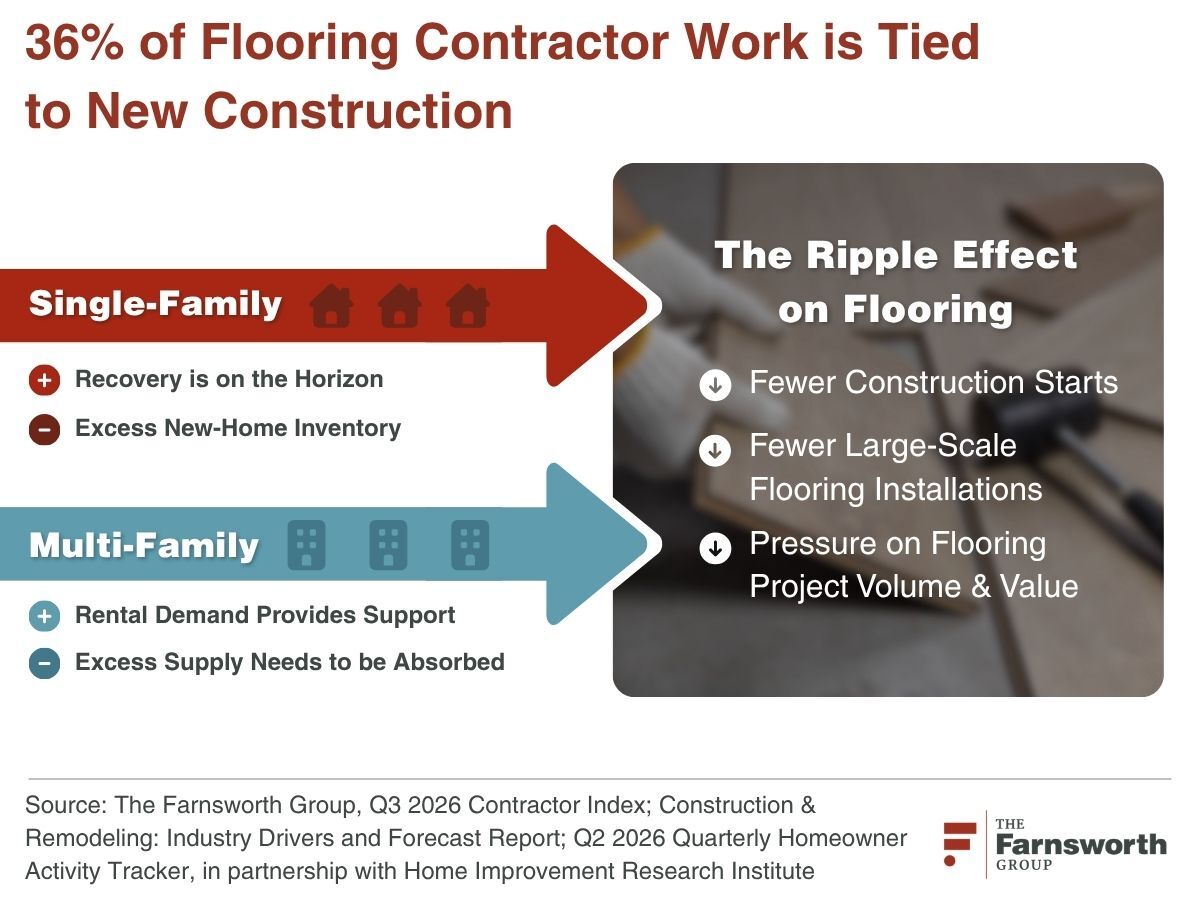
Single-family starts are projected to decline again in 2026 and stabilize in 2027 as financing conditions gradually improve. Multi-family starts are expected to again increase substantially in 2026 as household formations continue, then level off into 2027. Near-term growth remains mixed, with gains expected to be modest.
This is not the only dynamic influencing the sentiments and expectations of flooring contractors. There are a variety of other contributing factors and implications, as well. However, since their lead conversion, access to labor, financing, materials and other operating conditions remain generally solid, it suggests the pressure is more on the volume and value of future opportunities than on their ability to execute work.
What Flooring Projects are Driving Project Demand in 2026 and 2027?
Overall home improvement project activity fell to its lowest level since tracking began, based on findings from The Farnsworth Group’s and HIRI's Quarterly Homeowner Activity Tracker for Q2 2026. Maintenance is the biggest driver of demand, with 76% of homeowners completing a maintenance project in Q2. Meanwhile, 63% of homeowners completed repairs (down from 69% in the same quarter of 2025) and 36% did home renovations (down from 38% in Q2 2025).
The main challenges that homeowners face when tackling projects include:
- Cost (45%)
- Finding the products (15%)
- Project timelines (15%)
Budget/financial reasons are the dominant reason when it comes to why homeowners postponed or canceled projects in Q2 2026. It is also influencing them to scale down projects and to prioritize maintenance and repairs aimed at keeping their homes functional, rather than discretionary activities.
Looking ahead, interior projects—which include flooring repairs, maintenance, and renovations—have the intention, with 69% of homeowners planning an interior project for the next 12 months.
Flooring projects also have a moderately high level of DIY participation. Based on findings in our recent Industry Drivers and Forecast, about 40% of flooring, carpeting, and paneling projects are completed as DIY. The average cost of these projects hovers around $2,000.
Market Forecast for Flooring Products and Materials
The Home Improvement Research Institute (HIRI) also provides detailed data about flooring-related projects and materials for its members. For example, HIRI’s quarterly U.S. Home Improvement Products Market Forecast shows fairly similar growth rates for both soft- and hard-surface floor coverings from 2026 to 2030, although, when adjusted for inflation, the soft-surface flooring segment has experienced negative growth in the previous period, from 2020 to 2025. HIRI’s forecast shows higher growth in both categories for the consumer market compared to the professional market in the coming years.
Hard-surface floor coverings include:
- Hardwood flooring
- Tile
- Sheet goods
- Other hard-surface floor coverings and accessories
Soft-surface floor coverings include:
- Textile floor coverings and accessories
Additionally, HIRI’s Quarterly Homeowner Project Activity Tracker shows that flooring products and materials are consistently in the top three categories for interior finish when it comes to homeowner demand. Demand for flooring tends to heighten during the third and fourth quarters of the year.
Conducting Market Research to Strategize for the Flooring Market
Contractor sentiment provides a helpful lens for viewing the overall state of the flooring market and its projected growth over the next few years, as well as what challenges and trends to keep an eye on. However, the best way to gather nuanced data pertaining to your particular brand and customer base is through custom market research. The Farnsworth Group can work with your team to explore potential market opportunities, customer usage and attitudes around flooring materials, and actionable insights for product development. Schedule a consultation to learn how digestible insights will help you grow your market share.

Frequently Asked Questions
What is the current outlook for flooring contractors?
Future workloads and project pipelines for flooring contractors look healthy over the next 12 months, but the work itself is softer. Flooring contractors are booked out an average of 11.1 weeks, compared with 9.6 weeks for finish contractors and 8.5 weeks for all contractors, based on data from The Farnsworth Group's Quarterly Contractor Indez. Their lead volume and confidence in winning new business are lower, though.
Are flooring project sizes and revenues declining?
Flooring contractors are more likely to report lower lead volume and a decline in the average revenue per project, according to data from The Farnsworth Group of Q3 2026. About one-fifth of flooring contractors say average revenue per project has dropped over the past year, compared with 9% of finish contractors. Only 27% report bigger average project sizes. These findings suggest the challenge facing flooring contractors is not necessarily a lack of work. However, the value or scale of individual projects appears under more pressure than it is for the broader finish contractor group.
How is the slowdown in new construction affecting the flooring market?
About 36% of flooring contractors' work is new construction, compared with 24% for contractors overall. That higher exposure to new construction could potentially explain why their business outlook looks a little softer than the broader finish contractor group, as new construction has been notably slow over the past year, especially in the single-family market, based on research from The Farnsworth Group’s Industry Drivers and Forecast Report. In general, overall home improvement activity has been on the decline in 2026 as homeowners face a variety of challenges, including cost, finding the products they need, and project timelines.
What flooring projects are driving demand in 2026 and 2027?
The flooring projects that are driving demand in 2026 and 2027 are maintenance and repairs, as homeowners are watching their budgets. Interior projects—which include flooring repairs, maintenance, and renovations—have the intention, with 69% of homeowners planning an interior project for the next 12 months, based on data from The Farnsworth Group and HIRI's joint Quarterly Homeowner Activity Tracker. About 40% of flooring projects are done DIY, at an average cost of around $2,000.


Written By
Eric Voyer
Eric brings nearly 30 years of experience in market research, business development, and strategic consulting within the home improvement, building products, and outdoor industries. He spent decades in syndicated research for consumer durables, where he helped leading brands turn complex data into actionable insights that drive growth. Eric's expertise spans both quantitative and qualitative methodologies. At The Farnsworth Group, Eric focuses on client engagement, project design, and strategic storytelling to ensure insights lead to clear, confident decisions.
Originally from Orlando and now based in Louisville, KY, Eric studied Business at Transylvania University, where he also competed as a collegiate goalkeeper. Outside of work, Eric still enjoys playing soccer, loves to Ski and Scuba and has a new passion for playing ice hockey.

Written By
Grant Farnsworth
Grant has worked on every area of market research at some point – coding paper surveys, running tabs, programming surveys online, getting sample, managing fielding, generating reports and preparing analysis and presentations. Grant has been working with The Farnsworth Group since he was a teenager, learning the craft of custom market research and how to uphold the highest of standards in research design and data collection.
For the past 20 years, Grant has been involved with various associations, trade shows, committees, publishers, manufacturers, retailers, and suppliers in the home improvement, lawn & ranch, and building products spaces. For Grant, one of the most satisfying feelings is to know they helped a client to succeed when he sees the results of The Farnsworth Group work on store shelves, on new homes, and in the homes of friends and family. Based in Denver, Grant is a music buff who believes that life should be fun. In all his pursuits, Grant’s sincerest appreciation goes out to his wife – the most kind and patient person on earth.

Written By
Rachel Lampe-Sedgwick
Rachel brings a wealth of experience in visualization and storytelling to her role. With a strong background in design and a passion for creating compelling narratives, Rachel excels in delivering high-quality visual content and reporting that enhances client communication and engagement.
Her expertise spans a range of design and reporting tools, and she is known for her ability to work cross-functionally, ensuring consistency and excellence across all deliverables. Rachel’s creative approach and dedication to producing best-in-class visualizations align perfectly with The Farnsworth Group’s commitment to innovation and impactful storytelling. Her work has been recognized for its clarity and effectiveness in conveying complex information.
Based in Grand Rapids, Rachel enjoys bouldering, golfing, playing video games, sipping tea, and listening to Funk or Jazz music in her free time. You may meet her two cats, Milo and Willow, during a virtual call!