

The current economic situation is currently putting a strain on individuals and industries across the United States, which has a direct impact on the housing market and for building product manufacturers and suppliers.
Based on a variety of indicators, 2027 may feel similar to 2025 and 2026, with incremental growth anticipated in many categories as incomes struggle to keep pace of inflation, disposable income remains low, and interest rates show no signs of going down. Gains may once again come from cost increases and less from unit increases.
To prepare adequately, both for 2027 and beyond, building products and home improvement manufacturers must gain insight into emerging market trends and the current attitudes and behaviors of customers, both DIYers and industry professionals alike. That will enable your product development, channel, brand, and marketing teams to plan accordingly and make adjustments to account for factors impacting product selection. It will also equip your teams with the necessary intel to best position your products in annual line reviews.
What to Include in Your 2027 Strategy
As your internal teams strategize about product development, marketing efforts, and distribution for the upcoming year, our team at The Farnsworth Group recommends you make the following a priority:
- Understanding current demand and what is impacting opportunities
- Updating your merchandising strategy amid ongoing price sensitivity
- Focusing on nurturing brand loyalty in a slow-growth market
- Investing in understanding customer behaviors: who is buying, how, where, why
Let's dig deeper into why these four focuses should be core to your go-to-market strategy and the efforts of your teams.
1. Understand Where Demand is Coming From in 2027 and Beyond
A significant portion of demand is coming from maintenance and repair activities on existing housing stock, and all indicators continue to point towards repair and remodel activity driving building product sales in 2027 as well.
The current market conditions are still facing a degree of uncertainty such that depending on your product category and customer segments, you may hear a range of views and predictions. Spend enough time, and you'll likely hear various housing market commentators support conflicting cases using similar data.
So, what should you trust? We look at various market factors, and from those fundamentals, our position has been, and remains, that the existing home market represents more opportunity for growth amid new single family construction constraints. Particularly those larger, contractor related existing home projects.
Current Housing Demand and Supply
To begin with, housing demand remains intact. Household formations have slowed in 2026, compared to being relatively strong most of 2025. Slowed growth in household formation is related to affordability challenges. However, the average age of the first-time homebuyer is now 40 years old according to the National Association of Realtors, meaning a large portion of the Millennial generation is yet to hit the median first-time homebuyer age. Future home buyers are waiting in the wings.
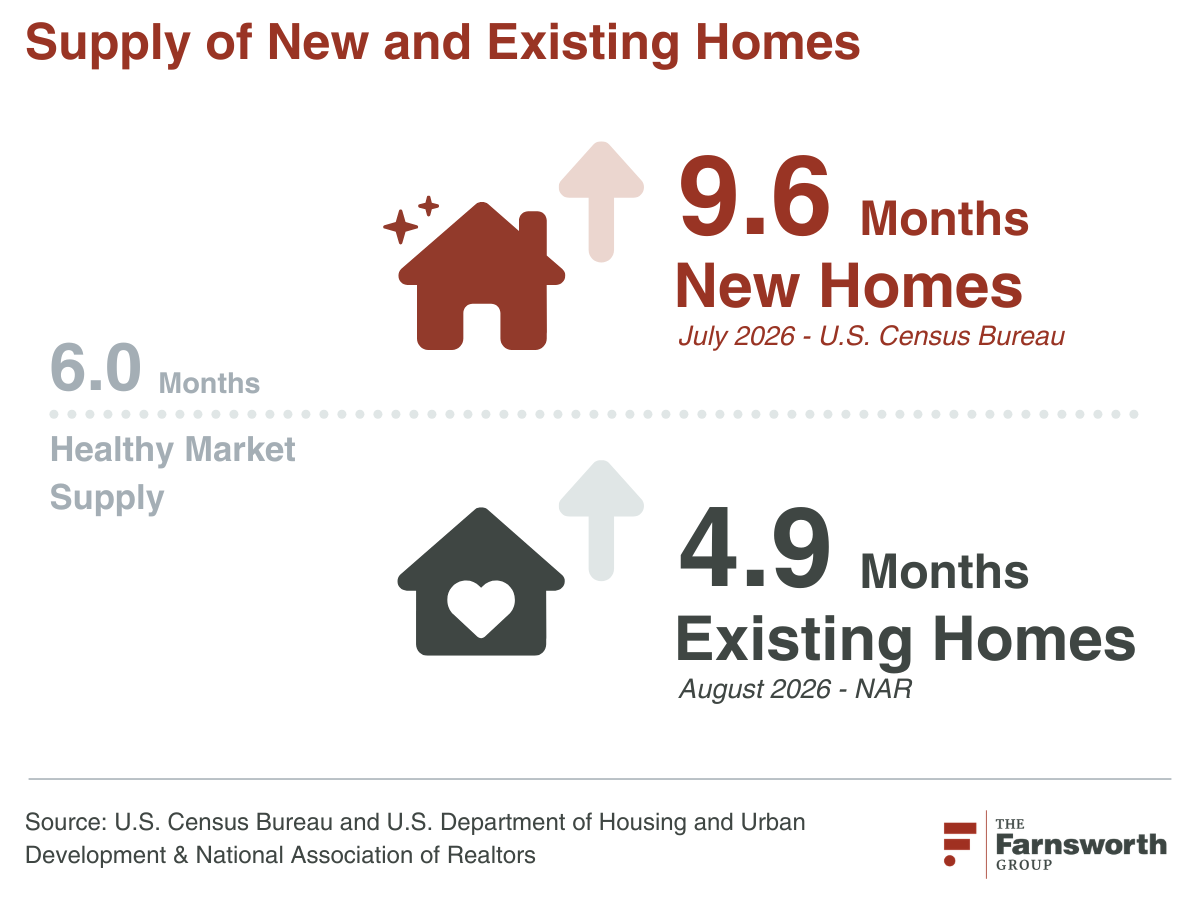
The national existing supply of resale homes is nearly a five-month supply, relatively constant compared to the past two years, based on data from the U.S. Census Bureau and the National Association of Realtors (NAR), but higher than the two- to three-month lows experienced for much of 2023 and 2024. Inventory remains highly regional or MSA based as we see certain markets with increasing supply and therefore declining home values. A once robust "sellers" market is now shifting towards a "buyers".
In contrast, the National supply of new homes is between a 9 to 10 month supply, up from this time last year and similar to the 10-month spike in 2022. Higher new home inventory creates more aggressive tactics to move inventory and causes builders to defer new starts.
Our New Construction and Remodeling: Industry Drivers and Forecast report also shows that houses are spending about 60 days on the market currently, which is comparable to pre-pandemic levels when days on the market hovered between 60 to 65 days.
Are Houses Becoming More or Less Affordable?
Based on the National Association of Realtors' (NAR) Housing Affordability Index, which measures whether a typical family earns enough to qualify for an average home, housing affordability has improved slightly compared to the trough experienced in 2023 and 2024.
However, the index has been sitting between 102 to 105 (value of 100 means that a family with the median income has exactly enough income to qualify for a mortgage on a median-priced home). This means median incomes are only slightly above qualifying requirements. Looking into NAR's measure, and we see affordability is worse in the Northeast and West with index values of 87 and 79 respectively. Meaning, median household incomes in the Northeast and West are not able to afford an median priced home in those markets.
Affordability is still constrained because of high home prices, higher and holding interest rates. Furthermore, consumer confidence dropped to 47.8 in September 2026, down 7.5% from August 2026 and down 13.3% compared to this time last year based on the University of Michigan Consumer Sentiment Index. With the continued decline in consumer confidence that started in January 2025, housing stock is not moving as it was in years prior, particularly the rush of 2020 and 2021.
Is the Lock-In Effect Resolving or Getting Worse?
As of the end of September 2026, the lock-in effect continues to be stubbornly entrenched, and could even be worsening since the Feds Fund Rate increased by 25 basis points in September, and may increase further in October and December. As of now, they are firmly in the upper 6.7% to 7% range. In addition, the 10-year Treasury reached it's highest point in September since June 2007. This has driven 30 year mortgage rates to recent highs of over 7%.
49.9% of homeowners with mortgages have interest rates below 4% (down from a record 65% in Q1 2022 and the lowest since Q4 2020). The number of mortgages outstanding with rates below 4% has been declining as more of the mortgages get paid off and recent home buyers take on higher rates. 77% of mortgage holders have a rate below 6%, down from a record 92.7% in the second quarter of 2022.
However, an estimated 30-40% of homeowners are without a mortgage, an all-time high. That, combined with high home equity, represents a more mobile segment better insulated from high rates and less impacted by affordability concerns. Rising housing inventory suggests the lock-in effect remains as there are more sellers than buyers, and many buyers hesitate to make a move until mortgage rates AND home prices fall.
Forced moves due to changing life circumstances and major life events (job changes, marriage, divorce, children) are causing some older loans to clear off the books. However, overall mobility rates continue to decline as we saw 20-year mobility lows in 2025 according to U.S. Census data.
While there had been hopes that small basis point decreases would be rolled out by the Fed in 2026, that has not been coming to pass. As a result of these inflation-cooling measures, the pool of available home buyers is also anticipated to remain tight until the cost of debt declines and more individuals and families are able to qualify for a mortgage.

Aging Housing Stock and Low Mobility Rates Create Demand for Repair and Remodel Activity
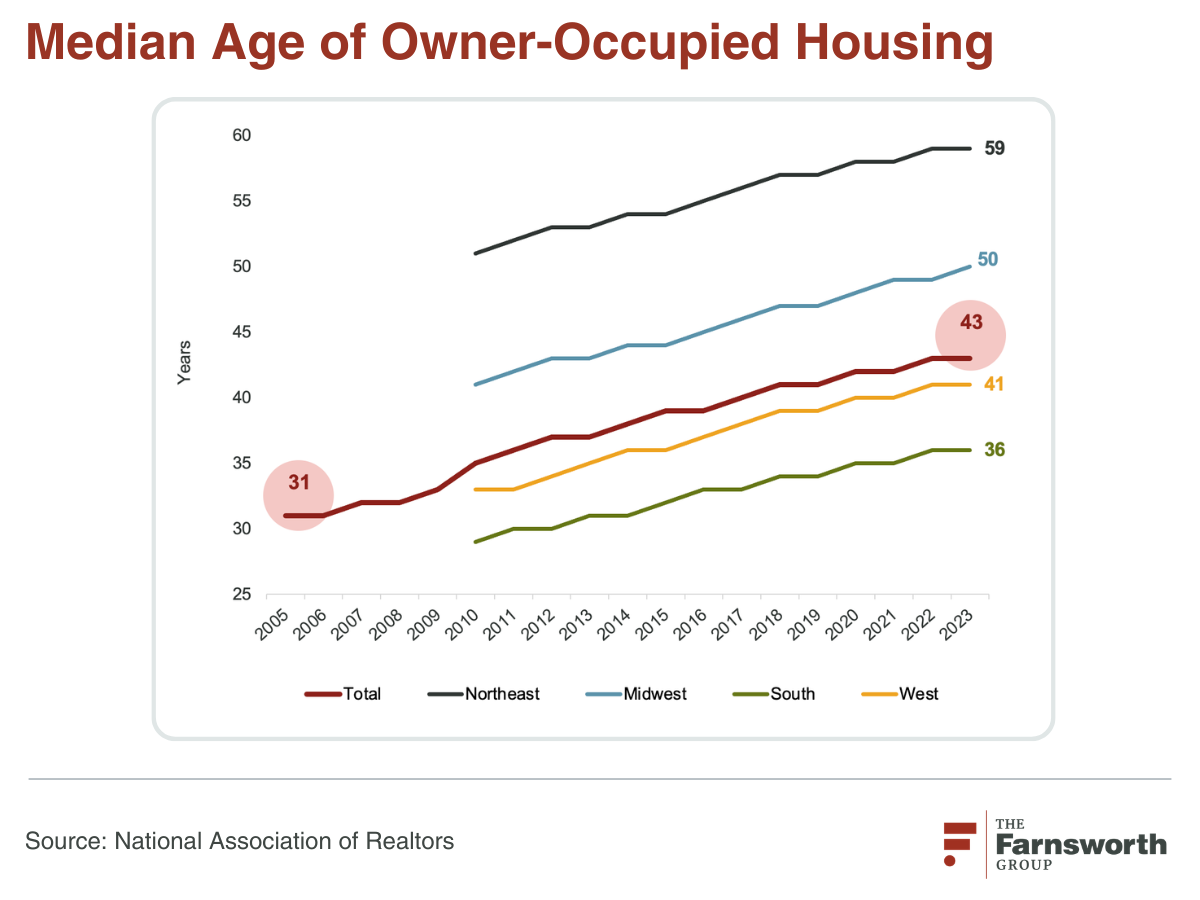
All the while, the national median home is now more than 44 years old, national equity is at record highs of more than $34 Trillion, and fewer people are moving. 47% of owner-occupied stock is 45 years or older; only 13% was built in the last 14 years.
In fact, U.S. household mobility rates have been on a long-term decline for decades, hitting an all-time low of 11.2% in 2024 according to U.S. Census and Harvard's Joint Center for Housing Studies. This means just over 1 in 10 households moved, a stark drop from higher historic averages.
People staying put longer in older homes has paved the way for increased maintenance, upgrades, and efficiency improvements. History shows that repair and maintenance categories are significantly less volatile than new construction in uncertain or sluggish markets. While larger remodel projects that use discretionary dollars may face more deferral as homeowners secure funding and gain confidence.
With more homeowners staying put and substantial equity in their homes from large home value gains from 2020 to today, individuals will continue to turn to contractors and home improvement professionals to complete larger renovation projects to make their home compatible with their evolving lifestyle and what they desire for the next phase of their life.
2. Update Your Merchandising Strategy
A strong merchandising strategy is made up of three primary components: What you should make, where you should sell it, and how you should price it. Generally speaking, building product manufacturers and suppliers that address availability constraints, while reducing internal costs to stabilize retail pricing, and offer clear value propositions are able to increase market share. A key reason for this is the current budget sensitivity of homeowners and their reduced confidence in spending on high dollar projects or products. This market reality is expected to continue into 2027.
Consumer confidence has weakened and expectations have softened considerably over the past year, to levels not seen decades. This is due to a combination of factors, from the rising cost of living and inflation to uncertainty surrounding the United States’ volatile trade policy and fears of recession to geopolicial conflict involving the U.S. Our team has proven that changes in consumer confidence impact home improvement spending. Lower confidence month-to-month or quarter-over-quarter has a high correlation to lower spending among consumers when it comes to investing in remodeling or home buying. Currently, about three-fourths of customers believe it’s a bad time to buy a home.
"When conducting strategic planning for 2027, value proposition will remain a key theme. Your teams need to continue evaluating internal pricing strategies against market demand to create appealing product mixes across the value continuum that deliver at different price points. Breadth of offerings that scale with your value proposition will ensure your customers have options to meet budget constraints." - Grant Farnsworth, President of The Farnsworth Group
We've heard over and over during our market research studies and strategic insight sessions in recent years that homeowners and contractors alike made changes to product, project, brand, or supplier because of pricing and availability pressures. That $100K remodeling project became a $75K project because of rising costs to borrow money and inflationary pressures on budgets. Homeowners have continued citing "Budget" as the biggest challenge with their home improvement, maintenance or repair project, much more than other challenges, such as project timelines, finding a contractor, or product knowledge.
Intent to Complete Home Improvement Projects Continues
We've tracked this topic since 2023 and continue to do so in our Quarterly Homeowner Activity Tracker in partnership with The Home Improvement Research Institute (HIRI). What we found is that intent to complete home improvement projects costing less than $5,000 has remained strong quarter over quarter despite headwinds. This is true across different generations and income demographics. This makes sense given that repair and maintenance projects are driving a large share of building material sales currently.
Many homeowners (particularly those not in the luxury market) are having to make concessions and that is putting contractors on their back foot to really focus on cutting material costs or provide options to win the project bid and keep their businesses running at a decent profit margin.
Provide Product Mixes That Allow for Value-Engineering
Additionally, many customers are looking for options and are often scaling down in your product mix without having a compelling reason to pay for the higher tier product. Look at your Product Development pipeline. Make sure you understand which features are critical, versus which are value-add features that can command a premium.
Your next move should be to provide SKUs that cover your bases from good, to better, and best at varying price points. Use custom market research on your unique customer base to find out directly from them what they value and how much by letting that data inform your merchandising and pricing practices in 2027. In a flat or down market, taking share is the key for your growth. Value propositions with clear benefits that align with customer needs will be critical for success.
Once you have these data-based insights, use them to your advantage in product line reviews. Suppliers are demanding more and more that you be the category captain and come to any review armed with information to support your case for increased shelf space, or a reason to promote your brand over another.
One other note: Focus your sales forecasts on unit sales rather than dollars to benchmark your performance metrics.

3. Work to Reduce Brand Switching Among Customers, Especially Pros
As homeowners remain budget sensitive and demand becomes more selective, contractors are experiencing increased competition among each other for available jobs. This may compress margins, extend bid cycles, and create revenue uncertainty-even for firms with solid backlogs.
Contractors still largely anticipate that the home improvement market will grow in the next 12 months and that their revenue will grow, based on findings in our Quarterly Contractor Activity Tracker, prepared with The Home Improvement Research Institute (HIRI). Sentiments were gradually improving throughout 2025, but optimism has declined for three straight quarters signaling increasing challenges as consumer sentiment continues or worsens. Looking ahead, all signs point toward cautious optimism as competitive pressure increases, with efficiency, technology and sustainable materials being primary drivers of growth.
In this competitive environment, your goal is to maintain your customer base despite ongoing levels of brand switching behaviors among pros and homeowners through 2027 as well.
Ways to Reduce Brand Switching
Brand shifting has been a trend over the past few years – both among DIY homeowners and industry professionals – driven by budget, availability, and quality. They are also using multiple suppliers and multiple buying methods, both online and in-store, based on our 2026 Building Products Customer Guide. And when pros do decide to switch to a new supplier, it’s often because the new supplier has the products they need in stock, better prices, and better delivery options. The opportunity for you? Nailing that perfect mix of in-store convenience and online flexibility to meet the evolving needs of home builders and remodelers.
.png)
Building product manufacturers and home improvement suppliers should focus on quality, reliability, and product variety in their messaging to increase loyalty among pros. It’s about value propositions and options in a tighter, more competitive market, where buyers are more budget-sensitive. Make sure your online presence delivers and reiterates what’s in stores, and meet your customer where they are by allowing options on how to purchase.
Different product categories are expected to grow at different rates. For specifics on your product category, we recommend you become a member of The Home Improvement Research Institute (HIRI), which makes product category specific size of market forecasts available to its members multiple times per year. Learn more >
Your Product and Channel teams should be working to refine your SKU mix to cover good, better, and best options to help prevent your homeowner and Pro customers from switching brands and making it more logical for them to remain loyal to your brand within their project’s budget constraints.
To this end, your Brand and Marketing teams should be working to understand your Brand Health. This is feedback from product buyers that provides your organization with critical metrics on brand awareness, consideration, use and perceptions. By tracking your Brand Health over time, you’ll be equipped with insights needed to know where you must focus in the sales funnel, and what changes may be needed to drive loyalty. This may be marketing spend to create awareness or service elements that drive loyalty and preference.
4. Continually Invest in Understanding Your Customers
The worst kind of scenario you face is losing market share because of a lack of information, which leads to taking the wrong actions and losing relevance among your customer base. Remember, it can take decades to recover market share that was lost over just a year or two, so tread carefully.
Understand Your Customers' Path to Purchase
As you compete in 2027, you want to make sure your dollars are well spent, and that means investing them in specific activities based on reliable data and insights. You need to hear directly from your customers about which resources they use to conduct project and product research specific to your category during their path to purchase.
Use the information you have gathered that sheds light on customer product uses, attitudes toward the project and product, and purchase behaviors to prepare your product roadmap, distribution strategy, marketing communications, and media investments for 2027. Know who to target, what to say to them, where to say it, and when to say it.
Invest in Building Customer Confidence
Also, understand that, as they have been for over a year now, consumers are still suffering a lack of confidence because of uncertainty regarding the economy, high mortgage rates, and the cost of home improvement materials among other cost-of-living increases. What you communicate and how based on what is impacting their behaviors in the current environment is critical for maintaining and gaining share in competitive markets.
Qualitative and quantitative customer usage and attitude (U&A) research will provide you with this information. We recommend you first lean into qualitative research to understand more deeply what is influencing customer behaviors, especially as market conditions are shifting. This should be followed with Quantitative research to validate finding and provide statistical relevance of various activities.
What are the Next Steps for Your Teams to Advance Sales in 2027?
To keep products moving this year and next, building products, home improvement, and lawn & garden companies will have to compete for market share and present a strong value proposition to more price-sensitive customers.
If you are plagued with questions about what’s going on in the mind of your customers, how your brand health is faring, and what kinds of markets you should be targeting to achieve YoY company growth, our research team at The Farnsworth Group is here to help.
For nearly 40 years, manufacturers and suppliers have trusted our primary research team to gain deep insights in their customers’ behaviors, their go-to market strategy opportunities/risks, and their overall market presence.



Written By
Grant Farnsworth
Grant has worked on every area of market research at some point – coding paper surveys, running tabs, programming surveys online, getting sample, managing fielding, generating reports and preparing analysis and presentations. Grant has been working with The Farnsworth Group since he was a teenager, learning the craft of custom market research and how to uphold the highest of standards in research design and data collection.
For the past 20 years, Grant has been involved with various associations, trade shows, committees, publishers, manufacturers, retailers, and suppliers in the home improvement, lawn & ranch, and building products spaces. For Grant, one of the most satisfying feelings is to know they helped a client to succeed when he sees the results of The Farnsworth Group work on store shelves, on new homes, and in the homes of friends and family. Based in Denver, Grant is a music buff who believes that life should be fun. In all his pursuits, Grant’s sincerest appreciation goes out to his wife – the most kind and patient person on earth.