
For home improvement retailers, the defining characteristic of the 2026 holiday shopper may not be whether they are willing to spend. It is how carefully they decide where that spending goes.
The holiday season is arriving at a time when homeowners are still investing in their homes, but many are prioritizing more deliberately, delaying discretionary projects and scrutinizing individual purchases more closely.
That does not necessarily point to a weak holiday season. Instead, it creates an environment where retailers that clearly demonstrate value, make purchasing easier and give customers confidence in their decisions may be best positioned to capture available demand.
For independent home improvement retailers, that can mean leaning into expertise and personal service. For larger retailers, it can mean using breadth of assortment, digital capabilities, financing options and convenient paths to purchase to reduce friction. Across the retail landscape, the common challenge is the same: helping a cautious customer feel comfortable moving forward.
A More Deliberate Holiday Shopper
Home improvement activity has softened over the past year. The Farnsworth Group and Home Improvement Research Institute’s Q2 2026 Homeowner Project Activity Tracker found that 38% of homeowners completed a home improvement project during the quarter, down from 44% in Q2 2025. Among projects completed, 76% were home maintenance-related, compared with 36% involving renovation.

“The story of this holiday season is a more deliberate customer,” says Karen Barnes, senior advisor at The Farnsworth Group. “Homeowners haven't stopped spending, but they're being more selective about where and how. Our research shows maintenance and necessity-driven projects remain the most consistent category of activity, the things people do regardless of economic conditions, while bigger discretionary projects are more likely to get pushed to ‘someday.’”
That selectivity matters because there is still substantial demand beneath the surface.
More than one-third of homeowners who started a project this year ultimately postponed or canceled it, most often citing financial concerns. Nearly three-quarters also have a project in mind that they simply have not started yet.

For retailers, that means many customers are not abandoning home improvement. They are waiting until the purchase, timing or economics feel right.
This changes the retail challenge. Rather than always needing to generate new demand, retailers have an opportunity to unlock demand that already exists by reducing the uncertainty and affordability challenges surrounding a purchase.
Value Does Not Necessarily Mean Lowest Price
Purchases tied to necessity, upkeep or clear functional value tend to hold up better when household budgets are squeezed. Big-ticket, purely discretionary projects are more likely to be delayed.
But retailers should be careful not to translate a more cautious consumer into a consumer who will automatically choose the cheapest product.
Quality and durability continue to rank among the leading purchase drivers for homeowners and can rank above price, particularly among younger buyers. That creates an important distinction between low price and strong value. A customer may still choose the more expensive option if the retailer can clearly explain why it lasts longer, performs better or solves the problem more effectively.
Provide Good-Better-Best Product Mixes
This is where merchandising, product information and employee expertise can work together.
Retailers can make it easier to compare good-better-best options, explain meaningful product differences and show shoppers where upgrading or trade-offs may be worthwhile in their specific use case. Project-based bundles can help customers understand what they need to complete a job while reducing the risk that an important component will be forgotten.
Larger retailers may also be able to use financing options, broader assortments and promotional bundles to make purchases easier to justify. Independents can provide many of the same confidence-building benefits through highly personalized recommendations and deeper product knowledge.

In either case, the goal is not simply to make something cheaper; rather, it is to make the value easier to understand.
Different Retailers Have Different Opportunities to Reduce Friction
The more deliberate the purchase, the more important it becomes for retailers to remove uncertainty at each stage of the buying journey.
Retailer websites remain the most-used research and shopping channel across every generation, ranging from roughly 59% of Millennial and Gen Z DIYers to approximately 79% of Boomers. Digital research is now firmly embedded in the home improvement path to purchase.
Younger buyers are also directing more of their spending toward channels such as Amazon compared with older generations, while big-box retailers continue to capture the largest overall share of wallet.
For large retailers, this makes the connection between digital and physical retail especially important. Product comparisons, inventory visibility, fulfillment options and consistent information across channels can help a customer move from research to purchase without unnecessary friction.
Yet digital does not eliminate the value of the store.
“For independent retailers specifically, we'd expect them to skew more in-store than the broader retail category overall because independents’ advantage if often expertise and personal service, differentiators that are harder to replicate online,” says Grant Farnsworth, President of The Farnsworth Group. “And that matters even more to a customer who's being more careful with each purchase this season.”
That observation points to a broader lesson for retailers of every size. The store creates value when it answers questions the customer has struggled to resolve elsewhere, questions like,
- Is this the right product for my particular situation?
- Do I actually need the premium version?
- What other materials will I need to finish the project?
- Can I use a less expensive alternative without sacrificing performance?
For independent retailers, knowledgeable employees and personal relationships can be major competitive advantages in answering those questions. For larger retailers, the opportunity is to ensure scale and convenience do not come at the expense of useful guidance.

Expect Different Customers to Experience the Economy Differently
Retailers should also avoid treating economic uncertainty as though it affects every household equally.
We remain in a segmented spending environment, in that higher-income households, particularly those in the top 20%, continue to spend more freely and account for roughly half of home improvement spending. Other households are watching their budgets much more closely.
That divide is likely to appear in purchasing behavior this holiday season. One shopper may continue to prioritize premium quality, convenience or a product upgrade. Another may be trying to accomplish the same project at the lowest practical cost.
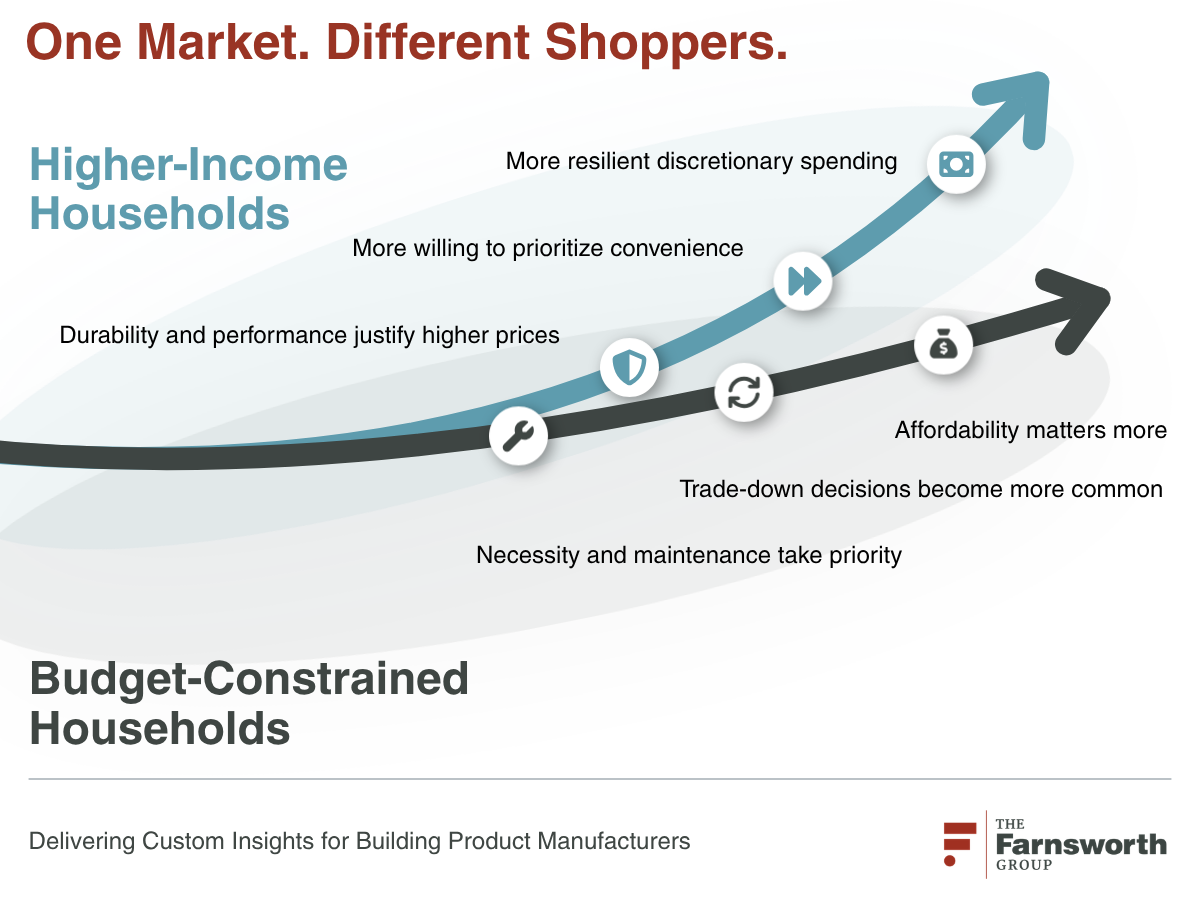
Retailers that clearly present options at multiple price and performance levels can serve both customers without forcing either toward a solution that does not fit their needs.
The lesson is particularly important when planning promotions. Bear in mind, that a value message does not have to mean one universal discount strategy. Value may mean affordability to one household, while it means durability, convenience or long-term performance to another.
Project Mix Matters During the Holiday Season
Retailers should also consider which home improvement projects tend to remain active during the holiday period.
Yard, garden and landscape activity typically falls during the fourth quarter. In the fourth quarter last year, 26% of homeowners completing a project reported doing an outdoor project.
Bathroom and kitchen projects, by comparison, remain popular throughout the year because they are less seasonal in nature.

For retailers, this suggests holiday merchandising should reflect not just gift-giving behavior but the types of home projects consumers are actually likely to tackle during the season.
Maintenance products, repair needs, indoor projects and products with an obvious functional benefit may provide opportunities that are less dependent on traditional holiday shopping behavior.
Look Beyond Holiday Sales Dollars
Retailers should also judge the success of the season using more than topline revenue.
Sales dollars alone can conceal what is happening underneath, particularly in an environment where inflation can increase revenue dollars even when fewer products are being sold, as reported by The Home Improvement Research Institute.
Transaction counts can help retailers understand whether more customers are actually making purchases. Units sold can reveal whether product movement is growing or declining. Average purchase size can indicate whether customers are maintaining project scope or scaling purchases down.
Project postponement and deferral rates are another important signal. If more homeowners continue pushing planned purchases into the future, that suggests financial pressure is outweighing purchase intent.
Together, those measures can provide a more complete picture of whether holiday performance reflects healthy consumer activity or spending concentrated among a smaller pool of customers.
The Opportunity Is to Make the Decision Easier
The larger message heading into the 2026 holiday season is that caution does not equal inactivity.
Homeowners still have maintenance needs, unfinished projects and home improvement wish lists. Many simply need stronger reasons to act now in the midst of economic headwinds.
For large retailers, the opportunity may be to combine assortment, digital convenience, availability, financing and fulfillment into a buying experience that removes barriers.
For independent retailers, the opportunity may be to lean further into expertise, personal service and the confidence that comes from talking with someone who understands the project.
Both approaches address the same underlying customer need for support and confidence. When shoppers are being more deliberate with every dollar, retailers can create value by reducing the risk of making the wrong decision. Help customers understand what they need, show them where spending more is worthwhile, offer practical alternatives when budgets are tight and make the path from consideration to purchase as easy as possible.
In a holiday season shaped by more conditional spending, helping the customer feel confident enough to say yes may be one of the most important competitive advantages a retailer can create.
Drive Growth Amidst Industry Headwinds
At The Farnsworth Group, we’ve helped hundreds of building products manufacturers, retailers, and industry associations go from a place of uncertainty about what to do next to a place of clarity. Our proven approach blends market intelligence consulting with primary market research to deliver actionable insights and grounded recommendations impacting your marketing and sales, brand, channel, and product teams.
Because we work exclusively in the building, home improvement, and lawn and ranch industries, you can trust that our insights and recommendations take into account the complex variables that impact your end to end go to market situation in the complex building materials environment.

Frequently Asked Questions
What are the biggest trends affecting home improvement retailers leading into the 2026 holiday season?
The 2026 holiday season is being shaped by more deliberate customer spending, continued demand for maintenance and necessity-driven projects, and greater scrutiny of discretionary purchases. Home improvement retailers can respond by emphasizing clear value, product durability, useful guidance and convenient purchasing experiences that give customers greater confidence to move forward.
How is economic uncertainty affecting home improvement spending in 2026?
Homeowners have not stopped considering home improvement projects, but financial concerns are causing many to delay or cancel work. The Farnsworth Group and HIRI’s Q2 2026 Homeowner Project Activity Tracker found that more than one-third of homeowners who started a project ultimately postponed or canceled it. Nearly three-quarters also had a project in mind that they had not yet started, suggesting substantial demand remains in the market.
What types of home improvement purchases are most resilient when consumers are cautious?
Purchases connected to home maintenance, necessity and clear functional value tend to hold up better when household budgets are under pressure. Quality and durability also remain important purchase drivers, meaning value-conscious shoppers are not necessarily looking only for the lowest price. Products that solve an immediate problem or offer clear long-term performance may continue to resonate.
How can large home improvement retailers appeal to cautious holiday shoppers?
Large retailers can reduce purchase friction through clear product comparisons, broad assortments, inventory visibility, financing options, project bundles and convenient digital and fulfillment experiences. The objective is to make it easier for customers to understand their options and feel confident that a purchase delivers sufficient value to justify moving forward.
What advantages do independent home improvement retailers have during a cautious spending environment?
Independent retailers can use knowledgeable employees, personal service and project-specific guidance to reduce uncertainty for cautious shoppers. When customers are carefully evaluating each purchase, having someone explain product differences, recommend the appropriate solution and help prevent costly mistakes can provide value that is difficult to replicate through an online-only experience.

Contributors

Karen Barnes
Through her expertise in brand consulting, market research design, and advanced analytics, Karen has been helping answer critical business questions for the past 15 years. She has had the privilege of working with many of the top global insights organizations and applying best practices across a myriad of clients in CPG, technology, finance, healthcare, and of course home improvement, including developers, building products manufacturers, and retailers.
An Iowa native, Karen was upgrading from riding mowers to full combines at the annual John Deere employee fair by age 7. Now in Denver, she fills her off hours hiking the Rocky Mountains, uncovering the best local food & drink spots, and traveling as much of the world as humanly possible with her fiancé, Adam.

Grant Farnsworth
Grant has worked on every area of market research at some point – coding paper surveys, running tabs, programming surveys online, getting sample, managing fielding, generating reports and preparing analysis and presentations. Grant has been working with The Farnsworth Group since he was a teenager, learning the craft of custom market research and how to uphold the highest of standards in research design and data collection.
For the past 20 years, Grant has been involved with various associations, trade shows, committees, publishers, manufacturers, retailers, and suppliers in the home improvement, lawn & ranch, and building products spaces. For Grant, one of the most satisfying feelings is to know they helped a client to succeed when he sees the results of The Farnsworth Group work on store shelves, on new homes, and in the homes of friends and family. Based in Denver, Grant is a music buff who believes that life should be fun. In all his pursuits, Grant’s sincerest appreciation goes out to his wife – the most kind and patient person on earth.