
Walking the floor at CEDIA Expo this year, one thing that stood out to me was how much the lighting conversation has expanded. Lighting was not simply being presented as a collection of fixtures or controls. It was increasingly part of a broader discussion around indoor and outdoor environments, shading, automation, entertainment, security, and the overall experience of the home.
That is an important signal for the category, but I would be careful about translating it into a simple conclusion that the future of lighting is “smart.” The fixture still has to win.
Lighting Is Moving From Product to Experience
For a long time, smart lighting was discussed in fairly narrow terms: connected bulbs, apps, voice control, dimming, and scheduling. Those capabilities still matter, but the larger opportunity is becoming much more sophisticated.
Lighting is increasingly being considered as part of a coordinated home environment rather than as an isolated product category. We saw the same broader ecosystem thinking across several building product categories at IBS and KBIS earlier this year. Products are becoming more interconnected, category lines are becoming less distinct, and manufacturers are increasingly being asked to consider not only how an individual product performs, but how it fits within the larger environment around it.
Lighting is particularly interesting in that context because it already touches so many parts of the home. It supports basic function and safety, but it also influences aesthetics, ambiance, outdoor living, convenience, energy use, and increasingly automation.
There is clearly opportunity in that expansion. The complication is that connectivity does not make the fundamentals of the category disappear.
The Fixture Has Not Disappeared Into the Smart Home
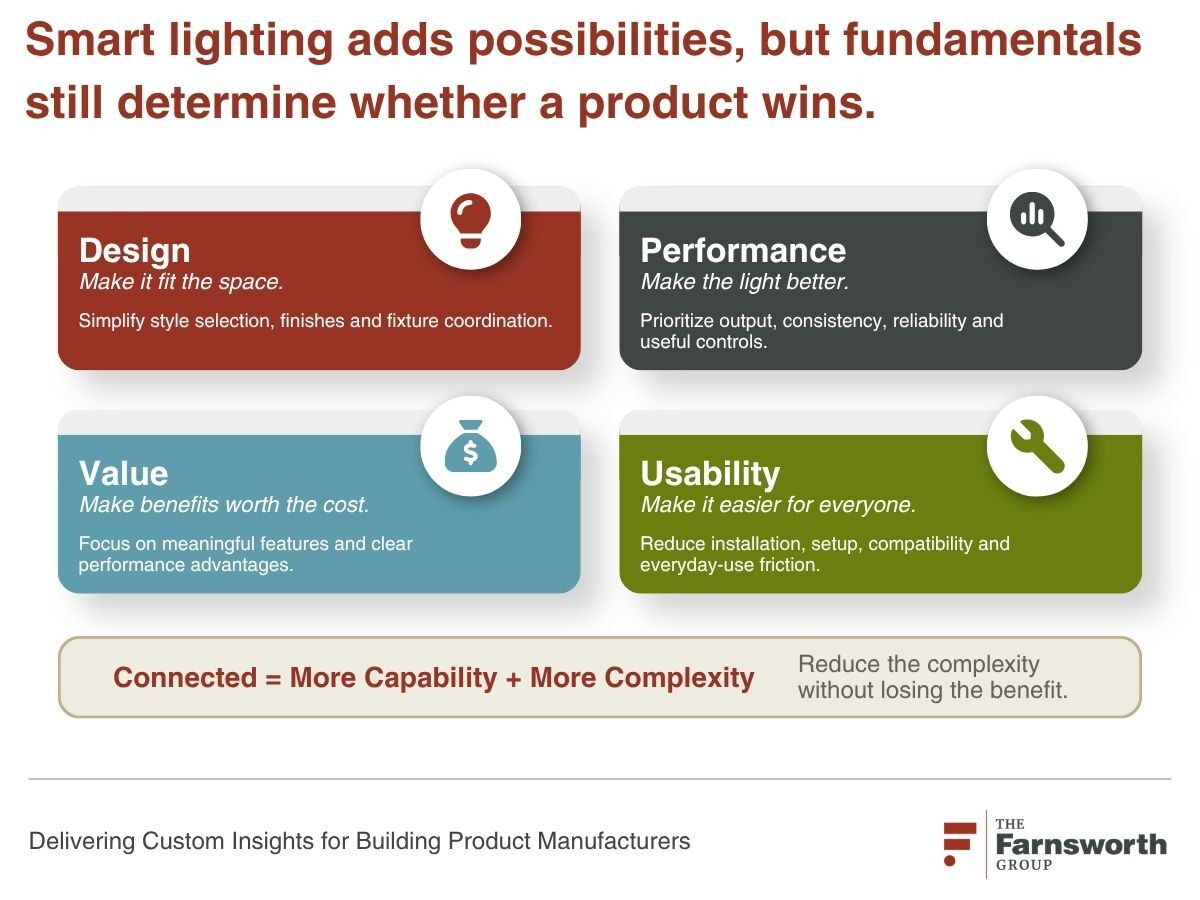
For all the attention placed on technology, lighting remains one of the more visible design decisions in a home. A fixture still has to fit the space, deliver the right light, make sense stylistically, fall within an acceptable price range, and be available when the project needs it. Somebody also still has to install it.
You could see that balance at Lightovation this year. While connected technologies continue to advance, the show still places significant emphasis on fixture design, decorative styles, architectural lighting, landscape lighting, and outdoor applications.
That matters because it reinforces something easy to overlook when we talk about smart homes. Technology may be changing, but customers are not suddenly abandoning traditional expectations around design, performance, value, and usability.
And right now, value deserves particular attention.
Our Q2 2026 Quarterly Homeowner Activity Tracker found that overall home improvement activity fell to its lowest level since tracking began, with 38% of homeowners reporting a project in the prior 90 days. At the same time, project cost reached its highest level as a reported challenge, while average spending among those who were actively completing projects rose sharply.
That is an important distinction for lighting manufacturers. Homeowners have not stopped investing. They are becoming more selective about where, when, and why they invest.
In that kind of environment, adding technology does not automatically create more value. It has to create value that the customer recognizes within the context of the project.
The Project Changes the Meaning of “Better”
This is where I think the lighting conversation gets more interesting.
We have written before about why broad brand attributes such as quality, value, reliability, and innovation often do not tell manufacturers enough about how customers actually make decisions. Customers do not choose products in the abstract. They choose them for a particular project, with a particular need and a particular set of constraints.
For lighting, those project contexts could include:
- A quick replacement of an outdated or failed fixture
- A kitchen or bath remodel
- A whole-home renovation
- Premium or custom new construction
- An outdoor living or landscape project
- An aging-in-place renovation
- A project focused on convenience, energy management, or security
- A fully integrated home where lighting is one component of a larger automation system
Each of these projects creates a different definition of value.
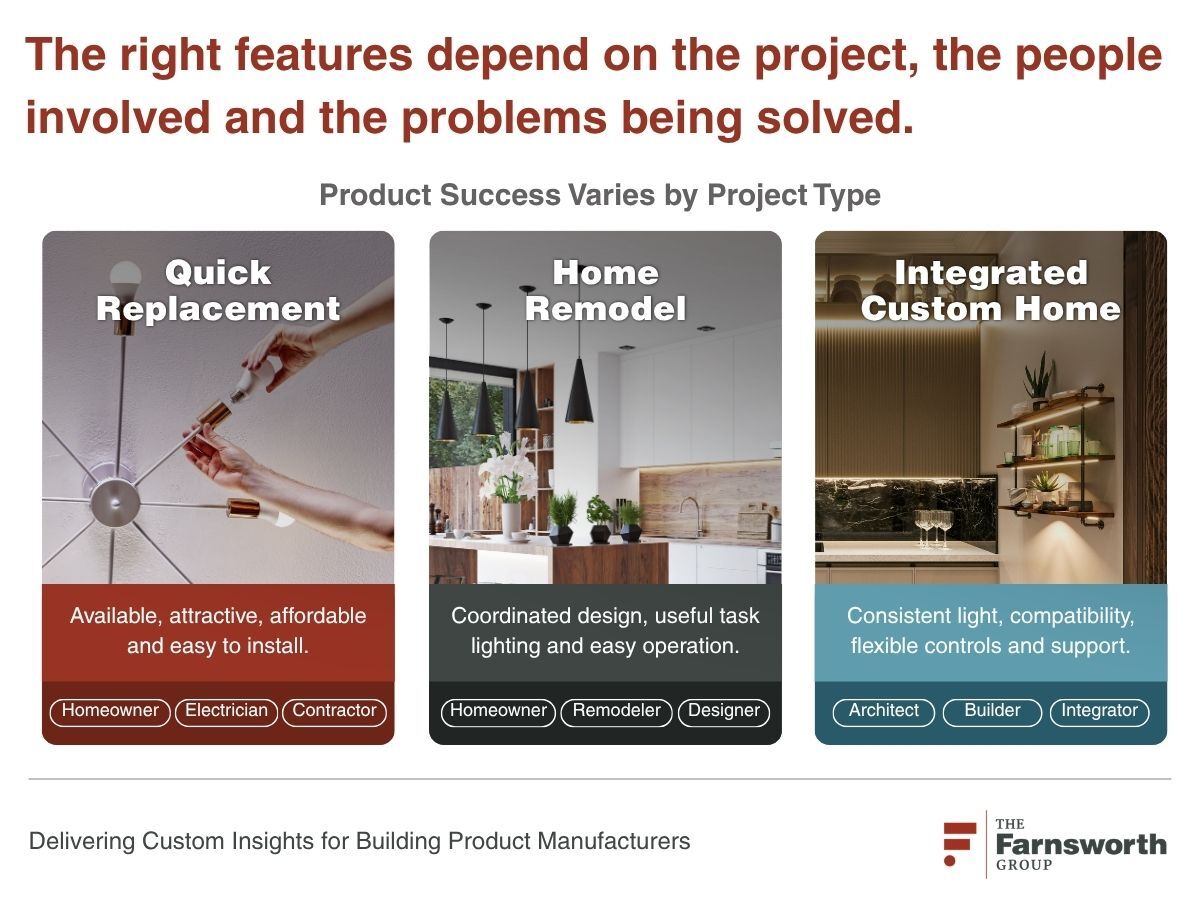
Take the difference between a homeowner replacing a ceiling fixture before family arrives next weekend and someone designing the lighting for a custom home with automated shading, outdoor living areas, entertainment systems, and whole-home controls.
Both customers may say quality and availability matters. But these mean something very different in each situation.
For the replacement fixture, it may mean attractive design, immediate availability, and straightforward installation. For the custom project, it may also mean color consistency, controls integration, programming flexibility, compatibility with other systems, technical support, and delivery on the larger project schedule.
That is why I think dividing the category simply into “smart” and “traditional” lighting can be misleading. The technology does not necessarily define the opportunity. The project may define it much better.

More Integration Means More People in the Decision
Project context also affects who gets a vote.
Depending on the application, a lighting decision may involve some combination of:
- Homeowners
- Interior designers and architects
- Builders and remodelers
- Electricians
- Lighting showrooms and distributors
- Landscape professionals
- Custom integrators and automation specialists
Those audiences do not evaluate the product the same way. A homeowner may focus on how the space looks and feels and whether everything is easy to use. A designer may be thinking about aesthetics and how lighting supports the architecture. An electrician may put greater weight on installation, reliability, and serviceability. An integrator may be looking closely at controls, compatibility, programming, and long-term support.
The more connected lighting becomes, the more important it is for manufacturers to understand these overlapping decision roles. The product has to create value for the end user without creating unnecessary friction for the people responsible for specifying it, selling it, installing it, and making it work.
That is not only a product challenge. It is a brand, channel, and customer strategy challenge as well.
Simplicity May Be a Bigger Innovation Opportunity Than Another Feature
Connected products create capability, but they can also create complexity. More products and systems can mean more specification decisions, training requirements, programming, commissioning, troubleshooting, and questions about compatibility.
So the next meaningful innovation in lighting may not come from adding another feature. It may come from making increasingly sophisticated products easier to specify, install, integrate, support, and live with.
We are seeing the same theme across building products more broadly. Innovation increasingly creates value when it removes friction for the customer or the professional using the product, not simply when it adds functionality.
For lighting manufacturers, I think that creates a useful distinction: are we adding capability, or are we solving a problem?
The strongest innovations will probably do both.
Context Can Reveal Opportunities We Might Otherwise Miss
Aging-in-place is a good example. At IBS and KBIS this year, we identified aging-in-place as one of several opportunities being supported by low homeowner mobility, an aging housing stock, and continued investment in existing homes.
Lighting can play an important role in these projects through better visibility, pathway illumination, simpler controls, automation, task lighting, and easier navigation of the home. But “smart lighting” is not necessarily the customer need.
The need may be safer movement through a hallway at night. It could be easier control from a bedside location, better task lighting in the kitchen, or more effective illumination around an exterior entrance.
Technology may be part of the solution, but the project context tells us whether it creates meaningful value.
And the same principle applies to a kitchen remodel, an outdoor living project, a quick replacement, premium new construction, or a whole-home renovation. The relevant features, decision-makers, price tolerance, and definition of quality can change considerably from one project to another.
That makes understanding the project just as important as understanding the product.
The Lighting Opportunity Is Getting Broader, Not Simply Smarter
There is little question that connectivity will continue to influence the lighting category. Controls will become more sophisticated, indoor and outdoor environments will become more coordinated, and lighting will interact with a wider range of products and systems.
None of that suggests the traditional fixture is going away; instead, lighting manufacturers increasingly need to understand when their product is being evaluated primarily as a fixture and when it is being evaluated as part of a larger experience.
For one project, success may depend primarily on design, price, availability, and installation simplicity. For another, integration, programming, interoperability, and professional support may be equally important.
Both opportunities can exist within the same category and potentially within the same portfolio. The more important question is whether manufacturers understand which decisions they are trying to win.
Across the projects and customers your brand serves, where is lighting still being selected primarily as a fixture, where is it becoming part of a larger system, and are your product, brand, and channel strategies aligned with that distinction?
Turning Category Signals Into Better Decisions: Questions Lighting Manufacturers Should Be Asking
Industry trends can tell us where the lighting category may be moving. They cannot tell an individual manufacturer which opportunities its customers value most, where its brand has permission to expand, or which features will materially change purchase behavior.
That requires deeper understanding of the people making the decision. For manufacturers evaluating lighting strategy, several questions are worth answering with current customer and channel evidence:
- Which project types create the greatest opportunity for our brand?
- Where does connectivity materially improve the customer experience, and where does it add complexity without enough perceived value?
- Which features actually influence purchase, specification, and willingness to pay within each project context?
- Who carries the greatest influence over product selection in different applications?
- Where do our products create friction for installers, integrators, designers, retailers, or homeowners?
- Which project contexts does our brand already have permission to win, and where would expansion require a different product, message, or channel strategy?
The Farnsworth Group works with manufacturers across the building products and home improvement industries to understand customer behavior, product needs, brand position, channel influence, and market opportunity. Through customized qualitative and quantitative research, we help organizations move from broad market signals to decisions grounded in their own customers, products, and growth priorities.
If your organization is evaluating where smart lighting, traditional fixtures, connected-home applications, or emerging project types fit within your portfolio, our research team can help you identify the questions worth answering before you invest.

Frequently Asked Questions
Is smart lighting replacing traditional lighting fixtures?
Not necessarily. Smart technology is adding new expectations around connectivity, controls, automation, and integration, but traditional purchase factors such as design, performance, price, availability, and ease of installation still matter. The importance of each factor depends heavily on the project context.
Why are project triggers important in the lighting category?
Project triggers help explain what job the customer is trying to accomplish. A fixture replacement, kitchen remodel, aging-in-place renovation, outdoor living project, and fully integrated custom home can each create different needs, decision-makers, price expectations, and definitions of value. Understanding those differences can make product and brand strategy more actionable than relying on broad attributes alone.
What should lighting manufacturers consider when developing smart lighting products?
Manufacturers should consider not only which features can be added, but whether those features solve meaningful customer or professional problems. Ease of specification, installation, compatibility, programming, service, and everyday use may be just as important as additional functionality.
Who influences lighting product selection?
The decision can involve homeowners, designers, architects, builders, remodelers, electricians, showrooms, distributors, landscape professionals, and custom integrators. The level of influence varies by project type, which makes understanding the path to purchase especially important in connected and premium lighting applications.
How are current homeowner trends affecting lighting opportunities?
The Q2 2026 Quarterly Homeowner Activity Tracker shows a more selective home improvement environment. Overall project activity declined, project cost became an even larger challenge, and homeowners who did move forward were spending more. That suggests manufacturers need to understand where homeowners see enough value to justify investment rather than assuming that added features alone will drive demand.


Written By
Karen Barnes
Through her expertise in brand consulting, market research design, and advanced analytics, Karen has been helping answer critical business questions for the past 15 years. She has had the privilege of working with many of the top global insights organizations and applying best practices across a myriad of clients in CPG, technology, finance, healthcare, and of course home improvement, including developers, building products manufacturers, and retailers.
An Iowa native, Karen was upgrading from riding mowers to full combines at the annual John Deere employee fair by age 7. Now in Denver, she fills her off hours hiking the Rocky Mountains, uncovering the best local food & drink spots, and traveling as much of the world as humanly possible with her fiancé, Adam.